
Snow leopards are on the prowl at the Seneca Park Zoo
Prowl, prowl, purr, purr! Visitors watch a snow leopards leap from a snowy rock, searching for its next meal. Snow leopards are originally found in



Prowl, prowl, purr, purr! Visitors watch a snow leopards leap from a snowy rock, searching for its next meal. Snow leopards are originally found in

The universe is waiting for you at the Rochester exhibit, Astronauts. RMSC has brought in an exciting new traveling exhibition from Perth, Australia. The exhibit

GG McQueen is celebrating the release of her debut picture book, Squash & Pumpkin: #SquashGoals. Squash is tired of all the attention Pumpkin gets each

This article originally appeared in the Fall 2025 issue of (585) Kids.

This article originally appeared in the Fall 2025 issue of (585) Kids.

Somehow the year is already 75% over. Catch up on these 2025 must-read releases before the 2026 titles hit the shelves! PICTURE BOOKS *Call Me

Regular readers of (585) Kids have likely heard of the Rochester Children’s Book Festival (RCBF). After all, it has been bringing authors, illustrators, kids, and

Ahhh summer … Picnics, graduation parties, weddings, backyard gatherings with neighbors. Children at home. ALL. DAY .LONG. I am certain that my children don’t eat

A NEW, INCLUSIVE PLACE TO PLAY As a special education teacher and administrator for more than twenty years, Kristen Bonn was often uncomfortable with the

ONGOING TUESDAYS–FRIDAYS SCIENCE TOGETHER Ithaca’s Sciencenter hosts its Science Together programs, which explore different science processes for children up to four years old. Children must

What makes a neighborhood a good neighborhood? Convenience and walkability factor in. Safety is essential. Beautiful architecture helps, as does a diverse population that enriches everyone and a sense of community.A really great neighborhood might also have a unique vibe and offer singular retail and dining experiences. Rochester’s South Wedge has all these things, along with a rich history. For those who appreciate an especially vibrant neighborhood scene, the South Wedge is steeped in the creativity of those who live and work there.

The neighborhood—a wedge shape, of course—is bordered by the Genesee River, Mount Hope Avenue, and South Avenue. If you haven’t been there or it’s been a while, you might be surprised by the richness of what the area has to offer. Walk around the neighborhood and you’ll discover some truly distinctive spots you won’t find anywhere else ... friendly bars with live music, pubs, theaters, coffee shops, restaurants, and studios to practice yoga or learn to contra or swing dance. Women of Color International makes its home on South Ave; Hipocampo Children’s Books offers story time events in English and Spanish; Happy Earth Tea sells eighty looseleaf tea varieties from around the world. Cheesy Eddie’s has been making its unmissable cheesecake for fifty years.
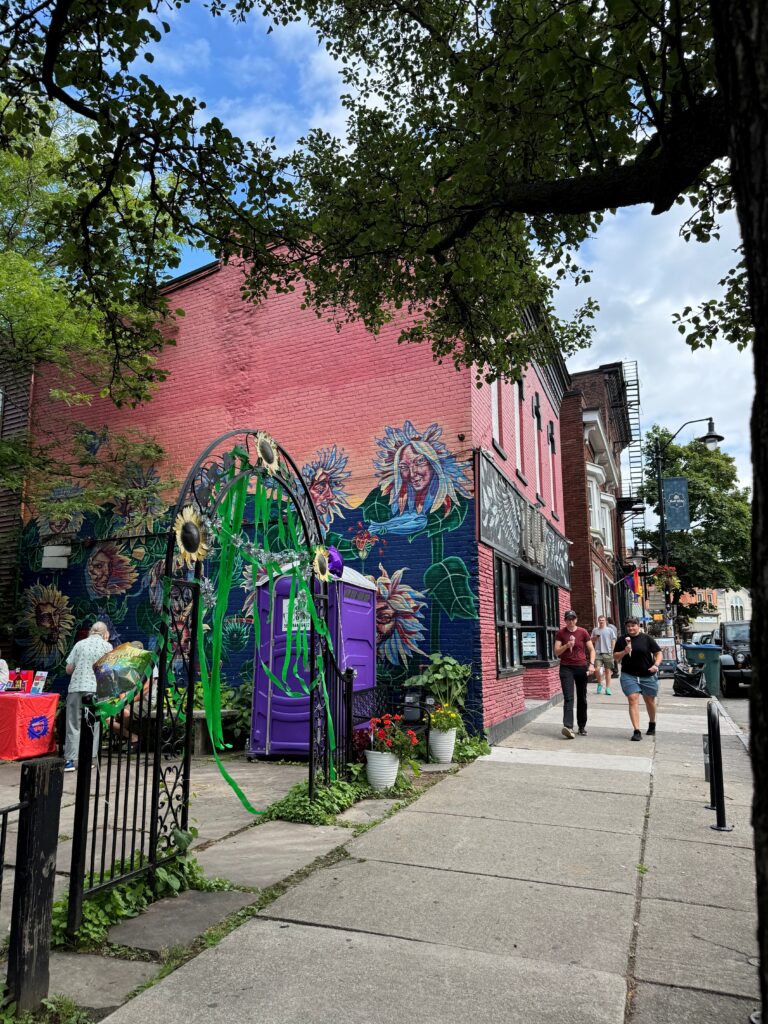
The neighborhood is fertile ground for new ideas, and it’s a sought-after place for residents and businesses alike. Interior designer Robin Muto grew up in Brooklyn and moved to the South
Wedge with her husband, artist Rick Muto, when they were in their twenties. They now operate Axom Home on South Avenue. The couple loves the neighborhood, and some aspects of it remind Robin of living in New York City. Some of their neighbors walk to the neighborhood grocery store, Abundance Food Co-op, with backpacks, she explains. “I mean, like, how New York City is that?”
Rick Muto feels that he and Robin and their two kids have all benefited from living in the South Wedge and its lively mix of people. He says that the historical development of the neighborhood can be seen in the architecture. “We had Ellwanger-Barry Nurseries, and they built homes for their workers, from field workers to office people or administrators. So, you have a diversity of architecture that’s very interesting. The early days of the neighborhood, back in the 1820s, brought in a very interesting mix of people, and that kind of held out, as a matter of fact.”
But by the late 1960s, the neighborhood was run down, and there were many vacant houses. The South Wedge Planning Committee was formed to revitalize the neighborhood in the 1970s. A group of dedicated and hardworking people saw the potential, and the renovation of homes and retail spaces began. There was “a cadre of people” who led the way, says Pat Tobin, who has been an involved resident in the neighborhood since the 1980s. “Ron Maier, Pete Monacelli, Bill Coppard, Bill Farmer. I think, I feel, that is kind of the team.” This group, a combination of businessmen who worked in construction, contracting, and real estate, brought the energy and the ability to fix up the neighborhood, resulting in a dramatic change for the better. “I could always spot a Bill Coppard house, because he had a really great sense of color,” Robin Muto
remembers. The group remodeled homes and commercial buildings in the neighborhood, including some that were in very rough shape. Then, the South Wedge Planning Committee was formed, “building on the foundation that was started in the seventies,” says Tobin. The committee ensured that the development of the neighborhood was intentional. Tobin himself brought his knowledge of finance to the table—he was the regional president of a bank as well as a developer.
A vibrant and dynamic community was nurtured along the way, and people from many walks of life, backgrounds, and religions came together to support each other and each other’s businesses. This intentional and rich cultural atmosphere created the perfect incubator for growing unique businesses. Robin Muto says she was amazed at how all the business owners support each other, and every year, festivals in and around the neighborhood bring in business.
As the neighborhood grew and changed over the years, Tobin and other residents have been concerned about overgentrification. But that has not yet happened; although it is a “hot” neighborhood, it has retained its character and has remained racially and socioeconomically diverse.
The Wedge feels like “just a safe environment that’s almost magical to me,” says Tobin. “Every time I drive into the Wedge, I feel like my shoulders go down. There is a thing about the Wedge
that just is powerful,” he says. He’s talked to many other residents who agree. “It feels we’re like-minded, you’re walking amongst your own, you feel safe.” It does help, though, if you like dogs. On a walk around the neighborhood, “you might run into twenty-five dogs on the way.” Tobin is now retired and does a lot of walking in the neighborhood. “I can do everything I need in this community.” And the business owners support each other and collaborate. “Everybody just hums together,” he says. “I don’t care if they’re Black, white, Asian, whatever, even religion-wise, people just live together, just coincide.” And, he says, they get outside and mingle.
Many of the homes have porches, and that fosters friendliness and connection. “Our street has really benefited by [being] a porch community,” he says. “It’s like, if you want good suburbs, you have to have a good city. And if you want a good neighborhood, you have to have a good main street.”
Special section

BUFFALO
REGULAR CLUB MEETINGS
African Violet & Gesneriad Society of WNY meets the third Tuesday of the month, September–August, at 7 p.m., Greenfield Health & Rehab Facility, 5949 Broadway, Lancaster. av*****@***il.com.
Alden Garden Club meets the second Wednesday of the month (except July and August) at 7 p.m., Alden Community Center, West Main St., Alden. New members and guests welcome. Plant sale each May. 716-937-7924.
Amana Garden Club meets the second Wednesday of the month (except January) at Ebenezer United Church of Christ, 630 Main St., West Seneca. Visitors welcome. 716-844-8543, si*****@*ol.com.
Amherst Garden Club meets the fourth Wednesday of the month (except December, March, July, and August) at 10 a.m., St. John’s Lutheran Church, Main St., Williamsville. New members and guests welcome. 716-836-5397.
Bowmansville Garden Club meets the first Monday of the month (except June, July, August, and December) at 7 p.m., Bowmansville Fire Hall, 36 Main St., Bowmansville. New members and guests welcome. For more information, 716-361-8325.
Buffalo Area Daylily Society. East Aurora Senior Center, 101 King St., East Aurora. The society is a friendly group who get together to enjoy daylilies. Plant sales in August. Open gardens, June–August. Facebook.
Buffalo Bonsai Society meets every second Saturday at 1 p.m. at ECC North Campus, STEM Bldg., 6205 Main St., Williamsville. Picnic/Auction; 9/14, (Rochester) Penjing Bonsai; 10/12, Mark Arpag; 11/9, Suiseki with Sean Smith. buffalobonsaisociety.com.
East Aurora Garden Club meets at noon on the second Monday of each month, except January. The club meets at Nativity Lutheran Church, 970 E. Main St., East Aurora (just west of the 400 Expressway exit). The club’s objective is to stimulate, create interest, and promote education on horticulture, the art of gardening, flower arranging, and environmental conservation; and to promote the beautification of surrounding areas. For more information about the club or membership call 716-912-1589.
Federated Garden Clubs NYS–District 8. Nancy Kalieta is the director; na*******@*ol.com. gardenclubsofwny.com.
Forest Stream Garden Club meets the third Thursday of the month (September–May) at 7 p.m., Presbyterian Village, 214 Village Park Dr., Williamsville and other locations. Summer garden teas and tours available. Ongoing projects include beautification of the Williamsville Meeting House, garden therapy at a local nursing home, youth gardening, and Victorian Christmas decorating. ei******@*****on.com.
Friends of Kenan Herb Club meets the third Monday of the month at 2 p.m. at the Taylor Theater. New members are always welcome. kenancenter.org/herb-club.
Garden Club of the Tonawanda meets the third Thursday of the month at 6:30 p.m., Tonawanda City Hall, Community Room. Facebook.
Garden Friends of Clarence meets the second Wednesday of the month at 7 p.m., September–June, Town Park Clubhouse, 10405 Main St., Clarence. ga*********************@*****il.com.
Gardens Buffalo Niagara open gardens on Thursdays and Fridays in July starts Thursday, July 11. Explore the beauty of gardens spread out in Erie and Niagara counties. Visit gardensbuffaloniagara.com/open-gardens-buffalo for more details and location information.
Hamburg Garden Club meets the second Wednesday of each month (except July and August) at 10 a.m. at the VFW Post 1419, 2985 Lakeview Rd, Hamburg. Events include a June plant sale and July and August field trips. New members and guests are welcome. Contact: mf******@********er.com
Kenmore Garden Club meets the second Tuesday of the month (except July, August, and December) at 10 a.m., Kenmore United Methodist Church, 32 Landers Rd., Kenmore. Activities include guest speakers, floral designs, and community service. New members and guests are welcome. so*******@*ol.com.
Ken-Sheriton Garden Club meets the second Tuesday of the month (except January) at 7 p.m., St. Mark’s Lutheran Church, 576 Delaware Rd. Kenmore. Monthly programs, artistic design, and horticulture displays. New members and guests welcome. 716-833-8799, ds********@***il.com.
Lancaster Garden Club meets the second Wednesday of the month (except January, July, and August) at 7 p.m., St. John Lutheran Church, 55 Pleasant Ave., Lancaster. All are welcome. Facebook.
Lewiston Garden Club meets the fourth Monday of the month. See website for meeting information, lewistongardenfest.com/garden-club.html or contact at PO Box 32, Lewiston, NY 14092.
Niagara Frontier Botanical Society meets the second Tuesday of the month September through May at 7:30 p.m. (except April) at the Harlem Rd. Community Center, 4255 Harlem Rd., Amherst. Entrance is on the north side of the building. Meetings are open to the public.
Niagara Frontier Orchid Society (NFOS) usually meets the first Tuesday following the first Sunday, September–June, Botanical Gardens, 2655 South Park Ave., Buffalo. niagarafrontierorchids.org.
Orchard Park Garden Club meets the first Thursday of the month (except July and December) at 11:30 am at the American Legion Post 567 at 5784 Ellis Rd, Orchard Park. Contact Lena Monaco at 716-270-7862 for membership information. Guests are always welcome.
Ransomville Garden Club meets the third Wednesday or Saturday of the month at 5:45 p.m., Ransomville Community Library, 3733 Ransomville Rd., Ransomville. Meetings are open to all. Activities include community gardening projects, educational presentations, and June plant sale. bb*********@***il.com.
Silver Creek-Hanover Garden Club meets the second Saturday of the month at 11 a.m., Silver Creek Senior Center, 1823 Lake Rd. (Rte. 5), Silver Creek. sc***************@***il.com
South Towns Gardeners Meets the third Friday of each month (except January) at 9:30 am. Location is the American Legion Post, 5784 Ellis Road, Orchard Park 14127, NY. New members welcome!
Springville Concord Garden Club Meets the first Friday of the month at 10 a.m. at the Concord Senior Center, 40 Commerce Dr., Springville. Meetings feature guest speakers on a variety of gardening and related topics. Annual July Garden Walk. Guests are welcome.
Town and Country Garden Club of LeRoy meets the second Wednesday of the month (except February) at 6:30 p.m., First Presbyterian Church, 7 Clay St., LeRoy 14482. Prospective members and guests are welcome. Contact: le***************@***il.com. Facebook: facebook.com/GardenClubLeRoyNY.
Town and Country Garden Club of Williamsville generally meets the second Thursday of the month from 2–4 p.m. at the Ransom Oaks Community Club House, 101 Ransom Oaks Dr., East Amherst. Some meetings are held off site for garden tours and special events. The club maintains a garden at the Clearfield Library, 770 Hopkins Rd. Membership brochures with program information are available in the library. For information, contact La*******@********er.com.
Tropical Fish Society of Erie County meets the third Tuesday of the month at 7:30 p.m., Lake Erie Italian Club, 3200 South Park Ave., Lackawanna. tropical-fish-club-of-erie-county.com
Western New York Herb Study Group meets the second Wednesday of the month at 7 p.m., Buffalo and Erie County Botanical Gardens, 2655 South Park Ave., Buffalo. Facebook.
Western New York Honey Producers, Inc. Cornell Cooperative Extension of Erie County, 21 South Grove St., East Aurora. wnyhpa.org.
Western New York Hosta Society. The WNYHS was formed to encourage members to appreciate hostas and to provide them with access to quality new varieties. The group meets three times a year at the East Aurora Senior Center, 101 King St., East Aurora. wnyhosta.com.
Western New York Hosta Society Breakfast Meetings are friendly get-togethers the first Saturday (winter months only) at 10 a.m., Forestview Restaurant, Depew, wnyhosta.com.
Western New York Iris Society meets at the Julia B. Reinstein Library, 1030 Losson Rd., Cheektowaga, at 1:30 p.m. on the first Sunday of each month.
Western New York Rose Society meets the third Wednesday of each month at 7 p.m. St. Stephens-Bethlehem United Church of Christ, 750 Wehrle Dr., Williamsville. Check the Facebook page or website for meeting content: wnyrosesociety.net.
Youngstown Garden Club meets the second Wednesday of every month at 7 p.m., First Presbyterian Church, 100 Church St., Youngstown. Facebook.
FREQUENT HOSTS
BECBG: Buffalo & Erie County Botanical Gardens, 2655 South Park Ave., Buffalo, NY 14218. 716/827-1584; buffalogardens.com.
REIN: Reinstein Woods Nature Preserve, 93 Honorine Drive, Depew, NY 14043. 716-683-5959; reinsteinwoods.org.
CLASSES / EVENTS
F Ongoing: Feed the Fish, 9:30 a.m. Regular admission for the day is included after the event. All tickets must be purchased ahead of time online. Check online for all dates. BECBG
Ongoing: Orchids After Dark, 6 p.m. on select days. See the beautiful blooms of the Orchid Exhibit after the sun sets. Check online for all dates and ticket prices. BECBG
F Ongoing: Seed Planting, 10 a.m.–1 p.m., Saturday. This activity is included with admission and is fun for kids of all ages. BECBG
F September, daily: Growing Back to School, 10 a.m.–4 p.m. Kids twelve and under get in free for the entire month of September. BECBG
September 5: Summer’s End, Fall’s Beginning, 10 a.m. Say goodbye to summer and hello to fall during a walk in the woods. Explore the changes taking place in the forests and ponds as the weather gets colder and the leaves start to turn. Registration required. REIN
September 9: The Hamburg Garden Club Annual Salad Luncheon, 11:30 a.m. at the. Bring a dish to pass, your own place setting, and a floral design to complement your setting. Guests are welcome. VFW–Post 1419, 2985 Lakeview Rd. Hamburg, NY 1407. If you are interested in joining the meeting, make your reservation at mf******@********er.com.
F September 12: Signs of the Changing Season, 10 a.m. This is a family-friendly guided walk to look for subtle clues that autumn is on its way. Registration required. REIN
September 17: Terrarium Workshop, 6–7 p.m. Discover the joy of bringing nature indoors with a hands-on terrarium workshop for adults. Perfect for beginners and plant lovers alike, this immersive session will guide students through designing and building their very own glass-encased ecosystem. All materials will be provided. $50 per person; $45 for members. BECBG
F September 19: 26th Annual Fall Festival, 10 a.m.–4 p.m. Kick off the fall season by spending a day in the woods. Family hands-on activities, crafts for kids, live animals, food, music, and more. REIN
F October 3: Birding for Beginners, 10 a.m. Guests will take a walk around the woods while learning how to identify common birds. For ages 10 and older. Registration required. REIN
October 3: Woods Walk: Fall Transitions, 1 p.m. Last year at this time, the leaves had just started to change, monarch migration was winding down, and bird migration was ramping up. Follow the trails on a guided walk. No registration required. REIN
October 14: Hamburg Garden Club Sculpting with natural materials class, 10 a.m. at the VFW Post 1419, 2985 Lakeview Rd. Hamburg NY. Garden Club member, Brenda Werely, will share her talent for sculpting with natural materials, such as driftwood, sea shells, and sea glass. If you are interested in joining the meeting, make your reservation at mf******@********er.com.
October 15: National Mushroom Day Walk, 2 p.m. Marvel at mushrooms on this walk through the woods. Registration required. REIN
ITHACA
REGULAR CLUB MEETINGS
Adirondack Chapter, North American Rock Garden Society (ACNARGS) Meetings are open to all. Check the current newsletter on the website for meeting location: acnargs.org or Facebook.com/acnargs.
Auraca Herbarists, an herb study group, usually meets the second Tuesday of the month at noon, Cornell Botanic Gardens, Ithaca. Brown bag lunch at noon followed by the program. and herb of the month. Field trips during the growing season. All are welcome. Contact Pat Curran: pc**@*****ll.edu.
Elmira Garden Club meets the first Thursday of the month, April–December, at 6 p.m., 426 Fulton St., Elmira. Annual plant sale, workshops, monthly meetings, local garden tours and community. Facebook.
Finger Lakes Native Plant Society meetings are usually on the third Tuesday of the month September to May. The organization is dedicated to promoting the appreciation of native flora and holds free public field trips and indoor programs, plus provides members a newsletter, seed exchange, native plant sale, and December celebration of native plants. flnps.org, in**@***ps.org.
Windsor NY Garden Group meets the second and fourth Tuesdays of the month at 10 a.m., members’ homes or Windsor Community House, 107 Main St., Windsor. Find on Facebook.
CLASSES / EVENTS
T September 4: Cultivating Hope: Plants and Indigenous Knowledge Plant Exhibition Tour, Guests will explore plants that are deeply connected to Indigenous cultures and discover how relationships rooted in respect, reciprocity, and responsibility have sustained both people and the natural world for generations and continue to do so today. Other fall dates are also available on the website. Cornell Botanic Gardens, 124 Comstock Knoll Road, Ithaca. cornellbotanicgardens.org.
September 18: Birds and Blooms, 9 a.m.–10:30 a.m. Guides from Cornell Botanic Gardens and Cornell Lab of Ornithology will lead combined bird and plant walks this season. Attendees will walk in the F.R. Newman Arboretum in search of birds and to learn about trees and other plants that provide biodiverse habitat. A limited number of binoculars are available to borrow. Space is limited and pre-registration is required for each individual tour date. Meet by the Sculpture Garden in the central part of the arboretum—362 Arboretum Rd., Ithaca. cornellbotanicgardens.org
ROCHESTER
REGULAR CLUB MEETINGS
7th District Federated Garden Clubs New York State, Inc. meets the first Wednesday of the month. 7thdistrictfgcnys.org.
African Violet and Gesneriad Society of Rochester meets the first Thursday of the month September–November and March–May, 7–9 p.m. at Messiah Lutheran Church, 4301 Mt. Read Blvd., Rochester. December and June meetings are social events TBD location. Contacts: Douglas Burdick, 585-313-8674, db******@*sn.com. Barb Festenstein, 585-461-1673, ba*************@*ol.com.
Bloomfield Garden Club meets the third Thursday of the month at 11:45 a.m., Veterans Park, 6910 Routes 5 & 20, Bloomfield. Visitors and prospective new members welcome. Marlene Moran, 585-924-8035, Facebook.
Bonsai Society of Upstate New York meets the fourth Tuesday of the month at the Brighton Town Park Lodge, Buckland Park, 1341 Westfall Rd., Rochester. 585-334-2595, Facebook, bonsaisocietyofupstateny.org.
Canandaigua Botanical Society meets for in-person botanical events. See website for event schedule. canandaiguabotanicalsociety.blogspot.com
Color Pittsford Green meets on the third Wednesday of the month, 6:45–7:45 p.m. via Zoom. All are welcome. colorpittsfordgreen.org
Color Webster Green meets on the second Wednesday of the month, 6:30–7:30 p.m. at the Webster Public Library, 980 Ridge Rd, Webster, NY, 14580. All are welcome. Co***************@***il.com.
Conesus Lake Garden Club announces its campaign for new members. Meetings are held March through December at the Watershed Education Center, Vitale Park, Livonia at 7 p.m. The primary missions of the club are civic beautification and scholarships for Camp Stella Maris and Livonia Central School. Inquiries can be made to Eleanor Dober, President at: em*****@***oo.com.
Country Gardeners of Webster This club is for those who like to dig in the dirt, smell the roses, learn about the birds and bees, take a walk in the park, eat, drink, and be merry, or live in Webster. They meet the second Monday of the month. Contact Elaine at 585-350-8270 to try this fun-loving club out.
Creative Gardeners of Penfield meets the second Monday of the month (except July and August) at 9:15 a.m., Penfield United Methodist Church, 1795 Baird Rd., Penfield. Visitors welcome. Contact 585-385-2065 or 09*******@***il.com if interested in attending a meeting.
Fairport Garden Club Meets the third Thursday evening of the month (except January, February, March, and August) in members’ homes or in the Perinton Ambulance building. Educational topics are presented through speakers, workshops, local tours, and community gardening i.e., Planter at Johanna Perrin School. fa********@***il.com, fairportgardenclub.com.
Finger Lakes Daylily Society members garden in west-central NY, covering an area from Batavia to Syracuse and the Southern Tier. Meetings are held in Rochester or the Canandaigua area. There are generally four regular Saturday meetings held in February, March, May, and September. Visitors and prospective new members are welcome to attend. Contact Deb Lawrence for information, bi******@***oo.com.
Friends of Ellwanger Garden meet all season long on Tuesday mornings. To volunteer at the garden, please contact Cindy Boyer at 585-546-7029, x12 or cb****@*************ty.org.
Garden Club of Brockport meets the second Wednesday of every month at 7 p.m., Jubilee Church, 3565 Lake Rd., Brockport. Visitors can learn gardening tips from knowledgeable speakers, make garden ornaments through hands-on classes, and explore beautiful local gardens. For more info please email ga*********************@***il.com.
Garden Club of Mendon meets the third Tuesday of the month, 10 a.m.–1 p.m., Mendon Community Center, 167 North Main St., Honeoye Falls. Members work on community gardens and gather new ideas in a casual, social environment. 585-624-8182, jo**********@***il.com.
Garden Path of Penfield meets the third Wednesday of the month, September–May at 7 p.m., Penfield Community Center, 1985 Baird Rd., Penfield. Members enjoy all aspects of gardening, new members welcome. ga******************@***il.com
Gates Garden Club meets the second Thursday of the month (except July and August) at 6:30 p.m., Gates Town Annex, 1605 Buffalo Rd., Rochester. New members and guests welcome. ga*************@***il.com
Genesee Region Orchid Society (GROS) meets the first Monday following the first Sunday of the month. Meetings are held at 6 p.m. at the JCC on Edgewood Dr. in Brighton. Please see the website for information, geneseeorchid.org.
Genesee Valley Hosta Society meets the second Thursday of the month, April–October, at Look Up Park, 3850 East Henrietta Rd, Henrietta. Contact 585-889-7678 or se*******@*********et.net, or visit geneseevalleyhosta.com for more information.
Greater Rochester Iris Society (GRIS) is an affiliate of the American Iris Society, meets on a Sunday during the months of March, April, September, and October at 2 p.m., St. John’s Episcopal Church Hall, 11 Episcopal Ave., Honeoye Falls. Public welcome. Plant Sales, guest speakers or location visits, Volunteer Opportunities. Honeoye Falls. 585-266-0302, th**********@*ac.com.
Greater Rochester Perennial Society (GRPS) Ongoing meetings (April through October) provide a variety of plant sales and member-only virtual lectures and on-site garden tours. A calendar of 2026 events is on the website Greater Rochester Perennial Society:rochesterperennial.com or the Greater Rochester Perennial Society Facebook page: facebook.com/GreaterRochesterPerennialSociety. To become a member, you can download our membership form: rochesterperennial.com or contact us via email: ro**********@***il.com.
Greater Rochester Rose Society meets the first Tuesday of the month at 7 p.m. on Zoom January, February, and March Email j.*******@***il.com for meeting link. Questions: 585-694-8430. Facebook: Greater Rochester Rose Society.
Henrietta Garden Club meets the second Wednesday of the month, except May-August and December. at 6:30 pm at The Henrietta Town Hall, Lower level, 475 Calkins Rd. Henrietta. Handicap accessible. Guests and nonresidents are welcome. Call 585-442-8634 or Sites.google.com/site/henriettagardenclub.
Hilton Garden Club Meetings are the third Tuesday of the month from February-December. At the Hilton Baptist Church, 50 Lake Ave from 7-9 p.m. Meetings are offsite in July and August. Facebook: The Hilton Garden Club.
Holley Garden Club meets the second Thursday of the month at 7 p.m., Holley Presbyterian Church. 585-638-6973.
Hubbard Springs Garden Club of Chili meets the third Monday of the month at 6:30 p.m. at the Chili Community Center, 3237 Chili Ave., Rochester. dt******@**********rr.com
Ikebana International Rochester Chapter 53 meets on zoom February to April at 10 a.m. the third Thursday of each month. Beginning in April, meetings are in-person. There are no meetings in December and January. Attendees will participate in an ikebana workshop, enjoy fellowship with your own brown-bag lunch, and have a short culture program following lunch. Ikebana International is a non-profit cultural organization whose objective is to stimulate and perpetuate the study of ikebana (the Japanese art of flower arranging) and related arts throughout the world. In-person meetings are at First Baptist Church, Hubbell Hall, 175 Allens Creek Rd., Rochester. ro**************@***il.com, ikebanarochester.org.
Kendall Garden Club meets the first Wednesday of the month at 7 p.m., Kendall Town Hall. 585-370-8964.
Klemwood Garden Club of Webster meets the second Monday of the month at 7 p.m. (except January and February) in members’ homes or local libraries. Accepting new members. 585-671-1961.
Lakeview Garden Club (Greece) meets the second Wednesday of the month (except January and February) at 7 p.m., meeting location varies depending on activity. Meetings may include a speaker, project or visits to local garden-related sites. New members always welcome. Contact, Darlene Markham, dm******@**********rr.com.
Newark Garden Club meets the first Friday of the month at 1 p.m., Park Presbyterian Church, Newark. Guests are welcome.
Pittsford Garden Club meets the third Tuesday of the month at 10:30 a.m. at the Spiegel Center on Lincoln Ave. in the Village of Pittsford. The club usually meets in Room 18, but visitors should confirm at the front desk. New members are always welcomed. Annual plant sale on the third Saturday in May, parking lot behind the library. pi*****************@***il.com
Rochester Dahlia Society meets the second Saturday of the month (except August and September) at 12:30 p.m., 2025 Rochester Dahlia Society Show and Sale Sept. 13-14 Aldersgate Methodist Church, 4115 Dewey Ave.; details at rochesterdahlias.org Visitors welcome. See website for up-to-date information concerning meetings and shows. 585-865-2291, Facebook, rochesterdahlias.org.
Rochester Herb Society meets the first Tuesday of each month (excluding January, February, and July) at noon, Pittsford Community Center, 35 Lincoln Ave., Pittsford. Summer garden tours and day trips. New members welcome. rh*********@***il.com
Rochester Permaculture Center meets monthly to discuss topics such as edible landscapes, gardening, farming, renewable energy, green building, rainwater harvesting, composting, local food, forest gardening, herbalism, green living, etc. Meeting location and details: meetup.com/rochesterpermaculture.
Seabreeze Bloomers Garden Club meets the fourth Wednesday of the month (except January) at 7 p.m., location varies depending on activity. Meetings may include a speaker, project, or visit to local garden-related site. Monthly newsletter. New members welcome. Meetings are currently canceled, contact Bonnie Arnold with any questions. Bonnie Arnold, 585-230-5356, bo**********@*********et.net.
Stafford Garden Club meets the third Wednesday of the month (except December and January) at 7 p.m., Stafford Town Hall, 8903 Morganville Rd. (Route 237), Stafford. All are welcome. 585-343-4494.
Urban Agriculture Working Group (UAWG) meets via Zoom on the third Thursday of the month at 7 p.m. UAWG is a collection of gardeners, community gardens, and individuals who garden/farm in the city or support such activities. UAWG offers a Spring Conference each year and sponsors the Urban Gardens ROC garden crawl in the fall. In addition, the group advocates for City policies that make urban gardening more accessible for people who want to grow fresh vegetables for themselves or their neighbors. If you are interested in getting on the email list, contact Mallory Hohl, md****@*****ll.edu. You do not have to live in the city to participate.
Victor Garden Club meets the second Wednesday of the month (except January and February) at 6 p.m. New members welcome. Meeting and location details: victorgardenclubny2.com, victorgardenclub.org.
The Webster Arboretum. 1700 Schlegel Road, Webster. thewebsterarboretum.org
Williamson Garden Club. On-going community projects and free monthly lectures to educate the community about gardening. Open to all. 315-524-4204, gr*******@***il.com, grow-thewilliamsongardenclub.blogspot.com.
FREQUENT HOSTS
BFF: B-friendly Farm and Garden, 2755 Penfield Road, Fairport 14450. 585-424-4476; broccolotreeandlawn.com.
CCE/GC: Cornell Cooperative Extension, Genesee County, 420 East Main St., Batavia, NY 14020. 585-343-3040, ext. 132; genesee.cce.cornell.edu.
CLASSES / EVENTS
S/O Ongoing Fridays & Saturdays: Lunch time with Lili, 11:30 a.m.–2 p.m. Gardeners and plant enthusiasts can participate in exclusive, online flash sales of orchids and carnivorous plants from Bergen Water Gardens. bergenwatergardens.com
S September 2–October 30: Produce and Flower Auction, times vary, Expect a variety of flowers, vegetables, fruit, and much more. Auctions Monday (11 a.m.) Wednesday (10 a.m.), and Friday (10 a.m.) Orleans County Produce Auction, 12590 Ridge Rd., Albion, NY 14411, auctioneer Caleb Nicodemus, 585-322-6331. facebook.com/orleansproduceauction
O September 3: Garden Talk: Vermicomposting, noon–1 p.m. Worm composting, also called vermicomposting, is an excellent way to turn household food scraps into nutrient-rich fertilizer for the garden. Setting up a worm bin is an inexpensive way to compost kitchen scraps all year long. Master Gardener Brandie W. teaches the basics of how to set up and maintain a worm composting bin. Held in-person at CCE Genesee office, 420 E. Main St, Batavia or register at genesee.cce.cornell.edu/events for a Zoom link. Questions? Please call 585-343-3040 x101.
S September 7: Flower Auction, 11 a.m. Expect a variety of flowers for auction. Orleans County Produce Auction, 12590 Ridge Rd., Albion, NY 14411, auctioneer Caleb Nicodemus, 585-322-6331. facebook.com/orleansproduceauction
September 12: Nature Apps Workshop, 10 a.m. In this workshop, associate professor John Bateman of Finger Lakes Community College explores a curated set of modern nature apps that support botanical exploration, plant identification, and ecological documentation, with special attention to tools useful for tracking invasive species. Free and open to the public. Wood Library, 134 North Main Street, Canandaigua, NY.
September 12: Hypertufa class, 10 a.m.–11:30 a.m. Each student will create a beautiful garden container that will last for years with the wonderful Hyper Tufa technique. (Ages 14 and up) $45 BFF.
September 12: Fantastical Fungi at Wesley Hill with Finger Lakes Land Trust, 10 a.m–noon. Dr. Shannon Nix, fungal ecologist and mycology expert, will speak at the Wesley Hill Nature Preserve for a guided walk to celebrate National Mushroom Month, Registration required, Wesley Hill Nature Preserve, town of Richmond, Ontario County.
September 13: Durand Eastman Park presentation at Burroughs Audubon Nature Club, 2–4:30 p.m., Durand Eastman Park expert Bob Beabout will guide everyone through the history of the 977-acre park—How it came to be, and the main people who were responsible. Call Julie Clayton at 585-704-5588 with questions. 301 Railroad Mills Rd. Pittsford, NY
September 14: Flowering Outdoors: Gardens & Parties, 9:30 a.m. Founder and editor-in-chief of FLOWER magazine Margot Shaw will present “Flowering Outdoors” at the Dryden Theatre at the George Eastman Museum. Tickets are required. Visit rochestergardenclub.com for more information.
September 16: Free Urban Rodent Management Workshop: Prevention & Control, 6 p.m. This workshop will share practical, research-based strategies to prevent and manage rodent activity through improved sanitation, habitat management, and integrated pest management (IPM) approaches, including the use of innovative tools such as Burro wRx for targeted burrow treatment. Several other class dates are available through January. Check available dates at monroe.cce.cornell.edu. CCE of Monroe County, 2449 St. Paul Blvd., Rochester, 585-753-2550
September 18–20: Flowers and Foliage, Amanda’s Native Garden, 9 a.m.–2 p.m. Shop for beautiful native perennials and autumn décor. There will be tours and demonstrations and a leaf rubbing station for kids. 8030 Story Road, Dansville. 585-750-6288; amandasnativeplants.com
S September 19: Fall Garden Gala, 10 a.m.–1 p.m. The Genesee County Master Gardeners will host its annual Fall Garden Gala. There is a plant sale featuring a selection of perennial plants and houseplants, a chance auction, and garden floral arrangements. Plant sale starts promptly at 10:00 a.m. CCE/GC
S September 26: Flea Market, 9 a.m.–2 p.m. Expect hay, straw, firewood, groceries, and a small animal and poultry auction. Orleans County Produce Auction, 12590 Ridge Rd., Albion, NY 14411, auctioneer Caleb Nicodemus, 585-322-6331. facebook.com/orleansproduceauction
September 26: Lantern decorating, 10 a.m.–11:30 a.m. Guests will decorate a lantern with leaves, grasses, fall themed ribbon, and a string of lights.decor. All materials provided. (Ages 12 and up) $45, BFF
O October 1: Plants in Gothic Literature, Noon–1 p.m. Gothic literature embodies stories filled with an atmosphere of mystery and gloom. This class explores the plants utilized symbolically by well-known gothic authors, such as Poe and Shelley, to enhance their storytelling. Held in-person at CCE Genesee office, 420 E. Main St, Batavia or register at genesee.cce.cornell.edu/events for a Zoom link. Questions? 585-343-3040 x101
October 3: Pumpkin Decorating, 10 a.m.–11:30 a.m. Decorate a faux pumpkin with live plants for use in the garden or in the house. The succulents can then be removed and planted in soil and enjoyed for years to come. (Ages 16 and up) $45 BFF
October 10: Fall Gardening Forum, Sonnenberg Gardens, 10 a.m.–3 p.m. Designing With Native Plant Communities—In this program led by Mina Vescera of Suffolk County Cooperative Extension, learn practical ways to integrate native plants into your existing garden and discover how native plant communities can enhance both the beauty and ecological value of your landscape. Prepaid registration required; box lunches provided. Sonnenberg.org
October 10: Wreath making, 10 a.m.–11:30 a.m. Students will use locally-grown dried flowers and grasses to create a one-of-a-kind- wreath. (Ages 14 and up) $45 BFF
October 14: Lakeview Garden Club talk on Adaptive Gardening, 7 p.m. Adaptive gardening focuses on modifying the environment, tools, and techniques so gardening remains accessible and enjoyable regardless of age, mobility, strength, or disability. Speaker Duane Pancoast hosts a semi-monthly blog, The Geriatric Gardner. Copies of his book The Geriatric Gardner will be available for purchase. Lakeview Community Church, 30 Long Pond Rd., Rochester. To attend, contact Darlene Markham at dm******@**********rr.com.
SYRACUSE
REGULAR CLUB MEETINGS
African Violet and Gesneriad Society of Syracuse. The chapter meets at 7 p.m., on the second Thursday of the month, September to December and March to May, there are no meetings in January or February due to weather conditions. The meeting place is Pitcher Hill Community Church, 605 Bailey Road, North Syracuse. More information is available on the chapter website (avsofsyracuse.wixsite.com/avgss) or via email pe************@***il.com
Baldwinsville Women’s Garden Club meets the first Thursday of each month except January at St Marks’ Lutheran Church in Baldwinsville at 7 p.m. The club plants the village flower barrels, raises money for the village flower hanging baskets, maintains the Pointe Garden, donates Arbor Day trees to schools, and gets involved in village improvement projects. Perennial sale yearly on Memorial Saturday morning in the village. See more information at Facebook, Women’s Garden Club of Baldwinsville.
Bonsai Club of CNY (BCCNY) meets the first Saturday of the month 10 a.m.–12 p.m., Pitcher Hill Community Church, 605 Bailey Rd., North Syracuse. Contact Dave Taylor, da*******@***oo.com or 315-395-3018. cnybonsai.com, Bonsai Club of CNY on Facebook.
Cazenovia Garden Club usually meets the first Tuesday of the month at 10:15 a.m. at the Cazenovia Public Library. With an active membership, their objective is to stimulate interest in horticulture, develop skills in the beautification of community and home, and create awareness of national and local conservation issues. Meetings feature guest speakers and field trips are planned throughout the year. For more information contact ca***********@***il.com.
Central New York Orchid Society meets the first Sunday of the month, September–May, St. Augustine’s Church, 7333 O’Brien Rd., Baldwinsville. Dates may vary due to holidays. 315-633-2437; cnyos.org.
Fairmount Garden Club meets the third Thursday of the month (March–November) at 6:30 p.m., Camillus Senior Center, 25 First St., Camillus. Speakers and community projects. All are welcome. to**********@***oo.com.
Federated Garden Clubs NYS–District 6. 315-481-4005, di******@***il.com.
Gardening Friends Club meets the third Tuesday of the month, March–December, at 6:30 p.m., Wesleyan Church, 4591 US Route 11, Pulaski. 315-298-1276, Facebook: Gardening Friends of Pulaski, NY, Vi********@*********et.net.
Gardeners in Thyme (a women’s herb club) meets the second Thursday of the month at 7 p.m., Beaver Lake Nature Center, Baldwinsville. 315-635-6481, hb****@******rr.com.
Habitat Gardening in CNY (HGCNY) meets the last Sunday of most months at 2 p.m. Liverpool Public Library, 310 Tulip St., Liverpool. HGCNY is a chapter of Wild Ones: Native Plants, Natural Landscapes; wildones.org. Free and open to the public. hgcny.org and ourhabitatgarden.org. Subscribe to the free e-newsletter by emailing in**@***ny.org.
Home Garden Club of Syracuse usually meets the first Tuesday morning of the month. Members are active in educating the community about gardening, horticulture, and floral design and are involved with several civic projects in the Syracuse area. New members welcome. ho**********************@***il.com, homegardenclubofsyracuse.org.
Koi and Water Garden Society of Central New York usually meets the third Monday of each month at 7 p.m. See website for meeting locations. 315-458-3199, cnykoi.com.
The Men and Women’s Garden Club of Syracuse meets on the third Thursday of each month at 7p.m. in the Reformed Church of Syracuse, 1228 Teall Ave., Syracuse. Meetings feature activities and/or guest speakers on gardening-related topics. The club also plans tours for its members. Members maintain gardens at Rosamond Gifford Zoo and Ronald McDonald House plus host annual flower shows. Regular club meetings at the church will take place in the months of March, April, May, August, September, and November. More information at facebook.com/MWGardenClubOfSyracuse and mw********************@***il.com.
Southern Hills Garden meets the third Tuesday of each month (unless otherwise noted), February through November at the LaFayette FIrehouse, 2444 US Route 11, LaFayette, NY, 13084. Meetings with a guest speaker usually begin at 7:00 pm. Offsite meetings typically have an earlier start time. Guests are welcome and membership is open to anyone interested in gardening. For info regarding meetings or membership, please email Kathie Forrest at ka************@***il.com.
Spade & Trowel Garden Club of Manlius & Fayetteville usually meets the third Thursday of each month at 7pm. Members enjoy education in horticulture, conservation, gardening, floral design and civic beautification. For more information contact ma*******@***il.com.
Syracuse Rose Society meets the second Thursday of the month (except December) at 7 p.m., Reformed Church of Syracuse, 1228 Teall Ave., Syracuse. Enter from Melrose Ave. Club members maintain the E. M. Mills Memorial Rose Garden, Thornden Park, Syracuse. Public welcome. syracuserosesociety.org.
Seneca County Community Garden Club members meet on the first Wednesday of each month at the Seneca Falls Recreation Center, 35 Water St., Seneca Falls, NY $20 individual/ family plots available. New members always welcome, and you don’t have to be a Seneca Falls resident to join.
CLASSES / EVENTS
Sep 10 Creating an Earth-Friendly Landscape, 6 p.m. to 7:30 p.m. Janet Allen, president of HGCNY Wild Ones Chapter Caring discusses planting native planting in the yard and how to provide habitats for even the smallest creatures. Registration is required. Tully Free Library, 12 State Street, Tully, NY, 315-696-8606
September 15: Speaker, Jackie Crane–Putting your Garden to Bed and Fall Flowers, 7 p.m. LaFayette Firehouse, 2444 US Route 11, LaFayette, NY
S September 26: 2026 Fall Native Plant Sale, 9 a.m.–3 p.m. Habitat Gardening in Central New York hosts a browse-about sale and they will take tree and shrub pre-orders from White Oak Nursery. Please note: payments accepted for the plant sale are limited to cash or checkWestvale (Syracuse), NY. Please visit hgcny.wildones.org to contact someone about the address. Sale also takes place on September 27, Noon to 3 p.m.
S October 3: 9 a.m.–3:45 p.m. The Bonsai Club of CNY annual show, 11 a.m–3 p.m. The event is at Liverpool Public Library in the Carman Community Room where members display a variety of their favorite trees of various styles and shapes. There will also be a sale and raffle of bonsai trees and related items. Club members will be available to answer questions about their trees. Also on Sunday October 4, 11 a.m.–3 p.m. Direct questions to Dave Taylor at 315-395-3018.
October 20: Speaker, Local Audubon Society–Native Birds/Migration Habits, 7 p.m., LaFayette Firehouse, 2444 US Route 11, LaFayette, NY
Deadline for calendar listings for the next issue (November-December 2026) is October 10, 2026. Please send your submissions to ca******@*********************al.com.
This article originally appeared in the September/October 2026 issue of Upstate Gardeners’ Journal.
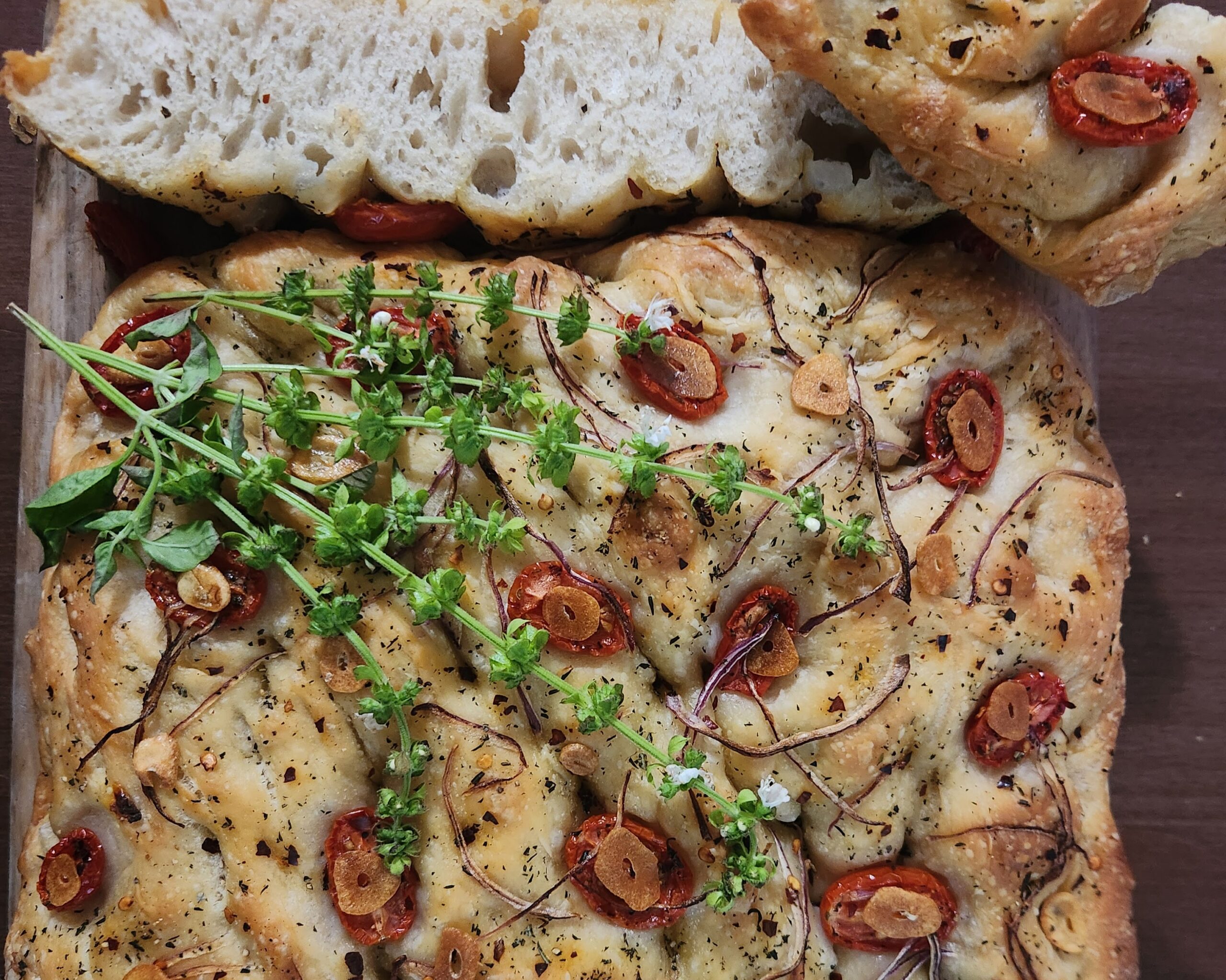
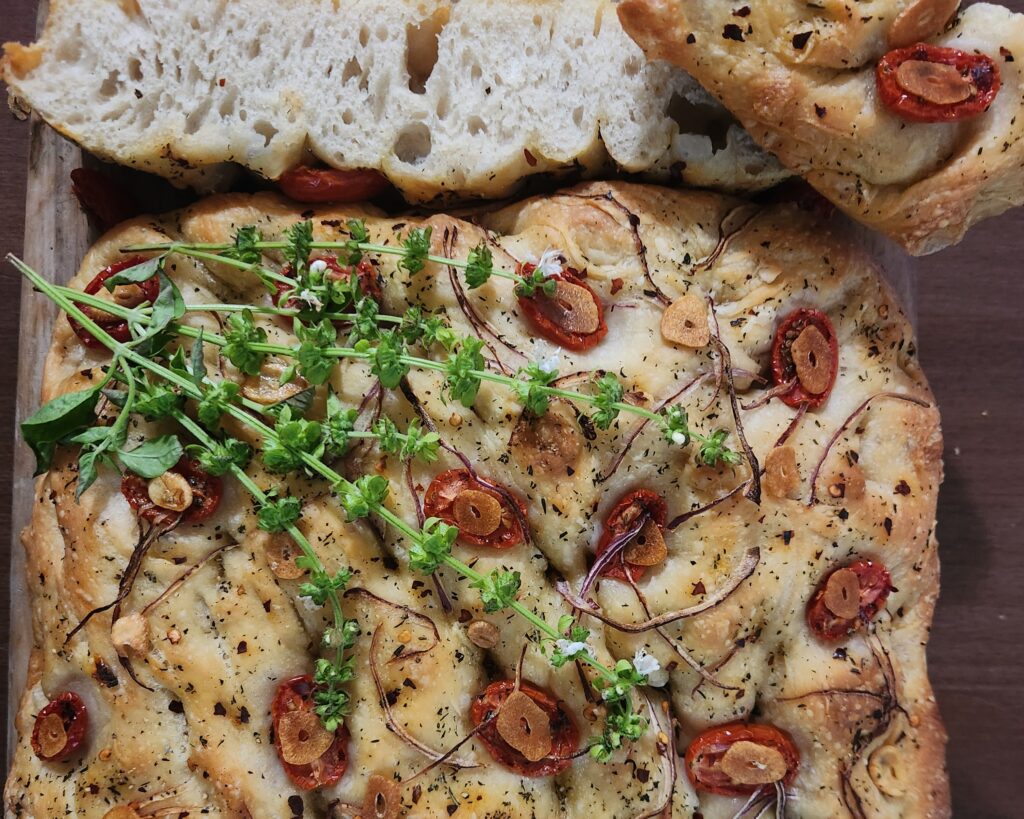
When I was asked to create a recipe for this issue, focaccia felt like a natural choice. Over the past year, working in the Wegmans pizza department has given me a much bigger appreciation for dough. It’s not just something one makes; it is a foundation for everything you put on top of it. Making this recipe for Upstate Gardeners’ Journal readers gave me an opportunity to take something I really enjoyed learning about and make it my own.
What I like most about focaccia is how simple it can be while still leaving a lot room to make your own adjustments. This recipe reflects what I’ve learned, what I enjoy cooking, and the flavors that remind me of this time of year.
YIELD: One half sheet pan
INGREDIENTS
Dough:
1,000 grams all-purpose flour
700 grams water
20 grams salt
1/4 teaspoon instant dry yeast
1 tablespoon olive oil
Toppings (to taste):
Cherry tomatoes cut in half
Thinly sliced red onion
Rosemary, thyme, and sage, minced
Crushed red pepper
Crushed black pepper
Thinly sliced garlic chips, fried separately in extra virgin olive oil
Lemon zest
Maldon sea salt
DIRECTIONS
1. Mix flour, 600 grams of water and oil by hand in a bowl. Cover and let rest for 30 minutes.
2. Dissolve yeast in the remaining 100 grams of water.
3. Sprinkle salt over the dough, add the yeast mixture and incorporate gently.
4. Stretch and fold three times in 30 minute intervals.
5. Let ferment at room temperature for up to 14 hours or until doubled in size.
6. Transfer to an oiled half sheet pan, cover in olive oil and stretch until it clings against the corners of the pan. This could take two or three resting periods to achieve.
7. Use your fingers to dimple the dough, pressing all the way down to create deep pockets.
8. Add your toppings along the surface of the focaccia before baking.
9. Bake for 30 minutes or until golden brown and crispy on top with an internal temperature of 200° F.
10. Serve and enjoy!
Sam Tabone runs a Wegmans pizza shop in Rochester and has been working in the culinary industry since 2010. He has worked his way up from doing dishes at a diner in his hometown to becoming a sous chef at a restaurant in Buffalo to now managing an entire team. “Everyone loves great food and the joy it can bring to people. It’s the reason I still love cooking and executing recipes to this day.”
This article originally appeared in the September/October 2026 issue of Upstate Gardeners’ Journal.
From the garden

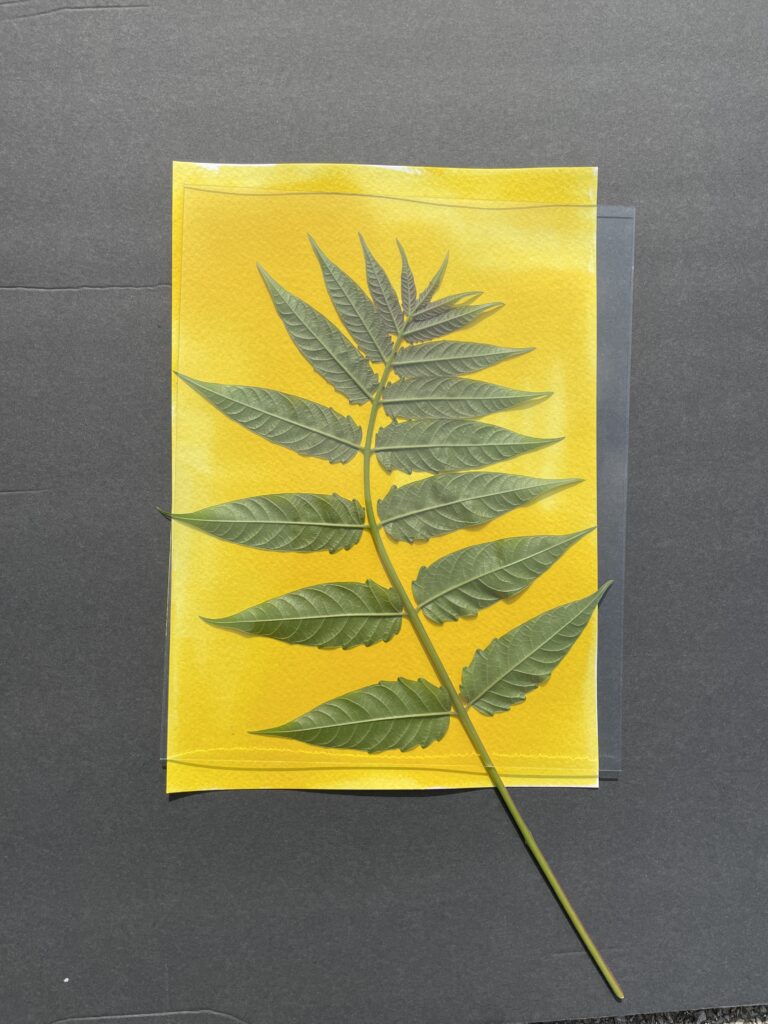
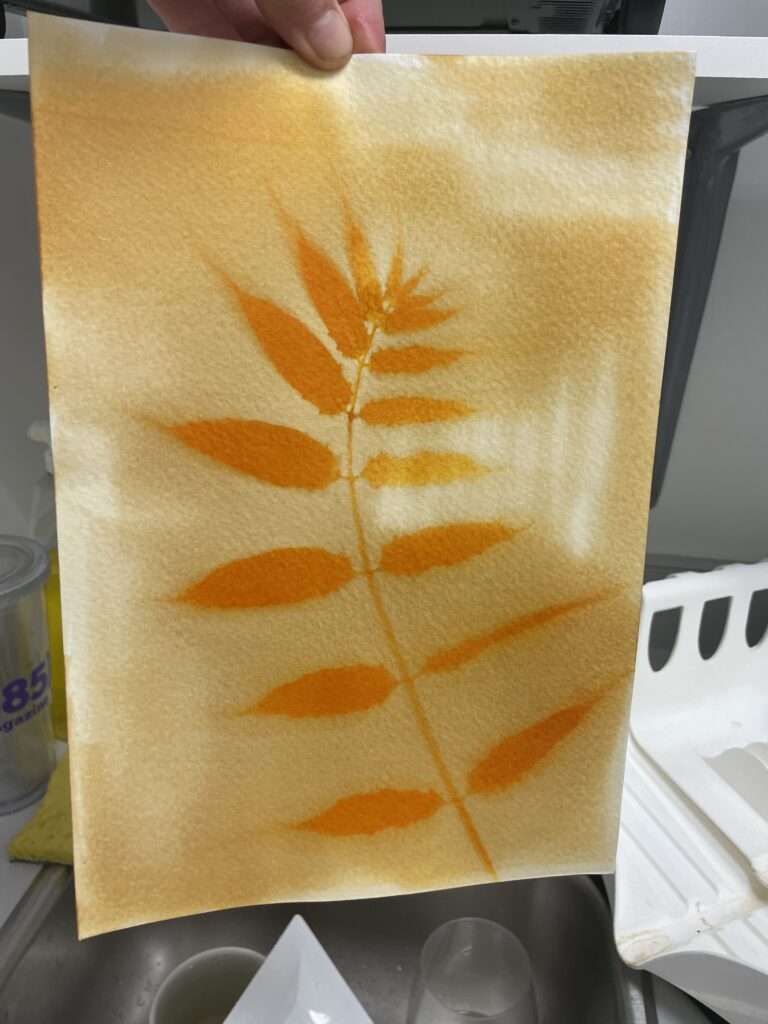
During my Pinterest surfing adventures, I stumbled across a new-to-me technique called anthotype, defined by alternativephotography.com as “…a photographic process using plant-based emulsions and sunlight.”
This unique art form is created by placing objects on paper coated with an emulsion made from a plant-based pigment mixed with alcohol. The paper is then placed in full sun until the emulsion not protected by the objects is bleached out. The piece is then submerged in a solution made with Borax or baking soda and water which stops the reaction and turns the yellow into a brownish-orange hue.
Note: Turmeric stains EVERYTHING. Wearing gloves—plastic or rubber—and an apron or smock is a must for mixing and applying the turmeric emulsion.
EQUIPMENT
Two disposable plastic cups or glass containers
Popsicle stick or disposable spoon
Coffee filter
Foam paint brush
Cookie sheet
Piece of glass the same size as watercolor paper
Oblong cake pan
MATERIALS
1 tsp turmeric powder
3 tbsp 70%+ isopropyl rubbing alcohol
2 tsp baking soda or Borax
1/2 cup warm water
Waxed paper
Watercolor paper
Pressed flowers and leaves
1. Cover cookie sheet with waxed paper, then place watercolor paper on top.
2. In one cup, mix turmeric and rubbing alcohol with popsicle stick or spoon. Let sit for three to five minutes.
3. Place coffee filter in second cup. Pour turmeric mixture through the filter. Squeeze the excess liquid from the filter and discard filter.
4. In a dimly lit area, use foam brush to apply a thin, even coat of the turmeric mixture to piece of watercolor paper.
5. Place the tray in a dark room or a cupboard until paper is completely dry—preferably overnight.
6. In a dimly lit area, arrange pressed plant material in desired pattern on the watercolor paper. Add glass on top to prevent items from shifting.
7. Place tray outside in an area that receives full sun until the turmeric emulsion has faded. This takes several hours.
8. Mix baking soda and warm water in an oblong cake pan.
9. Remove plant material from watercolor paper. Place paper upside down in the baking soda mixture to stop the exposure, just until coated, then remove. Let your masterpiece dry right-side up on the tray.
Anthotypes remain light-sensitive and are best stored or displayed in a frame away from direct sunlight.
Cathy Monrad is the graphic designer for Upstate Gardeners’ Journal.
This article originally appeared in the September/October 2026 issue of Upstate Gardeners’ Journal.
Crafty gardener
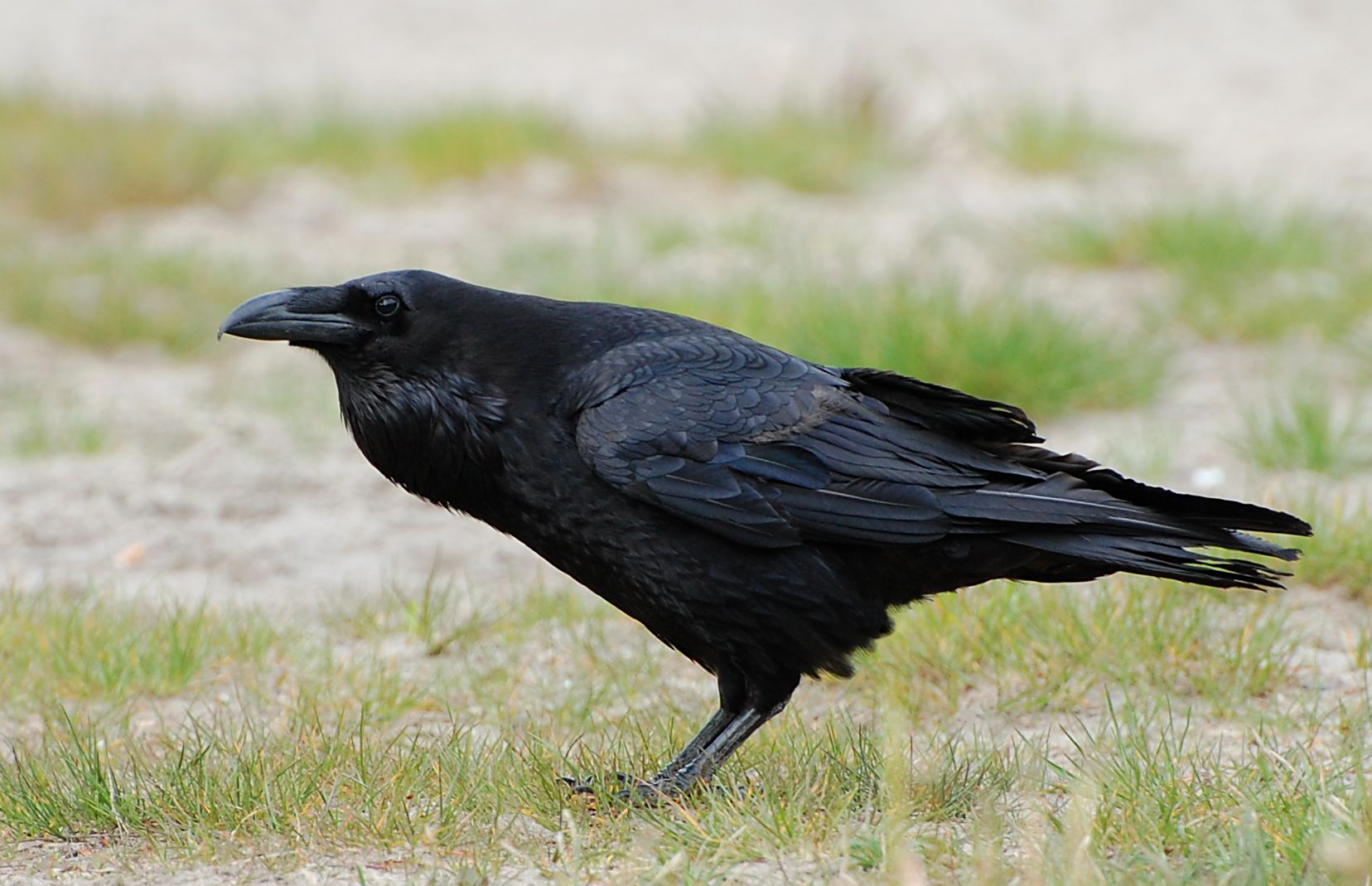
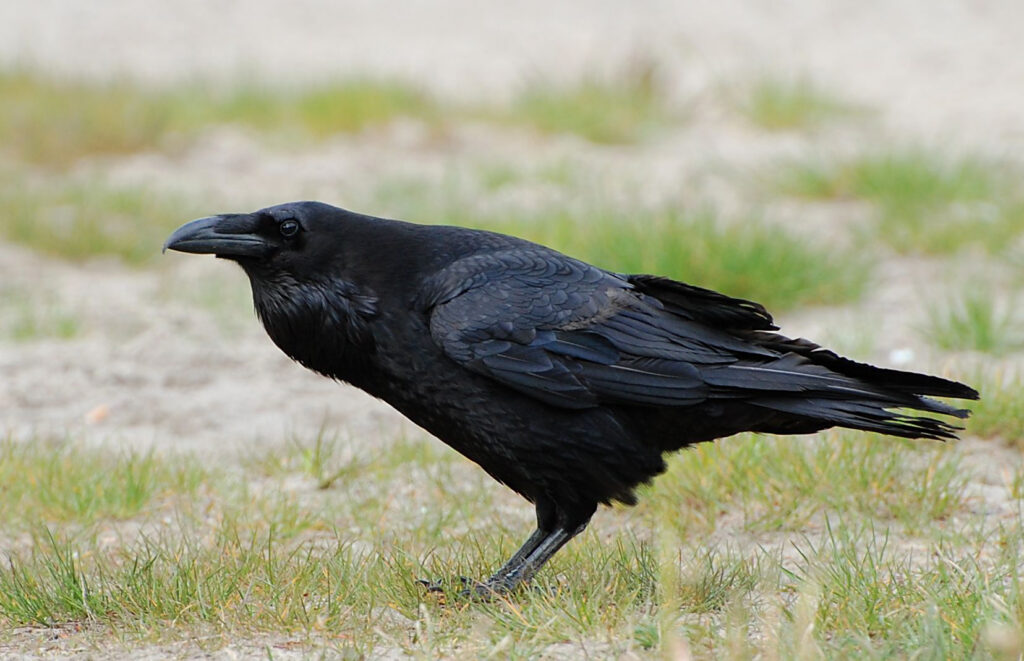
There is a new trend in the bird feeding world, and it is one that I am excited to write about—attracting Crows to the backyard! Crows can be found in a large range of habitats, are intelligent and curious, and are even known to leave small objects for humans who regularly feed them. It is very understandable why the appreciation for them is growing.
Here in Western New York, we have four species of birds in the Crow family which are commonly found, and one has blue feathers! The American Crow, Fish Crow, Common Raven, and the most common backyard visitor, the Blue Jay. Blue Jays are easy to identify by their loud varied calls, blue plumage, and large feathery crest.
The Common Raven is the largest of this group of birds, with a wingspan measuring up to 46 inches long. They are entirely black birds with a thick neck and shaggy feathers on their throat. They are not as social as Crows and therefore are often seen alone or in pairs. Ravens typically have a deeper voice than Crows and their most common call is described as a gurgling croak.
The American Crow is smaller than the Raven, with a wingspan ranging from 33 to 39 inches long. They are very social and are often found in flocks, sometimes into the thousands. Although they have many different calls, their most common is the typical “caw” they are associated with. They will also form mixed flocks with the Fish Crow.
Fish Crows are slightly smaller than the American Crows, but this can be hard to decipher in a mixed flying flock of Crows. Their call is quite different however and sounds more nasal and high-pitched, often repeating a sound like someone saying “uh-uh.” While often found by water, they can be seen in varied habitats inland and even in cities.
Crows are extremely intelligent birds. New Caledonian Crows found in the South Pacific are well known for their ability to make tools out of plant stems, sticks, and leaves to gather food. Studies have been done on Crows which have shown Crows can differentiate human faces and can tell which humans pose a threat. Even more amazingly, Crows share this information with other Crows and their offspring and future generations carry on this knowledge of learned threats. Crows are very social creatures. They will flock from their nighttime roosting sites in the morning to their feeding sites and then back to their communal roosting sites for the night. These sites provide safety in numbers and warmth as the nights begin to cool.
A perk for humans about attracting Crows is they will sometimes leave small gifts and trinkets to those who regularly feed them. These tend to be small shiny or colorful objects like coins, earrings, beads, and glass, but they also may leave things like bones, twigs, leaves, and even items they would consider food like small insects and mice.
If you have been feeding birds, you may already know how much Blue Jays love peanuts, especially peanuts in the shell. This is the same for American Crows. If you are putting out peanuts for Blue Jays or Crows, make sure that the peanuts are unsalted and raw or roasted. Crows are omnivorous and eat a wide variety of foods; they eat seeds, fruits, insects, eggs, carrion, and even small animals like mice, fish, and crayfish. Because of this, you could also offer unsalted walnuts, almonds, berries, and even pet food in your crow feeding setup. Consistency is key with attracting Crows. For best results, make sure you add food to the feeder at the same time each day.
Crows are large birds and won’t come to a traditional tube or hopper feeder like Blue Jays will. Instead, they will need a wide platform to fit on. You can get hanging platform feeders, but the best way to attract Crows is a platform feeder that is stationary and mounted on a pole. These platforms should be at least 12x20” in diameter so multiple birds can land on it at once. The pole it’s mounted on should be at least five feet high with a baffle on it to keep squirrels from climbing it and getting to the food. Most platform feeders can easily be mounted to a one-inch-round pole or wooden 4x4 post, both of which can have baffles easily attached. Mounting the pole in the ground doesn’t have to be cumbersome either! Cementing it into the ground usually isn’t necessary but getting a ground socket that is 15” or longer should keep the pole in the ground securely.
All four species of Crows we regularly see in this area are year-round residents, so you can try to attract them any time of the year. If there is a certain time span you tend to see them flocking into your neighborhood, that is a good time to start providing food regularly. Crows are usually quite skittish to humans, so make sure to give them their space until they begin to get comfortable with the feeding station and those around it. Each individual bird can have its own personality and sometimes be recognized, which makes attracting new Crow friends to your yard even more fun!
Liz Magnanti is co-owner of the Bird House in Brighton.
This article originally appeared in the September/October 2026 issue of Upstate Gardeners’ Journal.
Backyard habitat
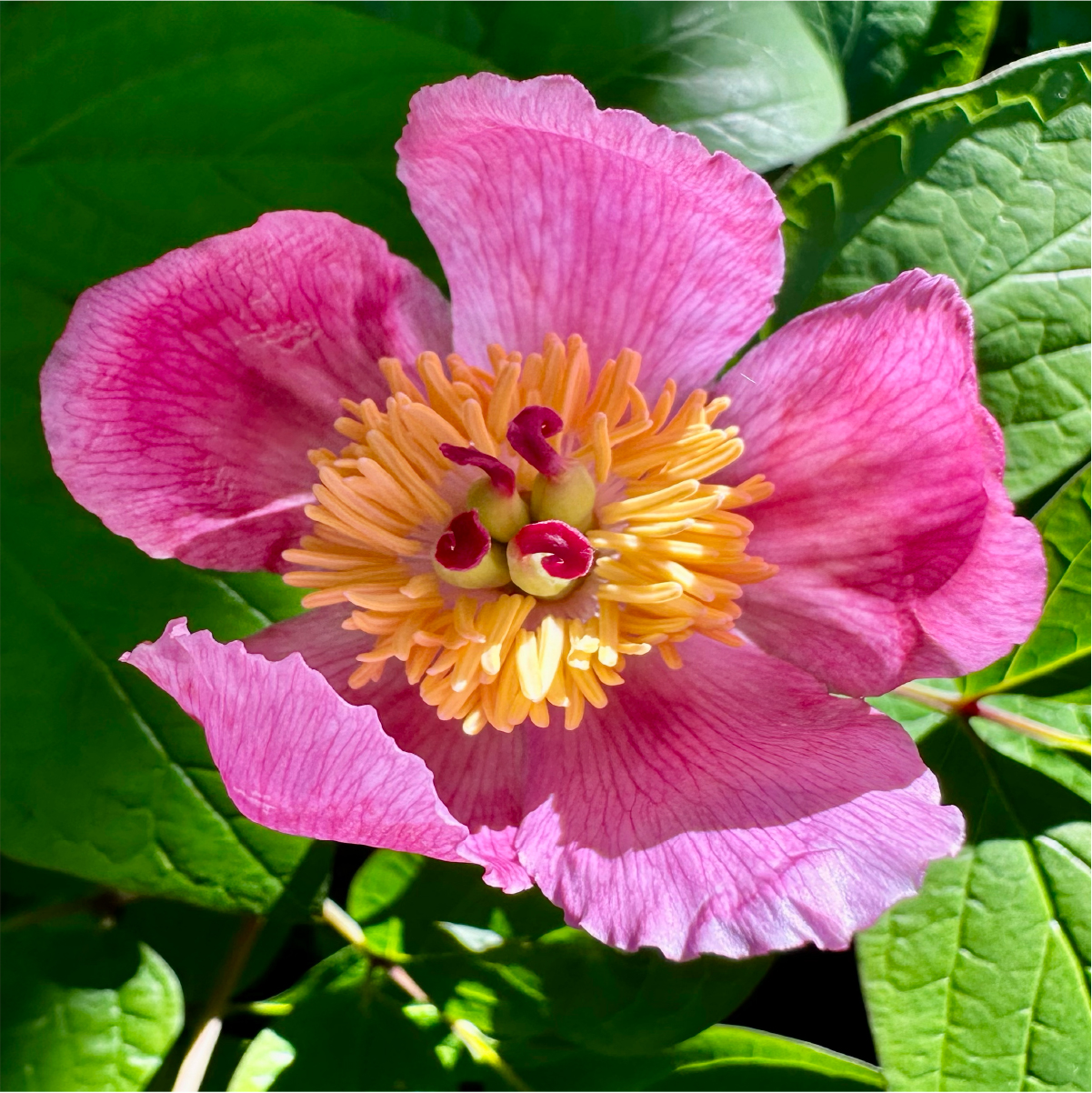
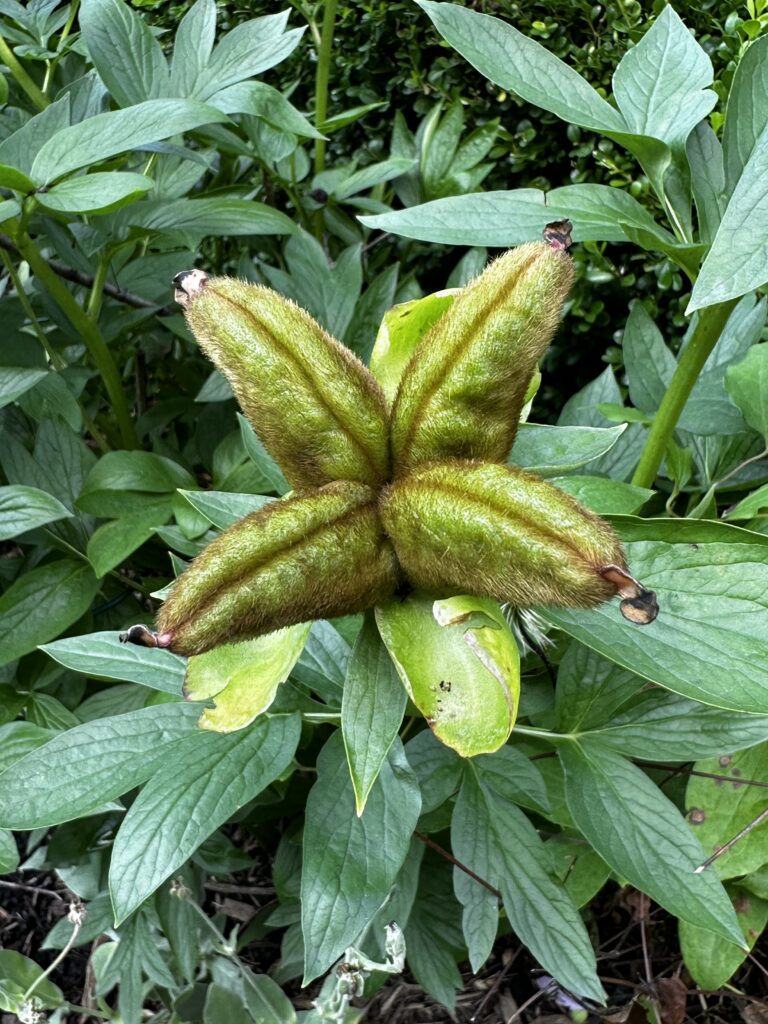

During mid spring through early summer, five distinct groups of peonies are the stars of my garden. They stimulate the senses with stunning blooms, exciting colors, and intoxicating fragrances. But only one species produces a show-stopping seed head in early fall!
WOODLAND PEONY
The parade begins in late April with Paeonia obovata, commonly referred to as the woodland peony. It is an understory, herbaceous plant which photosynthesizes by absorbing sunlight before the shading leaves emerge on the deciduous trees above it. As a result, these early season, shade loving peonies are the first to bloom. Delicate fragrant flowers rise above shrubby foliage growing just two feet tall. Woodland peonies are low maintenance, hardy in USDA zones 3 to 8, and will naturalize along the woodland’s edge.
If you do not deadhead the flowers, triangular pods develop over the summer and eventually split open. They reveal the shiny indigo fertile seeds alongside the contrasting bright scarlet infertile seeds. A true miracle of nature! Eventually the seeds will mature and fall to the ground. Keep in mind that peony seeds are slow to sprout and it may take two years to see visible seed leaf growth. You can recognize the seedlings by their pinkish-tinted leaves and stems. Be patient—seed-grown peonies take three to five years to produce blossoms.
I discovered that the woodland peonies are rare and nearly impossible to buy. My friend Gail was kind enough to send me a division from her peony and my friend Elissa sent me seeds. After several years of experimentation, I now nurture sixty-six woodland peonies throughout my garden. Most are just one to two years old, but several are flowering.
TREE PEONIES
The bloom sequence marches on with three classifications of tree peonies. P. suffruticosa is one of the largest groups with the most genetic diversity. It is highly fragrant with colors ranging from white to pink, magenta, and deep maroon.
Next are the Gansu tree peonies (AKA Rockii) which are a subgroup of the suffruticosa group. According to the Peony’s Envy Website these peonies are “distinguished by a purple flare at the center of each flower petal. Originally from the Gansu region of China, these plants are also referred to as Rockii peonies, as Joseph Rock helped make them famous outside of China. These plants are fast-growing for tree peonies, exceptionally hardy, and grow up to 7 feet tall. This group has thin billowy leaves that give a more informal appearance. They tend to cross-pollinate and produce wonderful seeds that can be grown into new cultivars.”
The yellow tree peonies, classified as the Lutea Hybrids, are the last tree peonies to bloom. “Sometimes referred to as Delavayi, this group is a Tibetan species that has a wide variety of yellows, bronzes, and oranges,” says Peony’s Envy.
Tree peonies have woody stems that persist above ground and develop buds for early flowering. They are unlike the herbaceous varieties that die back to the ground in winter. Tree peonies grow three to six feet tall with voluminous early blooms.
FERN LEAF PEONY
The peony parade continues with the fernleaf herbaceous peonies. These include P. tenuifolia, a species peony with dark red, single flowers with a double layer of cupped petals surrounding a cluster of canary yellow stamens. The feathery, dissected fern-like foliage creates a compact, mounded habit. It grows fifteen to twenty inches tall, blooms earlier than standard garden peonies and thrives in zones 3 to 8.
P. tenuifolia crossed with P. lactiflora produce hybrids with strong stems and vibrant blooms. P. ‘Merry Mayshine’ is a vigorous grower and increases rapidly. It is a reliable bloomer with single fragrant, crimson flowers. The stout clumps hold up well during inclement weather. The American Peony Society has recognized ‘Merry Mayshine’ with the Award of Landscape Merit.
Online sources include Peony’s Envy (peonysenvy.com) in New Jersey; Hollingsworth Peonies (hollingsworthpeonies.com) in Missouri; and Adelman Peony Gardens (peonyparadise.com) near Salem, Oregon.

WOODLAND PEONY
Paeonia obovata
Paeonia obovata subsp. japonica
• Prefers shade
• Fragrant 3” blooms
• White, soft pink, rosy pink or deep purple-red flowers
• 2' tall
• Viable from seed
• Amazing seed pods in the fall
• Blooms from late April to second week in May

FERN LEAF PEONY
Paeonia tenuifolia
Paeonia tenuifolia x Paeonia lactiflora
• Prefers full sun
• Requires good drainage to avoid root rot
• Fragrant
• Red, dark red, crimson flowers
• 15 to 20" tall
• Blooms from mid May to mid June

INTERSECTIONAL PEONY
Itoh Hybrids—Herbaceous x tree peonies
Paeonia lactiflora x Paeonia suffruticosa
• Massive fragrant blooms
• Unique colors including yellows, apricots, pastel pinks, vibrant reds, and rich purples
• Does not require staking
• Foliage lasts until autumn
• Remove seed heads. Seeds are not viable.
• 2 to 3' tall
• Blooms from late May to mid June

TREE PEONY
Paeonia suffruticosa
• White, pink, magenta, and deep maroon blooms
• Extremely fragrant
• 3 to 5' tall
• Blooms from late April to mid May
Paeonia suffruticosa Gansu & Rockii
• Purple splash on petals
• Fast growing
• Some as tall as 7'
• Blooms from late April to mid May
Paeonia suffruticosa lutea
• Yellow, bronze, orange, and gold flowers
• Needs shelter from strong winds
• Dislikes root disturbance
• 3 to 5' tall
• Blooms from late April to mid May

HERBACEOUS PEONY
Paeonia lactiflora
• Hundreds of cultivars & hybrids
• Fragrant, large flowering
• Clump forming
• Slow growing
• Long-lived
• Needs support
• 2 to 3' tall
• Blooms from mid May to mid June
Paeonia lactiflora x Paeonia officinalis
• Deep red, soft peach, coral, apricot, and magenta blooms
• 24 to 32" tall
• Blooms from mid May to mid June
CLASSIC HERBACEOUS PEONIES
The quintessential peonies, the Lactiflora group or Chinese peonies, are the old-fashioned, fragrant, large flowering species. They are clump-forming with perfumed flowers that bloom in late spring and early summer. Chinese peonies are slow-growing and may take up to three years to bloom, but they are long lived and may survive 100 years or more. Use stakes and twine or metal peony supports to prevent stems from flopping over after heavy spring rains. I purchased some heavy duty wrought iron supports at arusticgarden.com.
Since Chinese peonies have a long history of cultivation there are many hundreds of cultivars as well as hybrids. P. lactiflora ‘Bowl of Beauty’ is a fragrant, award-winning, early bloomer with bicolored pink flowers with frilly yellow centers. P. lactiflora ‘Green Lotus’, introduced in 1995, features pale, lime-green petals with soft pink edges. Its cactus dahlia-shaped blooms look exotic. Breck’s (brecks.com) offers many bare root peonies including ‘Green Lotus’.
True red herbaceous peonies include the officinalis hybrids. They bring intense, brilliant colors into the garden, including deep red, soft peach, coral, apricot and magenta. Many hybrids are robust and self supporting since they inherited strong stems that can handle wind and rain much better than the traditional heirloom peonies. P. lactiflora x P. officinalis ‘Red Charm’ was introduced in 1944 and is thought to be one of the best red cut flowers. Picture a lovely vase of the legendary ‘Red Charm’ on your kitchen table in June.
ITOH PEONIES
Last but not least are the intersectional peonies also referred to as the Itoh peonies. Toichi Itoh made the first successful cross between an herbaceous peony and a tree peony in 1948 thus producing the intersectional peonies. They extend the flowering season alongside herbaceous peonies providing the much cherished yellow color that is rare in herbaceous peonies and foliage that lasts until autumn. Their massive blooms sit atop sturdy stems that never need staking. The buds do not open all at once, giving way to two or three flushes of blooms over a two to three week period.
‘Bartzella’ was my first Itoh peony and is my absolute favorite. The plants are vigorous with lemon-yellow blooms highlighted in the center by a hint of red. I enjoy the spicy-sweet fragrance for three to four weeks depending on the weather conditions.
Fall is the recommended time for dividing, transplanting, and planting bare root peonies. Keep in mind that the woodland peonies and pot grown herbaceous peonies can be planted in spring as well. They thrive in nutrient rich soil with good drainage. Bury each peony eye no deeper than 2" below the soil line. Plants may not flower or fail to produce growth in the spring if the roots are buried too deep.
When I visited Sara’s Garden Center (sarasgardencenter.com) in July, potted Itoh peonies included ‘Old Rose Dandy’, ‘Lollipop’, ‘Julia Rose’ and ‘Court Jester’. For pots or small gardens, try P. lactiflora ‘Rome’, a patio peony growing just 2' tall with 5" blooms and hardy to zone 3! Several ‘Plena’ fernleaf peonies were waiting for a good home as well as P. suffruticosa ‘Shimadaijin’, a highly coveted purple flowered Japanese tree peony.
Palmiters Garden Nursery in Avon, New York (palmitersgardennursery.com) has been growing peonies for more than thirty-five years. A visit to their garden in May/June to see established mature plants is a must for peony lovers. The family does a gentle close in the fall, reducing their hours in September and October. A quick call is advised if you want to add to your collection with a fall planting.
Your garden can bloom from early spring to summer with enchanting, vibrant, fragrant flowers. Cooler weather will prolong the blooms, while hotter weather shortens the bloom time. The finale of the peony season ends with the striking seed heads of the woodland peony. What peonies will you plant to extend your season? To learn even more about peonies visit peonysenvy.com.
Colleen O’Neill Nice is a horticulturalist who is passionate about plant propagation and enjoys nurturing her garden in Clarence, New York.
This article originally appeared in the September/October 2026 issue of Upstate Gardeners’ Journal.
Natural selections
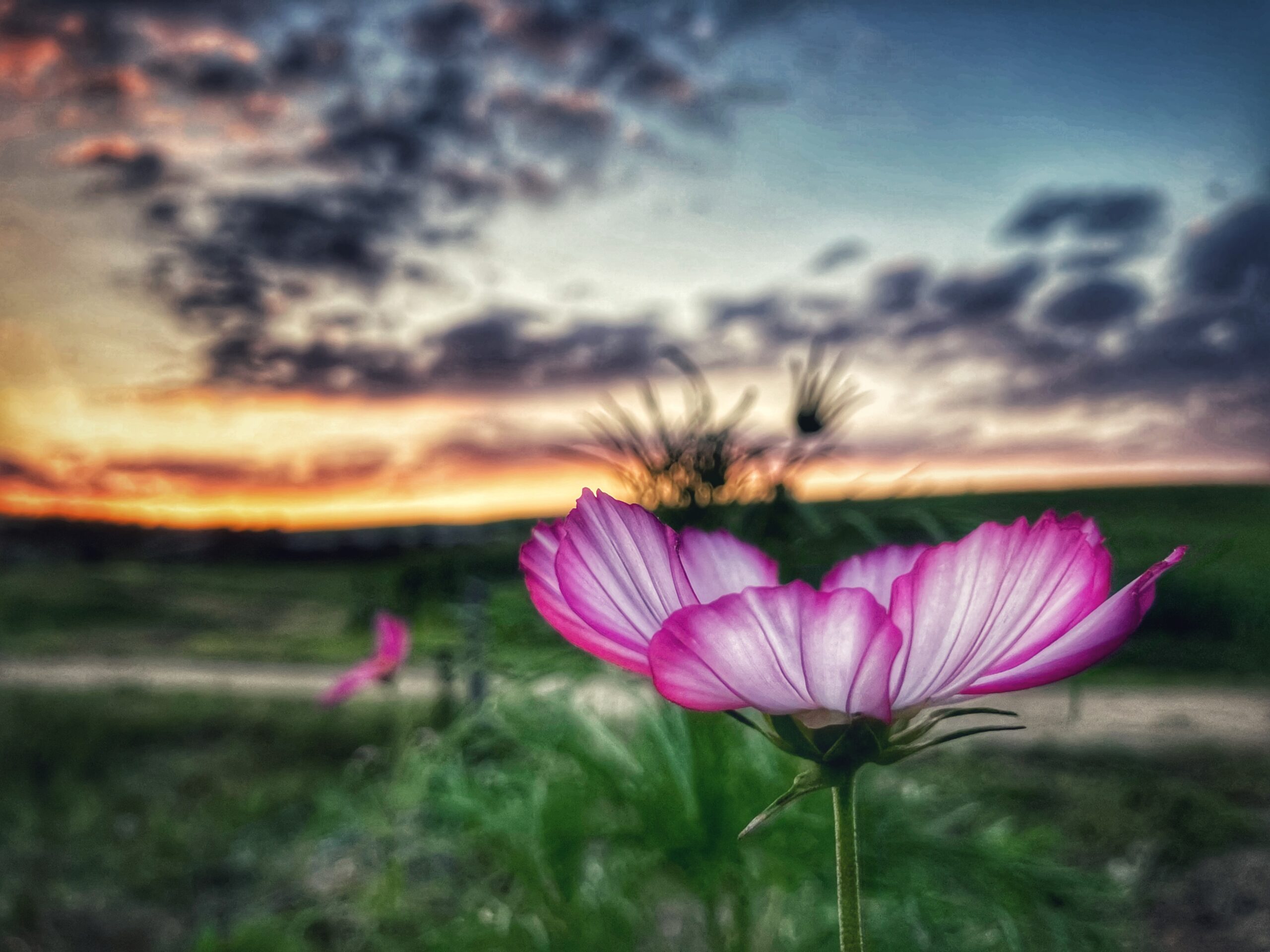
Ah, the -ber months are here! While I am looking forward to a weeding respite and enjoying cozy indoor time of the colder months, there are a few autumn traditions I like to do before tucking the garden beds in for the off season.
REFLECTION AND ORDER
Can you remember back to those dreamy winter months circling oodles of eye-catching plants in seed catalogs? I am a self-diagnosed seed hoarder, and every year I just can’t help but load the shopping cart up with many amazing seeds to start come winter’s end. There are always a few super dazzlers that I get excited about, but I try to limit my new picks to three or four so I don’t overwhelm myself. Each spring I endeavor to track their progress closely to see if they’ll make the permanent garden resident list. Early in the year, I am armed with a garden journal, meticulous seed-starting notes, and ambitious plans to log my garden’s growth. Alas, in the heat of the growing season these journals have melted into the mass of empty pots, six-packs and disconnected grow lights, and I’m lucky to find a working pen on my germination bench in July.
I remember Buffalo garden writer Sally Cunningham once describing a gardener’s “Neatness Scale,” and how we all develop our own level of tolerance for mess in our gardens. I tend towards the end that has zero clipped topiaries, paths that meander through and sometimes disappear into edges of plants that brush at my legs, to which the tactful kindly call “naturalistic.” My work areas, however, I consider clearly exempt from this scale, and they are never part of the garden tour. Much like my sink of dishes, the note taking, container organizing, and general horizontal surface discovery is an area of chaotic neglect in summertime.
But as the cooler months roll in, a sense of returning to order comes back over me, and while I do not tidy up my garden much in autumn, I do spend time cleaning and organizing my pots, tools, storage area, and germination workroom. Amidst the mess I always find my ambitious spring notes and seed catalog picture collages. It’s always interesting to see what met, exceeded, or took a nosedive from my spring expectations.
SEED COLLECTING
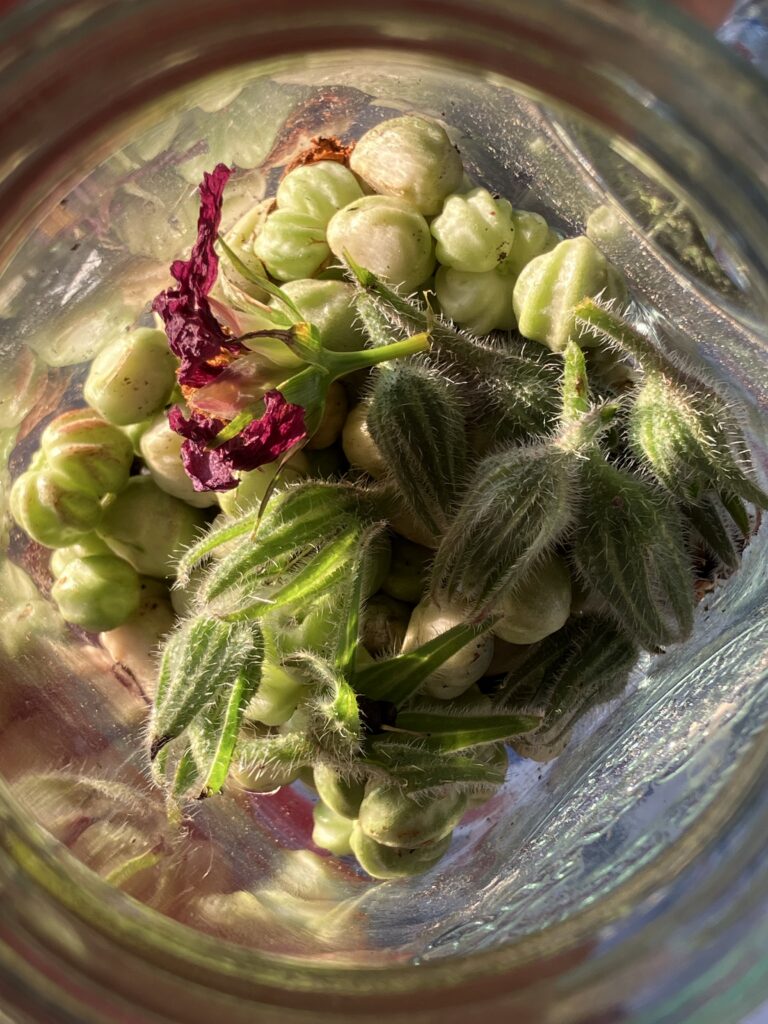
I grow a great deal of plants that produce viable seeds, and autumn is when I collect and dry seeds for next season. While I don’t consciously earmark specific plants to collect from, I slow down on deadheading as the season winds down, and naturally, seeds develop. Some plants, such as dill and feverfew, self-sow abundantly into my garden, so I don’t collect their seeds for indoor storage.
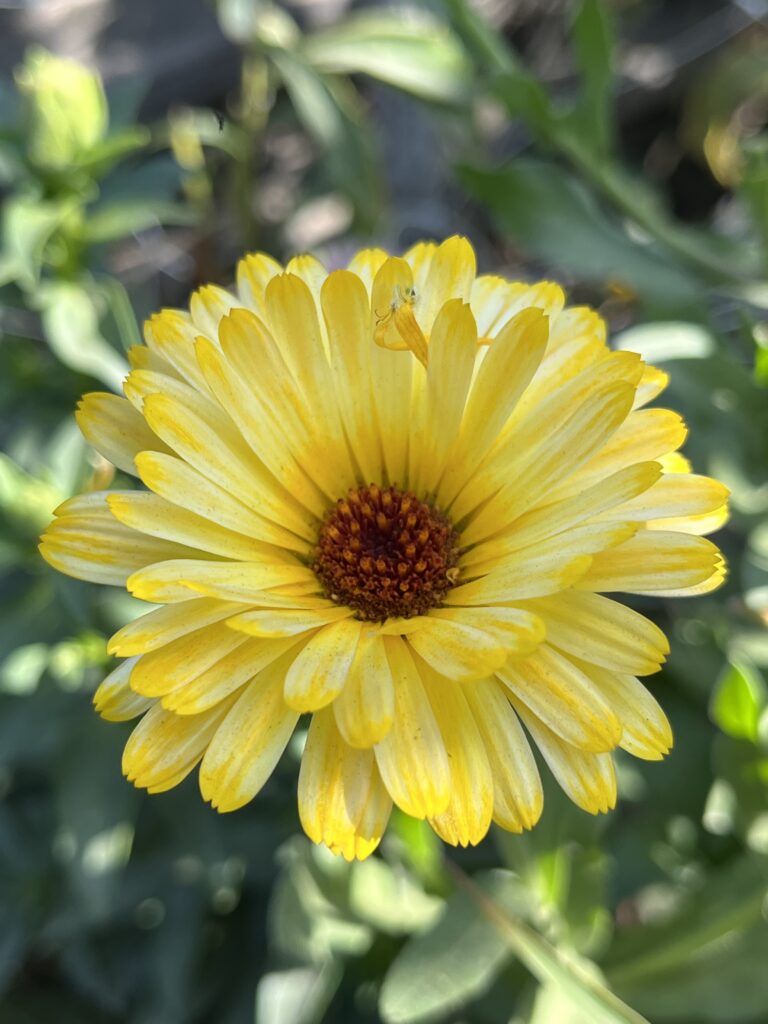
Among my favorite seeds to collect from the garden are calendula, cosmos, marigolds, basil, purple hyacinth bean vine, and zinnias. My seed collecting methods are similar to my other gardening habits, not very strict, but rather foolproof in their simplicity. I cut whole seed heads directly into paper bags, and leave the bags in a cool, dry place until I can separate the seeds and sort through them. This is best done on a dry day, in the afternoon, to ensure the least amount of moisture. If I am concerned with moisture or the seed heads were quite green when collected, I will spread them out on a newspaper-covered tray for a few weeks to dry. Then, I store them in labeled paper bags, later to be divided up for my winter seed swap gathering and personal collection for planting next year.


SEASONAL STARS
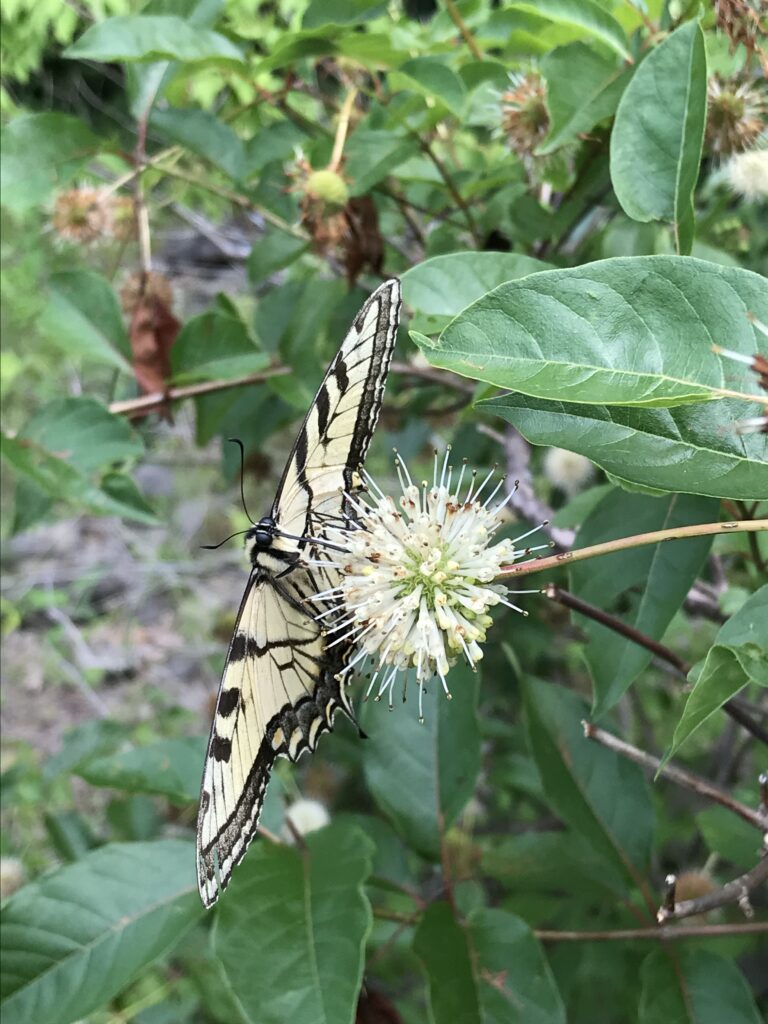
As autumn arrives, I like to pick out three top performers for the year. Sometimes my new introductions become my seasonal stars, but more often than not, my top three surprise me. This year, the clear winners are ‘Silver Plate’ eucalyptus (Eucalyptus polyanthemos), ‘Summer Pastels’ yarrow (Achillea millefolium ‘Summer Pastels’), and Cephalanthus occidentalis (buttonbush).
I’ve been growing eucalyptus from seed for three years now, but 2026 was my first growing ‘Silver Plate’. I chose this variety to satisfy my cut flower projects that required its dramatic draping foliage, like cascade bridal bouquets, and I loved the added dramatic flair of a reddish hue in its stems and growth tips. Eucalyptus is a slow growing plant, maturing at about 150 days from germination, so I started their seeds in late January. They were ready to harvest starting in early August and were a stunning addition to bouquets. There are also several ‘Silver Plate’ bunches drying for fall wreaths and seasonal decor projects. If you’re thinking of trying eucalyptus, I’d say it’s totally worth the wait, and other than having to monitor seedlings for a long time and increase their pot size once or twice, they are not that difficult to grow from seed.
‘Summer Pastels’ yarrow was on last year’s underperformer list, having been sown in spring and never producing flowers. Honestly, I had planted them as an afterthought; I had already exceeded my space for 2025 seed starts, and I threw the whole packet in an open tray. They were relocated into the garden late and forgotten about for the rest of last year. Well, they came back wonderfully this spring, and yielded dozens of bunches of blooms in soft shades of cream, pink, and purple. I am dividing the patch in September, as it is a solid mass of probably every seed I sowed last year, and gifting several of the divisions to friends for fall planting.
Last year I heeled in six bare root shrubs into a temporary bed, planning to move them to a new garden space I was creating this spring. I had purchased pairs of three fairly resilient species as I’m still getting the lay of the land: Philadelphus lewisii (mock orange), Forsythia × intermedia (border forsythia), and Cephalanthus occidentalis (buttonbush) and planned to use them as structural “corners” in my new garden bed. Unfortunately, by the time I got around to making a place for them in early June, my buttonbush shrubs had not one a leaf on them. We had some really cold spells late into May this year, and I wasn’t sure if their barrenness was due to never budding out or the new leaves being killed by late frost. Having nothing to lose but time, I relocated the water-loving skeletal pair to a permanent location close to the nearby drainage ditch. Sure enough, a few weeks later, I had leaves on most of the branches. On this lovely fall day, my buttonbushes are still sporting their conspicuous fragrant blooms for which they are aptly named. Reflective, autumn me is grateful that the overly ambitious, sometimes too impatient spring me remembered to give woody plants a second chance. That’s one of gardening’s rewards: learning that there is often more life waiting to emerge than meets the eye.
Bonnie Warriner is a horticulturalist and budding flower farmer with a love for capturing beauty in pictures and words. You can find her among the wildflowers and goats on her family’s 150 acre farm in Jasper, New York.
This article originally appeared in the September/October 2026 issue of Upstate Gardeners’ Journal.
Seasonal stakeout
GARDEN COACHES AND CONSULTANTS—SHOULD YOU HIRE ONE?
If you are planning a garden from scratch, or you have an existing garden but you need hands-on help and advice, a coach could be just what you’re looking for. Unlike a landscaper who does the work for you, a coach can teach you how to develop and maintain your own garden, working with you on skills like pruning, soil preparation, watering, and mulching. They can do a walkthrough of your garden and possibly give you ideas you may not have considered, as well as recommending plant varieties and tools. And coaches are not just for beginners. “Clients benefit from a garden consultant’s extensive experience with plants that work well in upstate New York growing conditions, as well as a fresh set of eyes to help come up with new solutions to existing garden challenges,” says Chrys Gardener of Chrys Gardener Designs in Ithaca. Among the services that she likes to provide are “coming up with different ideas for garden layout including planting beds, paths and outdoor entertaining areas, and providing quick sketches on site to help clients visualize some of these ideas.”
A coach can prove far superior to online searches—nothing beats a knowledgeable person. “A garden coach gives you something Google can’t,” says Kathleen Kepler of Sara’s Garden Center in Brockport. And that is “personalized, on‑site guidance tailored to your yard, your goals, and your skill level.” Getting things right the first time using a coach could potentially save a lot of work and frustration—and even money. “Instead of guessing which plants will thrive, a coach helps you choose the right varieties for your sun, soil, and space,” Kepler explains. And before you give the task to an AI agent, you might want to consider human-based knowledge and creativity for your growing space. “We’ve seen more AI designs than ever this season,” Kepler says, “and they are 99% generating designs using the same plants over and over and over again!” She stresses the need for personalized choices over generic suggestions: “Your plant choices need to fit your garden conditions and ideas for maintenance. AI is not going to give you that.”
PLANT BULBS, BUT MAKE IT UNIQUE
Looking for something more inspired than planting a few more tulips and daffodils this fall? For a more colorful landscape when spring comes, branch out by trying out some cool bulb specimens that will add interest and dimension.
Alliums: Laurie Broccolo of Broccolo Tree and Lawn Care in Fairport loves alliums, and she points out that they aren’t limited to the tall globular specimens—they come in a huge variety of sizes, shapes, and colors. “There’s so many different kinds … there are shorter ones,” she says. She recommends checking out the “Mediterranean bells” variety, noting that they are beloved by hummingbirds.
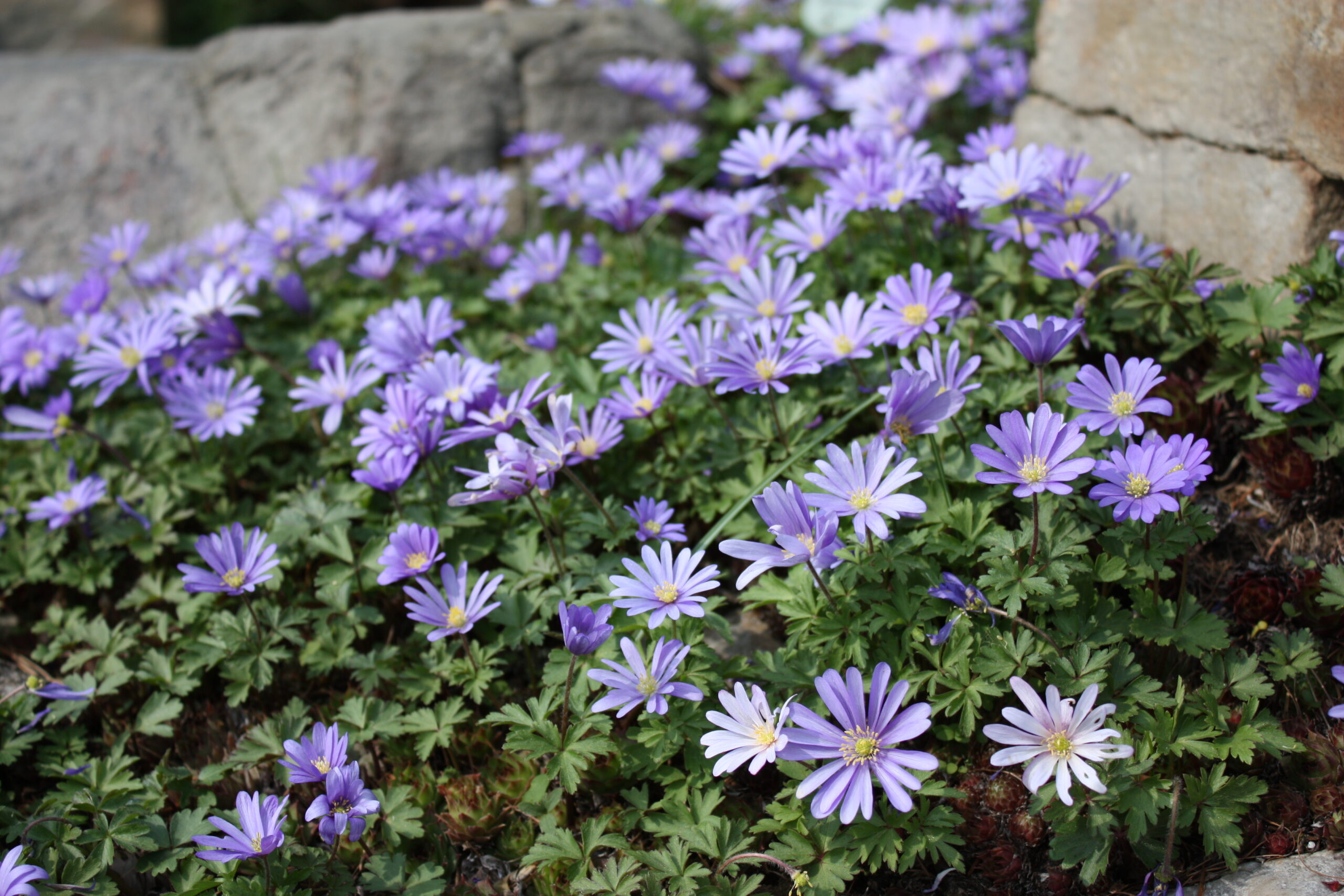
Balkan anemone: Kepler states that this is a customer favorite for its “charming, sweet, daisy-shaped flowers that come in blue, white, or pink.” They are easy to grow, she notes, and “they reseed politely without overcrowding and once you plant some, you never have to do bit of maintenance.”
Camas: Broccolo is also a fan of camas, known as the camas lily, camassia, or Indian hyacinth. It’s a perennial native to North America and its spiky blue, lavender, or white flowers bloom in late spring or early summer.
Fritillaria: This is a plant genus that boasts dozens of varieties; Broccolo likes the crown imperial type for its unique shape.
Minor bulbs: Kepler makes a case for revisiting “the small early spring bloomers that you never think about until you see them in bloom,” including crocus, snowdrops, scilla, and species tulips. Aesthetically, “they’re powerful for layering,” she says, and “one of the easiest ways to add depth, rhythm, and surprise to your planting schemes.”
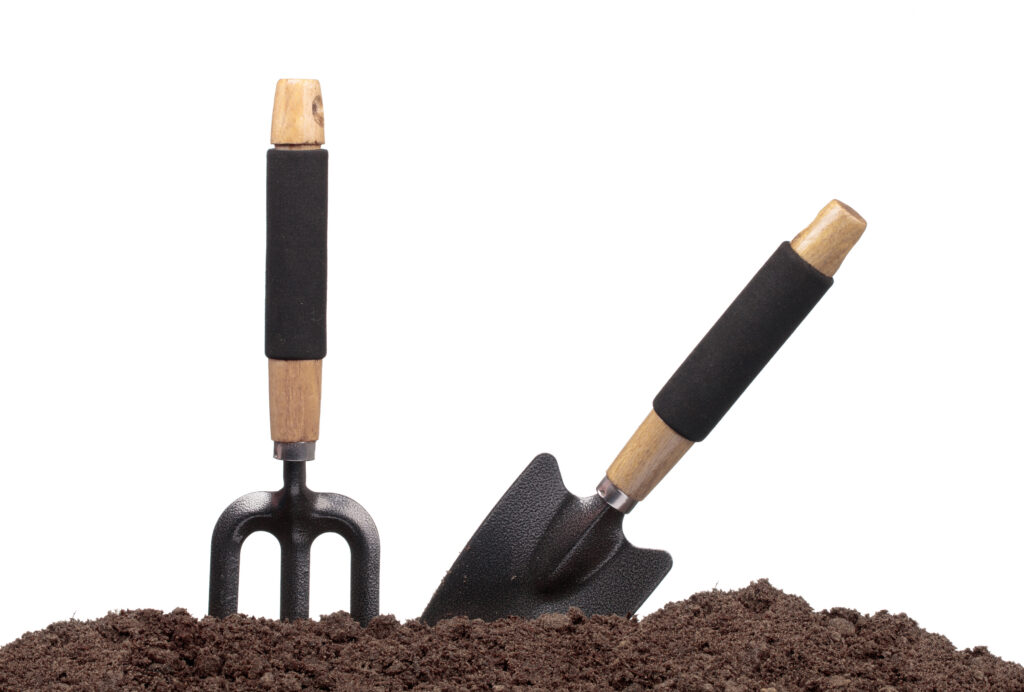
HELP YOUR TOOLS HELP YOU—CARE AND SAFETY
A well-stored, properly maintained garden tool is a safer bet for everyone.
Keep them dry: Always store tools dry. Keep them off the floor of your gardening shed or garage. Never leave them outside, even if you will be picking them up again the next day. This helps avoid rust and breakdown. “Just make sure that they’re clean of dirt and debris and things like that before [you] put them away,” says Lauren Domuracki, certified landscape technician and assistant manager at Broccolo. Wipe or spray them down with water and store them dry—if the day doesn’t lend itself to drying in the sun, use a rag or paper towel.
Keep them sharp: “Your spade better be sharpened,” Broccolo says. “You know, it’s a lot less stressful if it cuts right through the sod. And as we do a ton of edging so [we’re] sharpening those tools, constantly.” At their garden center, they sharpen frequently—once a year isn’t enough for a tool getting heavy use.
Use good quality and consider comfort: Felco is a favorite brand at Broccolo. If you have arthritis or issues with hand strength, Laurie Broccolo says, look for special tools such as the Felco 12 pruners, which have a revolving handle grip. Kepler also likes Felco pruners. “They’re a bit more money but worth their weight in gold,” she says. “You’ll use them often, so you want a well-made pair.” She also recommends Bully Tools, particularly the 12-gauge edging and planting spade. “The long handle version is easy on the back and provides better leverage. There’s a short handle one too, if preferred, and you can customize the handle material and grip design too!” She recommends purchasing on bullytools.com to avoid knockoffs. And of course, if a tool is broken, don’t keep using it—repair or replace it.
Pay attention: “One thing I would say about safety with your tools is making sure that you’re paying attention,” says Domuracki. “That and taking it slow. I was not doing both of those things one day, and I cut the tip of my finger off.” It’s crucial to slow down and consider “no matter how big or small it is, being conscious and appreciative of the fact that you’re working with a tool.
Carolyn Sperry is is a freelance writer in Rochester. She has published nationwide, won the Gotham Writers Stories Everywhere competition, and writes poetry featured in several journals.
This article originally appeared in the September/October 2026 issue of Upstate Gardeners’ Journal.
Ear to the ground
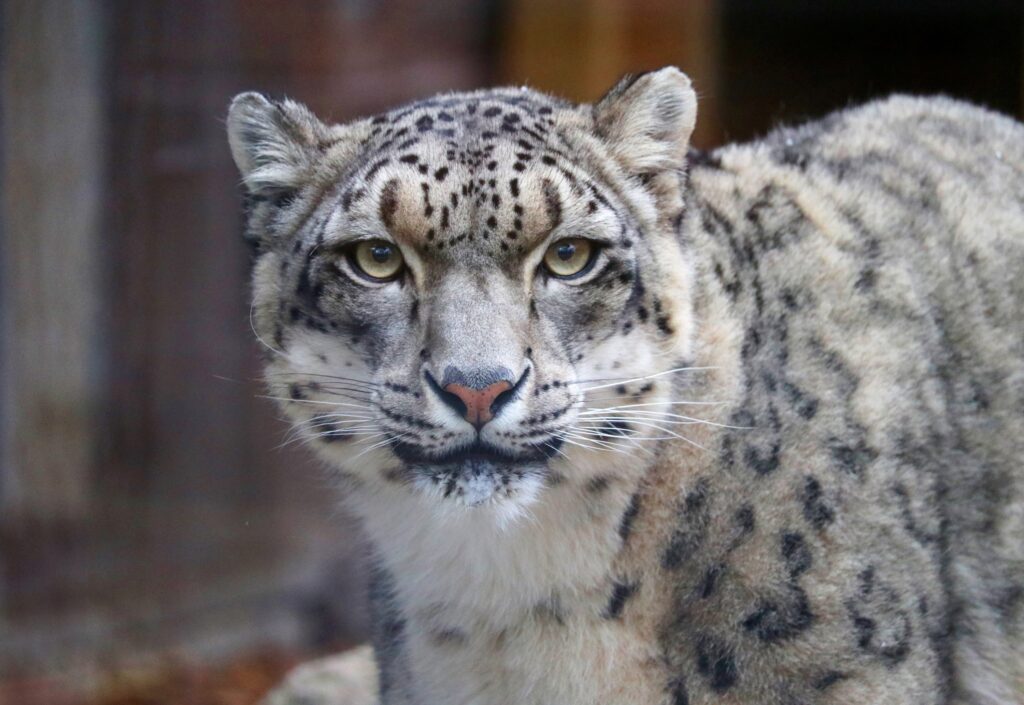
Prowl, prowl, purr, purr! Visitors watch a snow leopards leap from a snowy rock, searching for its next meal. Snow leopards are originally found in

The universe is waiting for you at the Rochester exhibit, Astronauts. RMSC has brought in an exciting new traveling exhibition from Perth, Australia. The exhibit
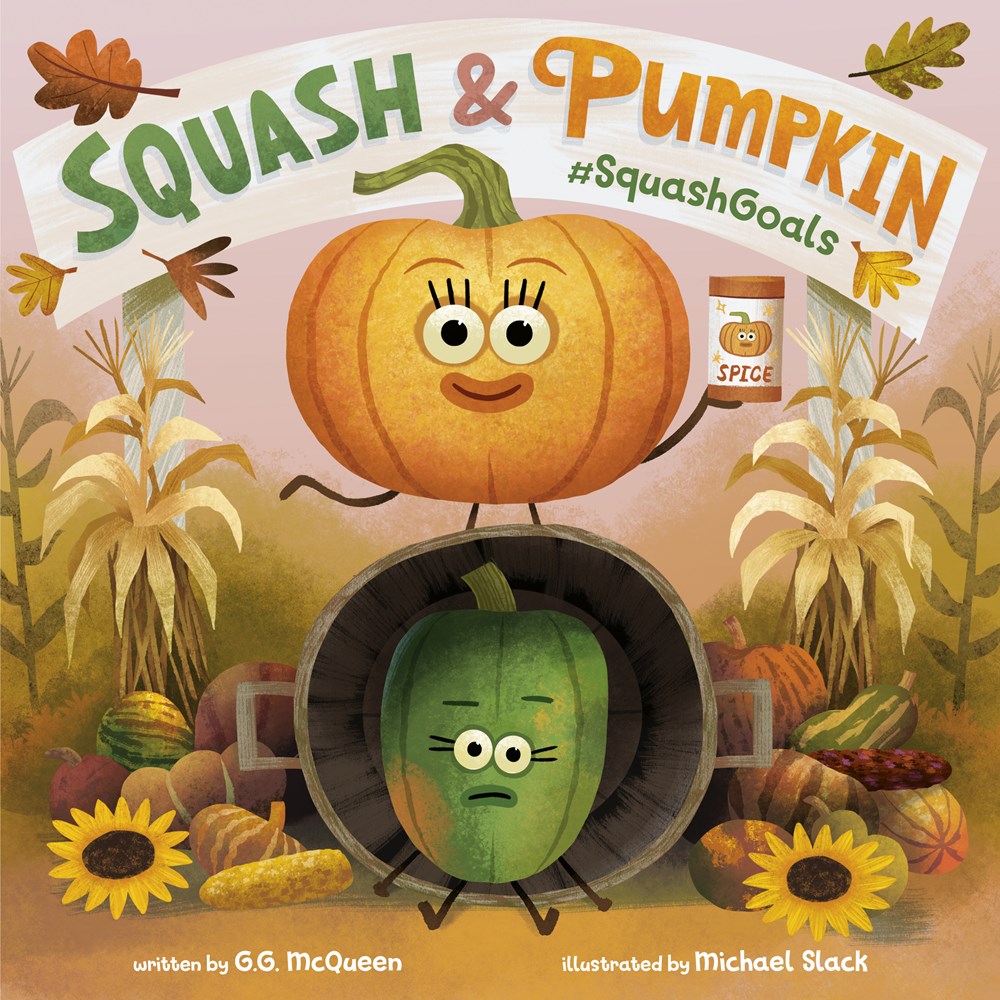
GG McQueen is celebrating the release of her debut picture book, Squash & Pumpkin: #SquashGoals. Squash is tired of all the attention Pumpkin gets each

This article originally appeared in the Fall 2025 issue of (585) Kids.

This article originally appeared in the Fall 2025 issue of (585) Kids.

Somehow the year is already 75% over. Catch up on these 2025 must-read releases before the 2026 titles hit the shelves! PICTURE BOOKS *Call Me

Regular readers of (585) Kids have likely heard of the Rochester Children’s Book Festival (RCBF). After all, it has been bringing authors, illustrators, kids, and
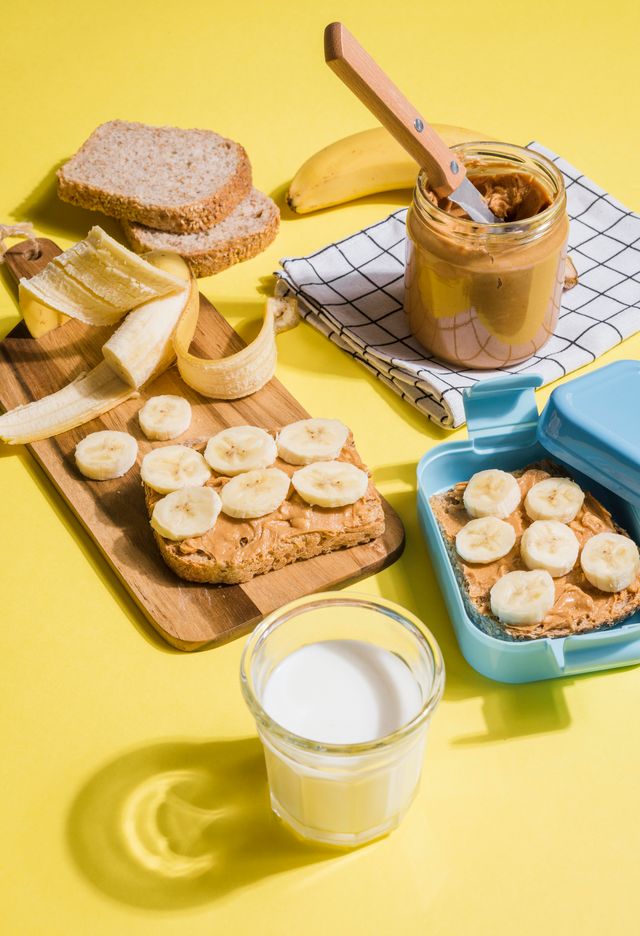
Ahhh summer … Picnics, graduation parties, weddings, backyard gatherings with neighbors. Children at home. ALL. DAY .LONG. I am certain that my children don’t eat

A NEW, INCLUSIVE PLACE TO PLAY As a special education teacher and administrator for more than twenty years, Kristen Bonn was often uncomfortable with the
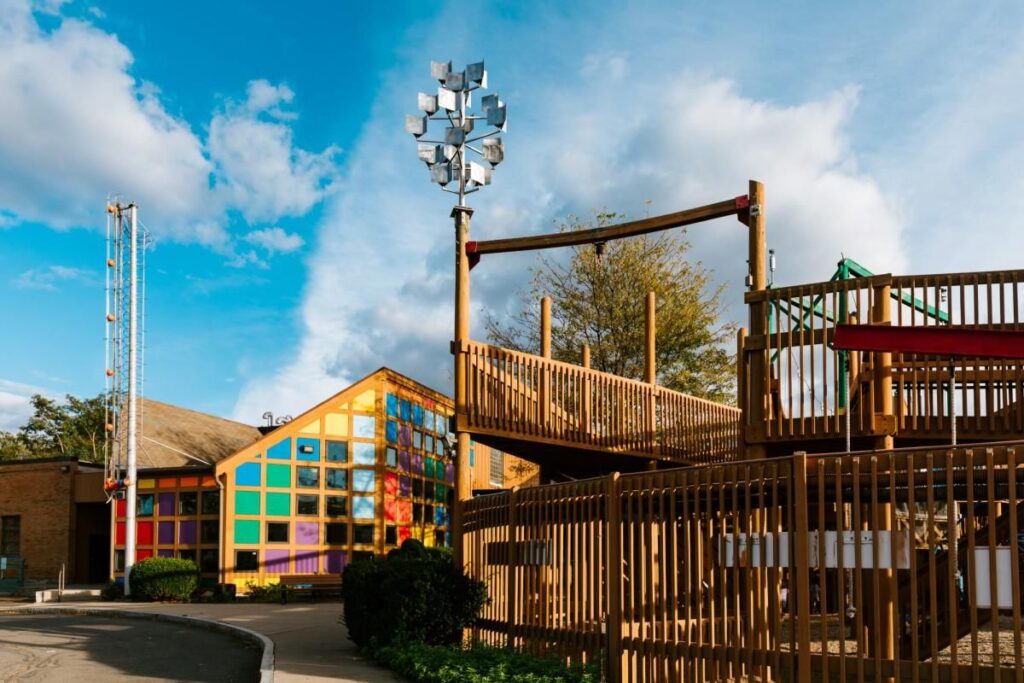
ONGOING TUESDAYS–FRIDAYS SCIENCE TOGETHER Ithaca’s Sciencenter hosts its Science Together programs, which explore different science processes for children up to four years old. Children must

.jpg)