


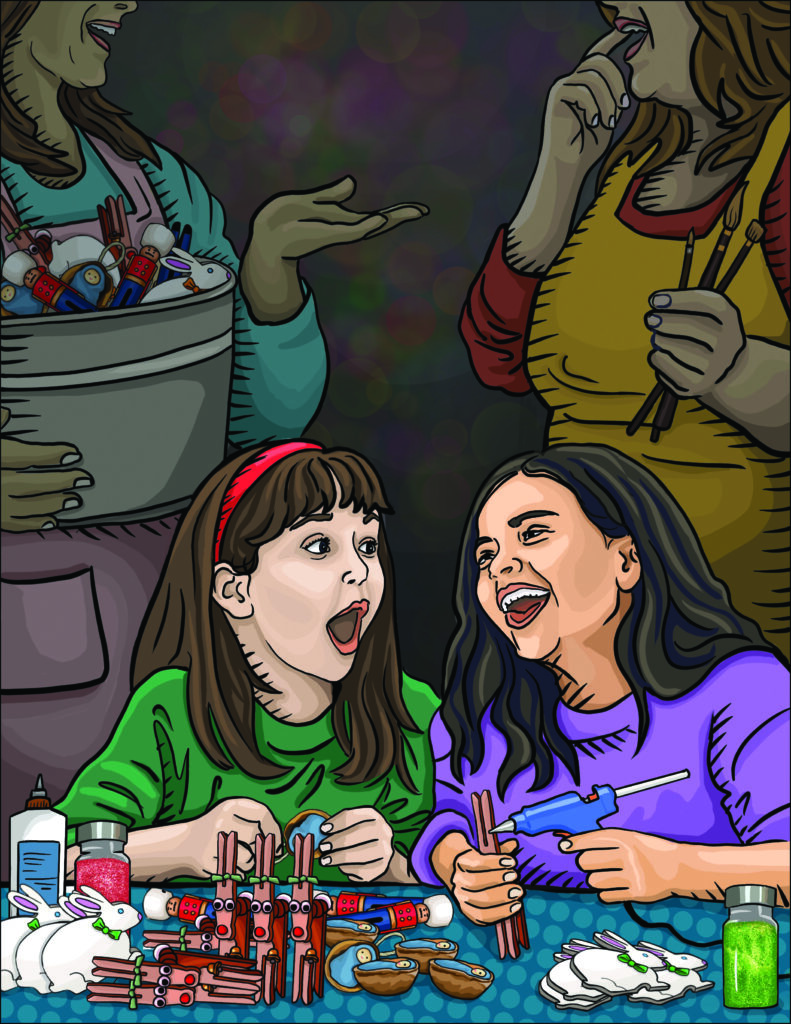
I’ve been painting wooden bunnies for so long that I can’t feel my fingertips. My little sister is right beside me at the kids’ table, running sandpaper across wood in a frenzy; beads of sweat hang off her nose. At the big table behind me, my aunt uses a miniature paint brush to dot the irises of the bunnies’ eyes. The aggressive whirr of a band saw hums up the stairs from my mom’s station in the basement, which currently looks like the Seventh Circle of Woodworking Hell. I think about scrawling the words “HELP ME” in the piles of sawdust, which are spread so deep and wide that my message could be easily spotted by a rescue chopper.
Every Thanksgiving during my childhood, my mom and Aunt Terre participated in the pre-holiday craft show circuit, and theirs were not your usual pipe-cleaners-and-Elmer’s-glue type of products. The ladies had an array of creations they put out every year, and their ideas were all original. Wooden soldier ornaments made out of clothespins, swaddled babies with cherubic painted faces nestled inside of an empty walnut shell, mini wooden magnets and animals painted to perfection. Mom and Terre had their customers in a chokehold because they had great ideas, high standards, and detailed execution.
What mom and Terre also had was an unofficial sweatshop at their disposal to bring their ideas to life. It was an unspoken rule in our circles that craft show prep meant everyone within a ten-mile radius was sentenced to one month of hard labor at our house—and this was non-negotiable. As it turns out, the arts and crafts world was the perfect place for mom and Terre to combine their creativity and their authoritarianism. No one dared question them, for their minds were full of beauty and whimsy, but their hearts beat with the sadistic rage of two wardens at a state penitentiary.
During craft prep, there was a job for everybody, no matter how young. The little kids got sandpaper duty, as their brains were not sophisticated enough to protest the drudgery that lay ahead. The bigger kids did light painting and gluing; adults did basic sewing. Pol Pot and Mao Zedong (née Mom and Aunt Terre) split duties on the band saw, cutting thirty wooden animals at a time. Terre was so exacting and precise that she was the only one trusted to paint eyeballs. It was just one of the tedious jobs normally assigned to torture prisoners in Attica that she accepted happily.
I must admit, their system was efficient. Once everyone knew their role, the workers entered a flow state; Mom and Terre settled into a sort of dictatorial Zen. Products rolled out at a pace that would make Henry Ford jealous. Like any true assembly line, this job also came with the threat of repetitive strain injuries—though it had none of the union benefits. In fact, the only real compensation for the kids who joined the table was access to coveted adult gossip and the occasional dessert.
One year, my cousin Krystal found family gossip was a mighty tempting mistress. It pulled her away from normal teenage activities and soon she was part of the labor camp. If she found third-degree burns from a hot glue gun preferable to a life of drugs and crime, who was I to argue? She was the older, cooler cousin that I and my sister idolized. I was a taciturn child who hated only two things in this world: crafts and my family. But once Krystal got involved, my attitude changed; I took a seat at the table and happily enlisted in the crafting gulag. Besides, my surliness was no match for the catering, which included a raspberry Danish so powerful it neutralized concern about the obvious child labor violations.
Soon enough, I was as caught up in the gossip as the rest of the kids, and even though we were too little to understand most of it, we loved listening. There’s nothing better than learning that someone else’s life is completely off the rails when your own situation isn’t great; we would hear the stories and shake our heads in judgement. “Oh, my God, get it together,” we’d laugh and then go back to aspirating spray paint and chewing our blisters.
In a way, my mom and Terre were destined for this: Their father was a talented carpenter. He had a small wood shop behind his house that he toiled in, utilizing his craftsmanship and creativity to make furniture. Every grandchild was gifted either a handmade cradle, a toy box, or a high chair that he built in his shop; they are one-of-a-kind heirlooms that we still have to this day. The high chair he made for me held up to the wear-and-tear from me, my siblings, and all who came after.
So, Mom and Terre had absorbed enough carpentry acumen to have no fear about using a saw during their craft show era. They decided they needed a name and chose “Chips Off the Old Block” as an homage to their father. It should be noted that my grandfather once had a minor shop accident and sawed off three of his fingertips, so we hoped that Mom and Terre’s career wasn’t an exact copy of his, and we hoped hard. Those of us who still had all our fingers kept them crossed.
Like all tough conditions, my time in the hot glue gun trenches shaped who I am. It was a great first lesson on what it means to buy and produce local. It also introduced me to hard work, which gave me a leg up among my peers. After all, no one else in my class was a manufacturing expert with time served in an oppressive factory setting before they hit the double digits.
This article originally appeared in the March/April 2026 issue of (585).
Views: 51