




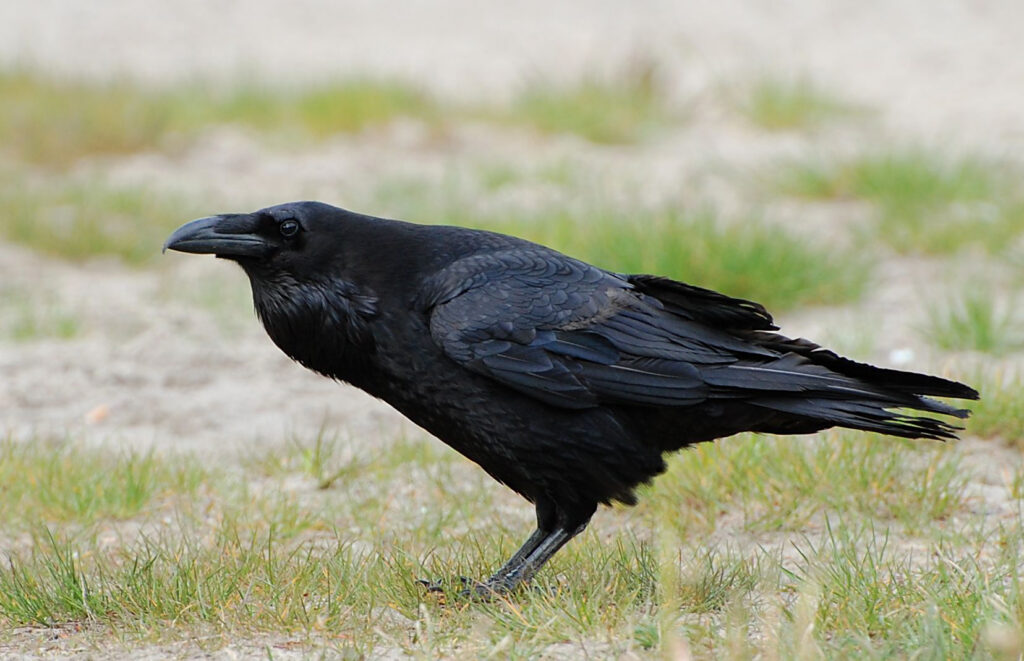
There is a new trend in the bird feeding world, and it is one that I am excited to write about—attracting Crows to the backyard! Crows can be found in a large range of habitats, are intelligent and curious, and are even known to leave small objects for humans who regularly feed them. It is very understandable why the appreciation for them is growing.
Here in Western New York, we have four species of birds in the Crow family which are commonly found, and one has blue feathers! The American Crow, Fish Crow, Common Raven, and the most common backyard visitor, the Blue Jay. Blue Jays are easy to identify by their loud varied calls, blue plumage, and large feathery crest.
The Common Raven is the largest of this group of birds, with a wingspan measuring up to 46 inches long. They are entirely black birds with a thick neck and shaggy feathers on their throat. They are not as social as Crows and therefore are often seen alone or in pairs. Ravens typically have a deeper voice than Crows and their most common call is described as a gurgling croak.
The American Crow is smaller than the Raven, with a wingspan ranging from 33 to 39 inches long. They are very social and are often found in flocks, sometimes into the thousands. Although they have many different calls, their most common is the typical “caw” they are associated with. They will also form mixed flocks with the Fish Crow.
Fish Crows are slightly smaller than the American Crows, but this can be hard to decipher in a mixed flying flock of Crows. Their call is quite different however and sounds more nasal and high-pitched, often repeating a sound like someone saying “uh-uh.” While often found by water, they can be seen in varied habitats inland and even in cities.
Crows are extremely intelligent birds. New Caledonian Crows found in the South Pacific are well known for their ability to make tools out of plant stems, sticks, and leaves to gather food. Studies have been done on Crows which have shown Crows can differentiate human faces and can tell which humans pose a threat. Even more amazingly, Crows share this information with other Crows and their offspring and future generations carry on this knowledge of learned threats. Crows are very social creatures. They will flock from their nighttime roosting sites in the morning to their feeding sites and then back to their communal roosting sites for the night. These sites provide safety in numbers and warmth as the nights begin to cool.
A perk for humans about attracting Crows is they will sometimes leave small gifts and trinkets to those who regularly feed them. These tend to be small shiny or colorful objects like coins, earrings, beads, and glass, but they also may leave things like bones, twigs, leaves, and even items they would consider food like small insects and mice.
If you have been feeding birds, you may already know how much Blue Jays love peanuts, especially peanuts in the shell. This is the same for American Crows. If you are putting out peanuts for Blue Jays or Crows, make sure that the peanuts are unsalted and raw or roasted. Crows are omnivorous and eat a wide variety of foods; they eat seeds, fruits, insects, eggs, carrion, and even small animals like mice, fish, and crayfish. Because of this, you could also offer unsalted walnuts, almonds, berries, and even pet food in your crow feeding setup. Consistency is key with attracting Crows. For best results, make sure you add food to the feeder at the same time each day.
Crows are large birds and won’t come to a traditional tube or hopper feeder like Blue Jays will. Instead, they will need a wide platform to fit on. You can get hanging platform feeders, but the best way to attract Crows is a platform feeder that is stationary and mounted on a pole. These platforms should be at least 12×20” in diameter so multiple birds can land on it at once. The pole it’s mounted on should be at least five feet high with a baffle on it to keep squirrels from climbing it and getting to the food. Most platform feeders can easily be mounted to a one-inch-round pole or wooden 4×4 post, both of which can have baffles easily attached. Mounting the pole in the ground doesn’t have to be cumbersome either! Cementing it into the ground usually isn’t necessary but getting a ground socket that is 15” or longer should keep the pole in the ground securely.
All four species of Crows we regularly see in this area are year-round residents, so you can try to attract them any time of the year. If there is a certain time span you tend to see them flocking into your neighborhood, that is a good time to start providing food regularly. Crows are usually quite skittish to humans, so make sure to give them their space until they begin to get comfortable with the feeding station and those around it. Each individual bird can have its own personality and sometimes be recognized, which makes attracting new Crow friends to your yard even more fun!
Liz Magnanti is co-owner of the Bird House in Brighton.
This article originally appeared in the September/October 2026 issue of Upstate Gardeners’ Journal.
Views: 0