




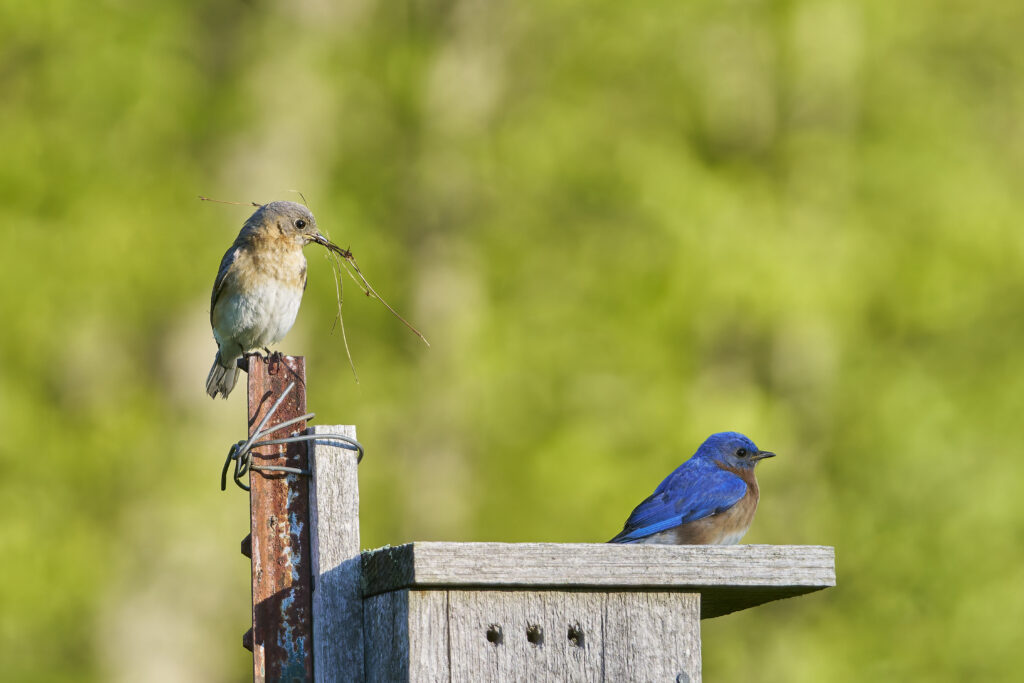
As the days get longer and warmer, the sound of bird songs will start to fill the air. Birds will sing to attract a mate and soon the nesting process will begin. Nesting takes place in a variety of spaces: tall grassy fields, trees and shrubs, along shorelines and inside hollow spaces, to name a few. Birds that nest inside hollow spaces are called “cavity nesting” species and there are several that you can attract to your yard with the help of a bird house.
When picking out a bird house, there are lots of options to choose from! Believe it or not, not all bird houses are the same. There are certain features to look for when selecting a bird house for your space and depending on what species you are trying to attract, they can have very different features. In general, most cavity nesting birds prefer a house that is securely mounted to something stationary. Mounting a bird house on a pole allows for this and also allows it to be baffled against predators that might try to climb the pole and empty its contents. Baffles are barriers added to bird houses, feeders, and feeder setups to keep intruders out.
Having a cleanout is what I would consider the most important thing when selecting a bird house. Being able to open it up to clear out the contents, at least once a year, is very important. One feature that is not needed on a bird house, however, is a perch. Perches can leave the house susceptible to predators like raccoons, squirrels, and even Blue Jays and Grackles, which may try to get into the house to raid it.
Wrens are some of the simplest and smallest birds that can be attracted to a bird house. With their size being so small, they can fit inside a house that has an opening entrance hole of 1” to 1 1/8” in diameter. Wrens are not particularly picky when it comes to selecting a place to nest. I have heard stories of wrens nesting in mailboxes, shoes, even the pockets of clothes left outside to dry. There are even multiple forums online dedicated to wrens roosting in unusual places. Wrens are cavity nesters who will actively search out bird houses, even if they are hanging from a tree and swaying in the wind. Wrens will build a nest made of many small sticks. Sometimes, you may find a bird house has a few scattered sticks in it, but no nest was fully formed. This is most likely from a Wren. The males are known to start multiple nests in various cavities and then the female he attracts will select the final nesting place and finalize the nest building, which includes lining the nest with soft materials.
Chickadees are another small bird that you can attract to your backyard with a bird house. They can fit into a house that has an opening of 1 1/8” or larger. The chickadee has a preferred nesting material of moss. The hole size of 1 1/8” is also important because it is too small of a hole for a House Sparrow to fit inside. House Sparrows are an introduced cavity nesting species that have a bad reputation of taking over the nest sites of other species. This sometimes includes destroying the eggs or nestlings of other birds.
Bluebirds are a songbird that requires a house with an entrance hole of 1 1/2” to fit inside. These brightly colored birds are one of the first songbirds to begin to nest in the spring. They are often found in a habitat of open grassland or fields surrounded by trees. Tree Swallows will also use the 1 1/2” nesting hole and live in this same habitat, so don’t be surprised if you see some inspecting houses in this type of habitat! Tree Swallow nests consist of grasses and a lot of feathers on top, while Bluebirds have a nest made just of long grasses.
Nuthatches and Woodpeckers will also nest in bird houses occasionally. They tend to prefer tree cavities, but will nest in houses, especially those that are mounted on trees ten feet high or higher. All of our Woodpecker species will nest in a house or cavity. Woodpeckers are considered “primary cavity nesters,” meaning they will excavate their own nesting sites. They don’t build a nest but will lay their eggs on the soft wood chips made during excavation.
It’s not only songbirds that will nest in houses either! Other birds like Wood Duck, Hooded Merganser, Screech Owl, and American Kestrel will also nest in houses if they are placed in the right habitat. These houses are larger—for example, a Screech Owl house has an entrance hole of 3” in diameter and should be over a foot tall.
When attracting birds to your bird house, it doesn’t take much work besides the maintenance. There is no need to fill them with food or nesting material—the birds will take care of that on their own. The most important thing is making sure to clean the house out at least once a year. Late August or September is usually a great time for this. The house can also be cleaned out throughout the season once the young have fledged if the bird has multiple broods, or rounds, of young per year. In our area, make sure your bird houses are out by April for your best chance at success in attracting a nesting bird.
Liz Magnanti is co-owner of the Bird House in Brighton.
This article originally appeared in the March/April 2026 issue of Upstate Gardeners’ Journal.
Views: 18