




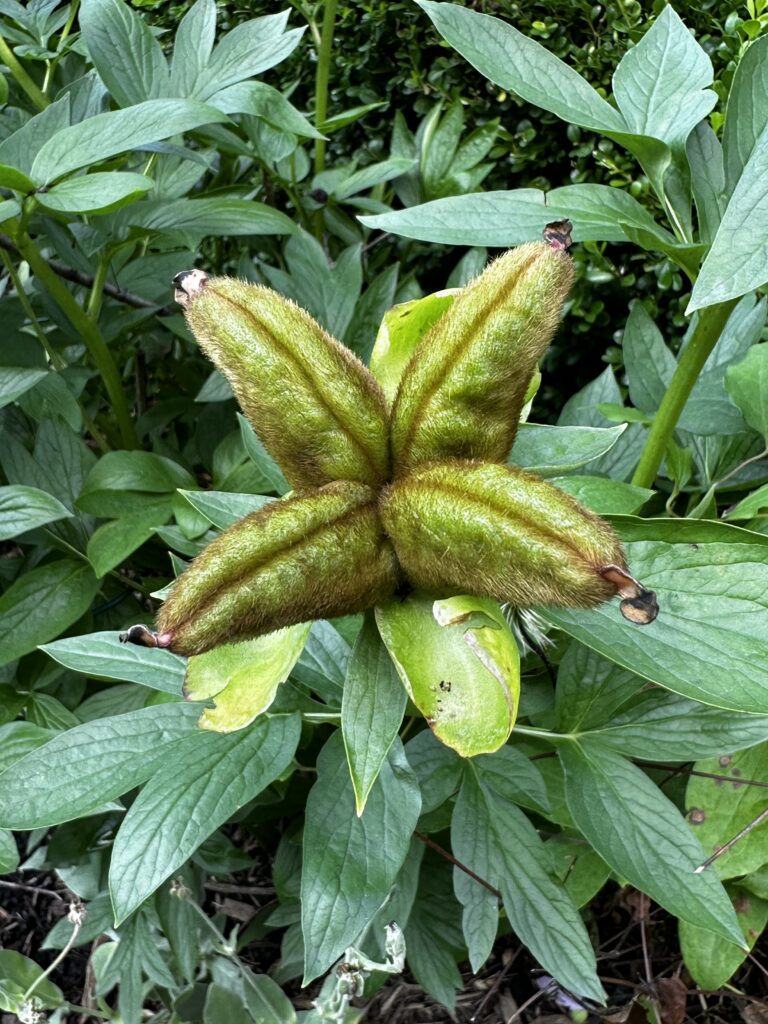

During mid spring through early summer, five distinct groups of peonies are the stars of my garden. They stimulate the senses with stunning blooms, exciting colors, and intoxicating fragrances. But only one species produces a show-stopping seed head in early fall!
WOODLAND PEONY
The parade begins in late April with Paeonia obovata, commonly referred to as the woodland peony. It is an understory, herbaceous plant which photosynthesizes by absorbing sunlight before the shading leaves emerge on the deciduous trees above it. As a result, these early season, shade loving peonies are the first to bloom. Delicate fragrant flowers rise above shrubby foliage growing just two feet tall. Woodland peonies are low maintenance, hardy in USDA zones 3 to 8, and will naturalize along the woodland’s edge.
If you do not deadhead the flowers, triangular pods develop over the summer and eventually split open. They reveal the shiny indigo fertile seeds alongside the contrasting bright scarlet infertile seeds. A true miracle of nature! Eventually the seeds will mature and fall to the ground. Keep in mind that peony seeds are slow to sprout and it may take two years to see visible seed leaf growth. You can recognize the seedlings by their pinkish-tinted leaves and stems. Be patient—seed-grown peonies take three to five years to produce blossoms.
I discovered that the woodland peonies are rare and nearly impossible to buy. My friend Gail was kind enough to send me a division from her peony and my friend Elissa sent me seeds. After several years of experimentation, I now nurture sixty-six woodland peonies throughout my garden. Most are just one to two years old, but several are flowering.
TREE PEONIES
The bloom sequence marches on with three classifications of tree peonies. P. suffruticosa is one of the largest groups with the most genetic diversity. It is highly fragrant with colors ranging from white to pink, magenta, and deep maroon.
Next are the Gansu tree peonies (AKA Rockii) which are a subgroup of the suffruticosa group. According to the Peony’s Envy Website these peonies are “distinguished by a purple flare at the center of each flower petal. Originally from the Gansu region of China, these plants are also referred to as Rockii peonies, as Joseph Rock helped make them famous outside of China. These plants are fast-growing for tree peonies, exceptionally hardy, and grow up to 7 feet tall. This group has thin billowy leaves that give a more informal appearance. They tend to cross-pollinate and produce wonderful seeds that can be grown into new cultivars.”
The yellow tree peonies, classified as the Lutea Hybrids, are the last tree peonies to bloom. “Sometimes referred to as Delavayi, this group is a Tibetan species that has a wide variety of yellows, bronzes, and oranges,” says Peony’s Envy.
Tree peonies have woody stems that persist above ground and develop buds for early flowering. They are unlike the herbaceous varieties that die back to the ground in winter. Tree peonies grow three to six feet tall with voluminous early blooms.
FERN LEAF PEONY
The peony parade continues with the fernleaf herbaceous peonies. These include P. tenuifolia, a species peony with dark red, single flowers with a double layer of cupped petals surrounding a cluster of canary yellow stamens. The feathery, dissected fern-like foliage creates a compact, mounded habit. It grows fifteen to twenty inches tall, blooms earlier than standard garden peonies and thrives in zones 3 to 8.
P. tenuifolia crossed with P. lactiflora produce hybrids with strong stems and vibrant blooms. P. ‘Merry Mayshine’ is a vigorous grower and increases rapidly. It is a reliable bloomer with single fragrant, crimson flowers. The stout clumps hold up well during inclement weather. The American Peony Society has recognized ‘Merry Mayshine’ with the Award of Landscape Merit.
Online sources include Peony’s Envy (peonysenvy.com) in New Jersey; Hollingsworth Peonies (hollingsworthpeonies.com) in Missouri; and Adelman Peony Gardens (peonyparadise.com) near Salem, Oregon.

WOODLAND PEONY
Paeonia obovata
Paeonia obovata subsp. japonica
• Prefers shade
• Fragrant 3” blooms
• White, soft pink, rosy pink or deep purple-red flowers
• 2′ tall
• Viable from seed
• Amazing seed pods in the fall
• Blooms from late April to second week in May

FERN LEAF PEONY
Paeonia tenuifolia
Paeonia tenuifolia x Paeonia lactiflora
• Prefers full sun
• Requires good drainage to avoid root rot
• Fragrant
• Red, dark red, crimson flowers
• 15 to 20″ tall
• Blooms from mid May to mid June

INTERSECTIONAL PEONY
Itoh Hybrids—Herbaceous x tree peonies
Paeonia lactiflora x Paeonia suffruticosa
• Massive fragrant blooms
• Unique colors including yellows, apricots, pastel pinks, vibrant reds, and rich purples
• Does not require staking
• Foliage lasts until autumn
• Remove seed heads. Seeds are not viable.
• 2 to 3′ tall
• Blooms from late May to mid June

TREE PEONY
Paeonia suffruticosa
• White, pink, magenta, and deep maroon blooms
• Extremely fragrant
• 3 to 5′ tall
• Blooms from late April to mid May
Paeonia suffruticosa Gansu & Rockii
• Purple splash on petals
• Fast growing
• Some as tall as 7′
• Blooms from late April to mid May
Paeonia suffruticosa lutea
• Yellow, bronze, orange, and gold flowers
• Needs shelter from strong winds
• Dislikes root disturbance
• 3 to 5′ tall
• Blooms from late April to mid May

HERBACEOUS PEONY
Paeonia lactiflora
• Hundreds of cultivars & hybrids
• Fragrant, large flowering
• Clump forming
• Slow growing
• Long-lived
• Needs support
• 2 to 3′ tall
• Blooms from mid May to mid June
Paeonia lactiflora x Paeonia officinalis
• Deep red, soft peach, coral, apricot, and magenta blooms
• 24 to 32″ tall
• Blooms from mid May to mid June
CLASSIC HERBACEOUS PEONIES
The quintessential peonies, the Lactiflora group or Chinese peonies, are the old-fashioned, fragrant, large flowering species. They are clump-forming with perfumed flowers that bloom in late spring and early summer. Chinese peonies are slow-growing and may take up to three years to bloom, but they are long lived and may survive 100 years or more. Use stakes and twine or metal peony supports to prevent stems from flopping over after heavy spring rains. I purchased some heavy duty wrought iron supports at arusticgarden.com.
Since Chinese peonies have a long history of cultivation there are many hundreds of cultivars as well as hybrids. P. lactiflora ‘Bowl of Beauty’ is a fragrant, award-winning, early bloomer with bicolored pink flowers with frilly yellow centers. P. lactiflora ‘Green Lotus’, introduced in 1995, features pale, lime-green petals with soft pink edges. Its cactus dahlia-shaped blooms look exotic. Breck’s (brecks.com) offers many bare root peonies including ‘Green Lotus’.
True red herbaceous peonies include the officinalis hybrids. They bring intense, brilliant colors into the garden, including deep red, soft peach, coral, apricot and magenta. Many hybrids are robust and self supporting since they inherited strong stems that can handle wind and rain much better than the traditional heirloom peonies. P. lactiflora x P. officinalis ‘Red Charm’ was introduced in 1944 and is thought to be one of the best red cut flowers. Picture a lovely vase of the legendary ‘Red Charm’ on your kitchen table in June.
ITOH PEONIES
Last but not least are the intersectional peonies also referred to as the Itoh peonies. Toichi Itoh made the first successful cross between an herbaceous peony and a tree peony in 1948 thus producing the intersectional peonies. They extend the flowering season alongside herbaceous peonies providing the much cherished yellow color that is rare in herbaceous peonies and foliage that lasts until autumn. Their massive blooms sit atop sturdy stems that never need staking. The buds do not open all at once, giving way to two or three flushes of blooms over a two to three week period.
‘Bartzella’ was my first Itoh peony and is my absolute favorite. The plants are vigorous with lemon-yellow blooms highlighted in the center by a hint of red. I enjoy the spicy-sweet fragrance for three to four weeks depending on the weather conditions.
Fall is the recommended time for dividing, transplanting, and planting bare root peonies. Keep in mind that the woodland peonies and pot grown herbaceous peonies can be planted in spring as well. They thrive in nutrient rich soil with good drainage. Bury each peony eye no deeper than 2″ below the soil line. Plants may not flower or fail to produce growth in the spring if the roots are buried too deep.
When I visited Sara’s Garden Center (sarasgardencenter.com) in July, potted Itoh peonies included ‘Old Rose Dandy’, ‘Lollipop’, ‘Julia Rose’ and ‘Court Jester’. For pots or small gardens, try P. lactiflora ‘Rome’, a patio peony growing just 2′ tall with 5″ blooms and hardy to zone 3! Several ‘Plena’ fernleaf peonies were waiting for a good home as well as P. suffruticosa ‘Shimadaijin’, a highly coveted purple flowered Japanese tree peony.
Palmiters Garden Nursery in Avon, New York (palmitersgardennursery.com) has been growing peonies for more than thirty-five years. A visit to their garden in May/June to see established mature plants is a must for peony lovers. The family does a gentle close in the fall, reducing their hours in September and October. A quick call is advised if you want to add to your collection with a fall planting.
Your garden can bloom from early spring to summer with enchanting, vibrant, fragrant flowers. Cooler weather will prolong the blooms, while hotter weather shortens the bloom time. The finale of the peony season ends with the striking seed heads of the woodland peony. What peonies will you plant to extend your season? To learn even more about peonies visit peonysenvy.com.
Colleen O’Neill Nice is a horticulturalist who is passionate about plant propagation and enjoys nurturing her garden in Clarence, New York.
This article originally appeared in the September/October 2026 issue of Upstate Gardeners’ Journal.
Views: 46