



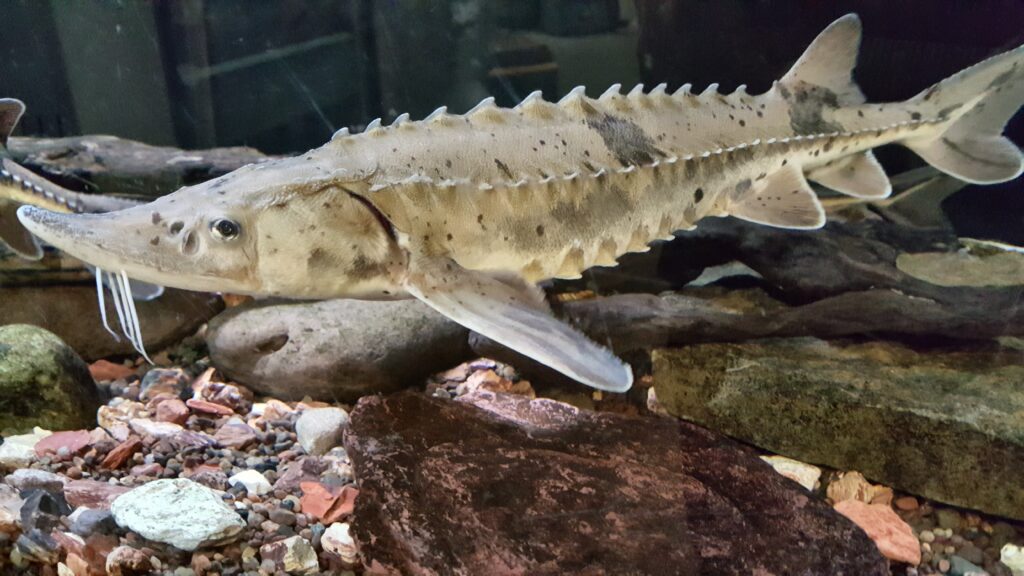
Did you know that there is a fish as old as the dinosaurs swimming in the Genesee River? The lake sturgeon, sometimes called the rock sturgeon, is the oldest and largest species of fish in the Great Lakes. These fish are so old that they are sometimes called “swimming fossils.” With their long bodies, hard bony plates, and whisker-like barbels, the lake sturgeon looks very different from most fish you see today.
Although the sturgeon has lived in the Great Lakes for thousands of years, they have almost disappeared from nearby waters because of pollution and overfishing. Today, scientists and the Seneca Park Zoo are working to bring this prehistoric fish back to the Genesee River and Lake Ontario.

WHAT IS A LAKE STURGEON?
If you saw a lake sturgeon swimming in the Genesee River, you might think you were looking at a dinosaur…and you would be right! Lake sturgeon are very different from most fish. Instead of scales, these fish have long bony plates called scutes, which act like protective armor. The lake sturgeon is a North American freshwater fish, and just like all twenty-seven species of sturgeon, these fish are bottom feeders. Instead of teeth, these benthic feeders use a soft, suction-tube-like mouth to vacuum food off the lakebed.
Near the front of their mouth and at the bottom of their snout, the lake sturgeon use four sensitive, whisker-like organs called barbels to help them detect food along the murky, rocky bottoms of rivers and lakes. Since they are bottom feeders, sturgeon spend most of their time looking for snails, crayfish, worms, and larvae.

THE DINOSAUR FISH
The lake sturgeon are often called the “Dinosaurs of the Great Lakes” because their ancestors first developed more than 200 million years ago. Sturgeon have remained unchanged for almost 100 million years, which is why scientists call them living fossils!
Lake sturgeon are considered one of the longest-living and largest freshwater fish in North America. They can live to be 150 years old, often reaching lengths of seven to nine feet and weighing up to 300 pounds! They have inhabited the Great Lakes for more than 10,000 years, but they grow very slowly. This slow rate of growth it has made it very difficult for the species to recover from a shrinking population.
FROM COMMON TO RARE
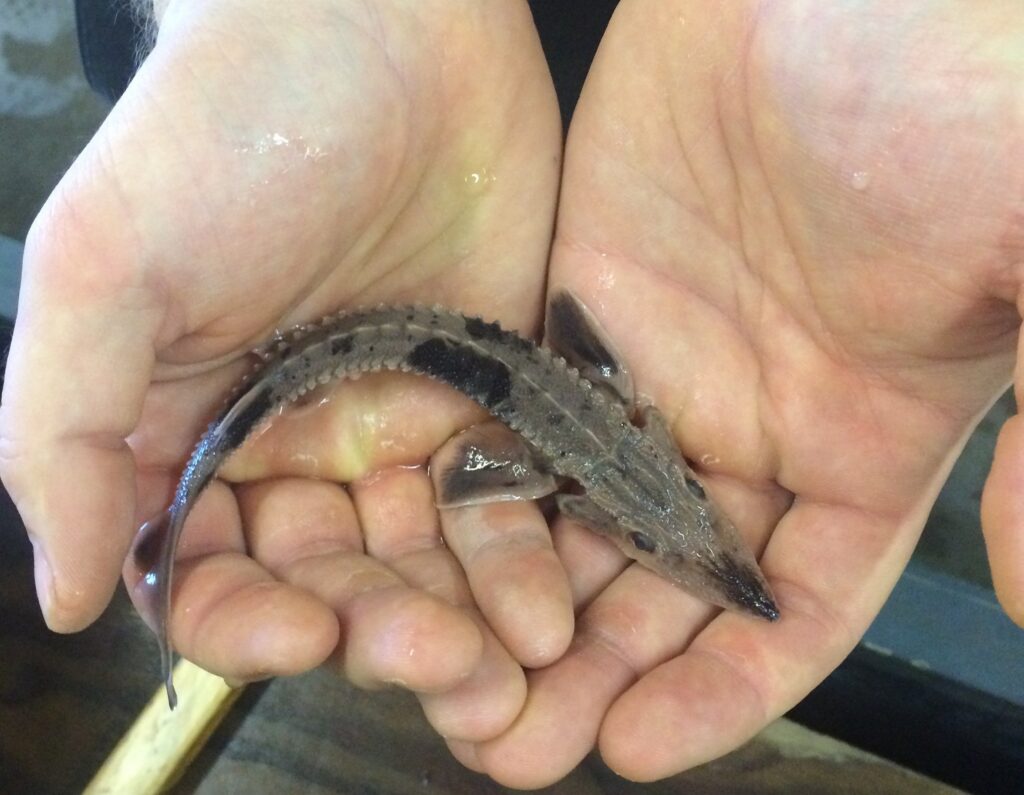
Once a fish that was so common that it was caught and thrown back by fishermen, the lake sturgeon has become a vulnerable species in the Great Lakes. Both overfishing and pollution mean there are fewer lake sturgeon than there used to be. Scientists introduced 1,900 lake sturgeon into the Genesee River between 2003 and 2004. This was the kickstart to annual releases, where roughly 1,000 lake sturgeon were released into the Genesee annually until 2021, when the first spawning female was found. This spawning female was identified to be one of the juveniles released at the start of the restoration project.
The Seneca Park Zoo is a leading organization in the effort to help restore lake sturgeon populations. Scientists that work with the zoo have participated in attempts to increase the lake sturgeon population and zoo programs have helped spread awareness of the danger the lake sturgeon is in. Isn’t it great the Seneca Park Zoo is helping protect these unusual and important fish?
GLOSSARY
A scute is a special type of tough scale found on sturgeon that protects them from harm, like how armor can protect a knight!
A benthic feeder, or bottom feeder, is an animal that lives and feeds at the lowest level of a body of water, the benthic zone, and mainly eats other animals found in the benthic zone.
A barbel is a short whisker-like organ found on Sturgeon that they use to detect food. Barbels help fish understand their surroundings, like your eyes and nose do for you!
This article originally appeared in the Spring 2026 issue of (585) Kids.
Views: 27