




There’s a raw honesty to a farm-to-table restaurant in January.
For nearly two decades, chef Art Rogers has transformed the bounty of our region into something extraordinary. His restaurant Lento, tucked in the Village Gate Square, has become the unofficial embassy of the Finger Lakes agricultural scene.
The menu reads like a roll call of farming’s local celebrities—duck from the guys you’ve definitely seen at the Public Market (Fisher Hill Farm), cheddar from a creamery running on solar power (5 Spoke), and pork from one of the most beautiful pastures in the Finger Lakes (Bedient Farms). Rogers switches things up frequently because he’s obsessively tracking what’s popping out of the ground within a fifty-mile radius. This careful curation has earned him both a local following and a James Beard nomination—the culinary equivalent of an Oscar.
But winter poses a unique test.
As summer’s vibrant tomatoes and green beans surrender to the inevitable frost, Rogers doesn’t retreat into imported produce purgatory. Instead, he doubles down on Brussels sprouts, squash,and all those veggies your grandparents might have stored in a cellar. It’s during these brutal months that Rogers performs his most impressive magic trick: making you crave what’s actually growing (or stubbornly surviving) in the frosty landscape outside.
“It’s definitely a lot more muted produce flavors,” Rogers says. “With climate change, unfortunately, there actually is more stuff available because we’re having milder winters. Things like greens and Brussels sprouts. They can leave those out in the field longer because it doesn’t get so brutally cold like it used to.”
Rogers shifts to root vegetables, storage crops, and hearty proteins “when it’s not bathing suit season,” he laughs. There’s no single trick to making dishes this time of year exciting. In fact, he’s quite practical. Simply get a sharp knife, learn to use it, get a little creative, and maybe stop expecting your February dinner to look like a summer garden party.
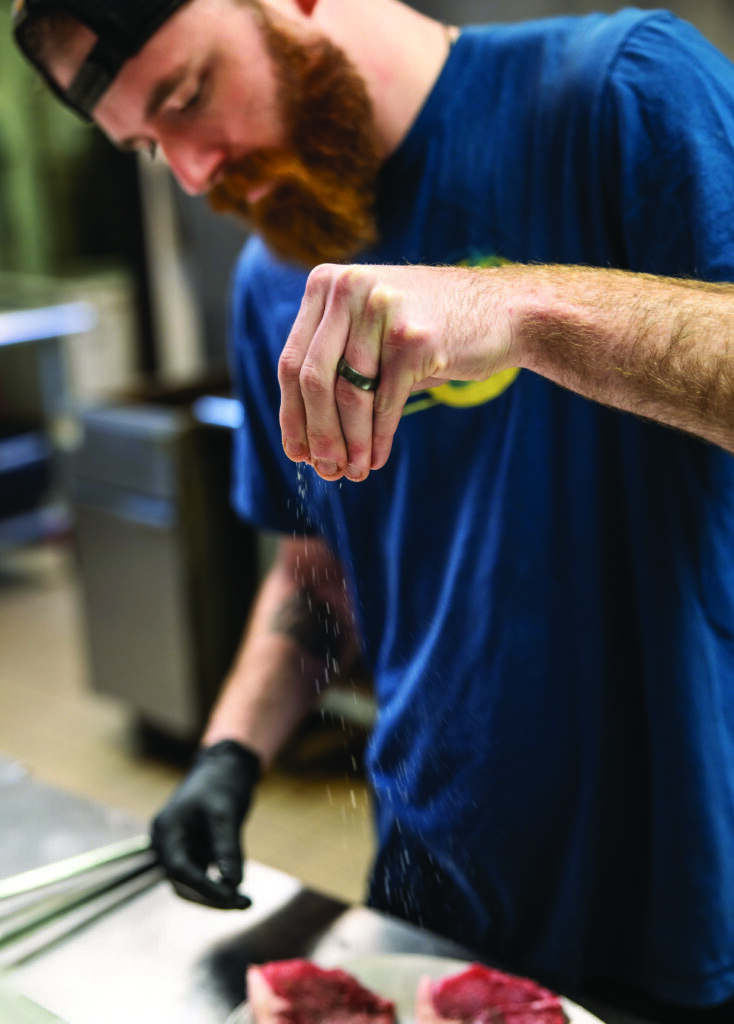

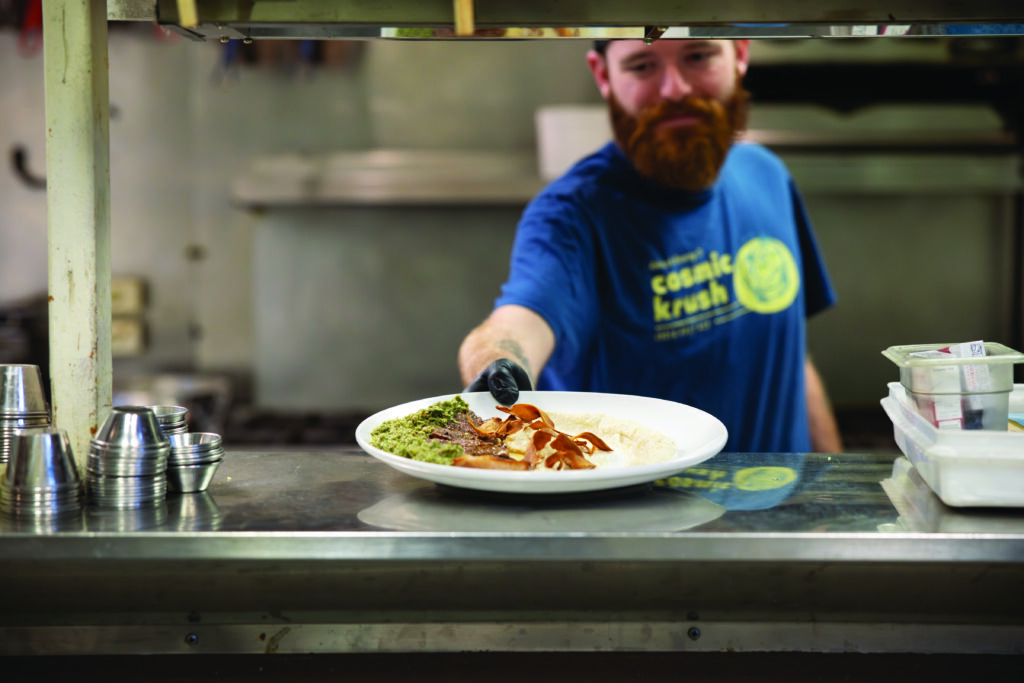

These are his five tips for cooking like a farm-to-table chef in winter.
1. Start with quality, local ingredients “Make the effort,” Rogers says. He recommends visiting the Brighton and Rochester public markets or checking online for local farms that offer drop-offs or deliveries, such as Bedient Farms in Middlesex. “Yes, it requires more effort than just going to Wegman’s, and I understand the convenience factor,” he says. “But my advice is to take some time to look at your food, smell it, and talk to the farmer. That’s the best approach if you have the luxury of time.”
2. Prioritize fresh herbs Skip the sad viles from the grocery store and grab something that was recently alive. Otherwise, he says, “You’re wasting your money.” If you’re heading to a farmers’ market and looking for something fresh to incorporate, herbs are a good place to start. Rogers keeps a small herb sanctuary on his windowsill at home, featuring sprigs of rosemary and basil to elevate his meals. “A little bit goes a long way, especially for family cooking,” he says. Perhaps, unsurprisingly, he’s also converting the yard of his little city house into an urban farm.
3. Use the right fat for the job In Rogers’s kitchen, every fat has its specific purpose. For high-heat cooking and searing, he reaches for neutral, all-purpose oils like soybean or vegetable oil. “There are a million different ones, and I’m not opposed to any of them,” Rogers explains. Quality matters most where you’ll actually taste the fat. Rogers saves his extra-virgin olive oil exclusively for finishing dishes or bread dipping, where its flavor can truly shine. His approach to butter reveals the practical side of his cooking philosophy. At home, he uses standard supermarket butter for everyday cooking. At Lento, however, he occasionally upgrades to Plugra—a European-style butter with higher fat content—when its richer flavor will make a noticeable difference in a dish.
4. Sharpen your knives “There might be future Michelin star chefs out there who don’t even know it yet, until someone teaches them how to use a knife properly,” Rogers says. Everyone’s got that dull kitchen knife that can’t cut through anything. He believes fixing this culinary crime should be your first priority. “That’s the most important tool you need,” he says. From there, focus on improving your knife skills to do your ingredients justice.
5. Learn how to (really) cook “Winter is a great time to develop cooking skills if you’re just starting out,” Rogers says, clearly unaware that now is the time many of us develop a relationship with DoorDash and our couch. According to this chef, if you already know how to cook, “you’re a step above the game” because you can shop and eat better, rather than relying on premade products. The good news is you don’t need an expensive culinary degree to elevate your skills. Regardless if you’re a beginner or an industry professional, Rogers recommends exploring YouTube. Try typing “how to make X,” watch a few videos, and figure out what all the tutorials have in common. Recently, he’s been tackling chicharrón, a gloriously crispy pork belly dish popular in Latin America. “I have a million cookbooks but couldn’t figure it out from reading alone,” he confesses. “Then I watched a few videos, and it made sense immediately.”
Lento
274 Goodman St. N.
271-3470

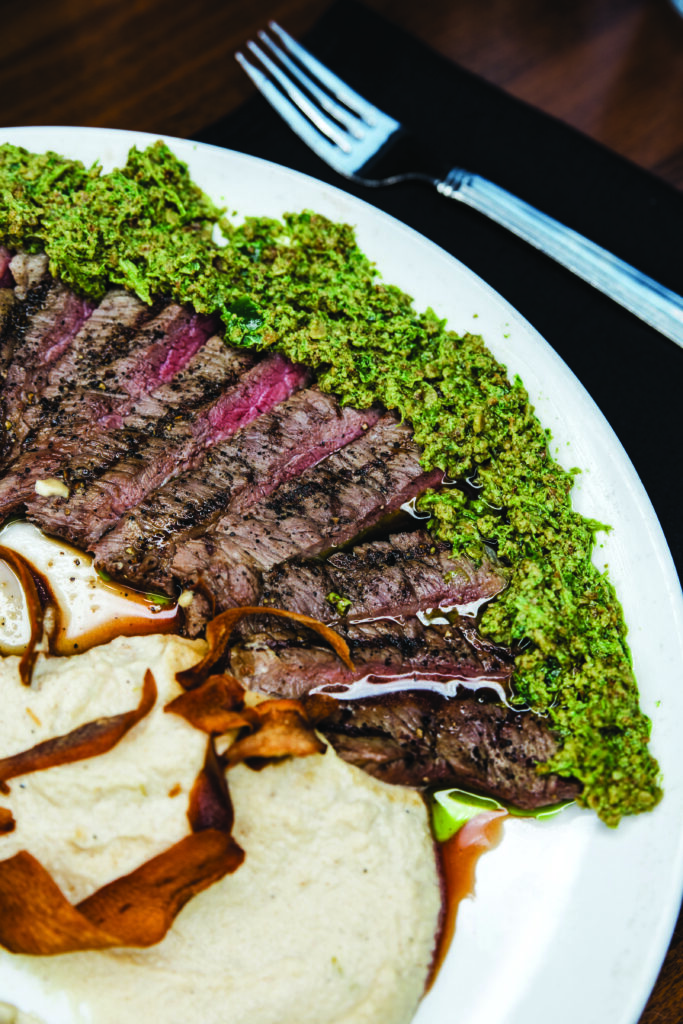
Grilled skirt steak, cauliflower purée, and pepita chimichurri
By Art Rogers
INGREDIENTS
• 1 head cauliflower, roughly chopped
• 2 cups milk, or enough to cover
• 1 bunch parsley, washed
• 1/2 bunch cilantro, washed
• 1 cup toasted pepitas
• 1 jalapeno or a spicier pepper (or no pepper, depending on your taste for spiciness)
• 2 tablespoons chopped garlic
• 1/3 cup red wine vinegar, plus a little more
• A drizzle of extra virgin olive oil
• 2 pounds skirt steak, preferably grass-fed from a small local farm, seasoned with salt and pepper)
DIRECTIONS
• Simmer the cauliflower in salted milk for 5–7 minutes, or until it is al dente. Purée the cauliflower in a food processor, using only as much salted milk as necessary to achieve a smooth consistency. (There will probably be liquid left over.) If you want to be fancy, push the mixture through a fine-mesh sieve. Salt and pepper to taste.
• For the chimichurri, purée parsley, cilantro, pepitas, jalapeno, and chopped garlic in a food processor with red wine vinegar. Drizzle in extra-virgin olive oil until it reaches a pesto-like consistency. Add more vinegar and salt to adjust the flavor to your taste.
• For the steak, cook it over high heat on a grill or in a pan for about 6 to 8 minutes, flipping it on both sides, for medium-rare. Let it rest for 10 minutes, then slice.
• Spoon the chimichurri over the sliced skirt steak and serve alongside cauliflower purée.
• Serves 8
This article originally appeared in the January/February 2026 issue of (585).
Views: 49