



One common question I receive is how to keep “bully” birds out of feeders and birdhouses. What makes a bird a “bully” tends to be in the eye of the beholder, but usually people are talking about Starlings, Grackles, and House Sparrows. While nothing is 100 percent, there are some things that can be done to discourage these birds from taking up residence in your yard.
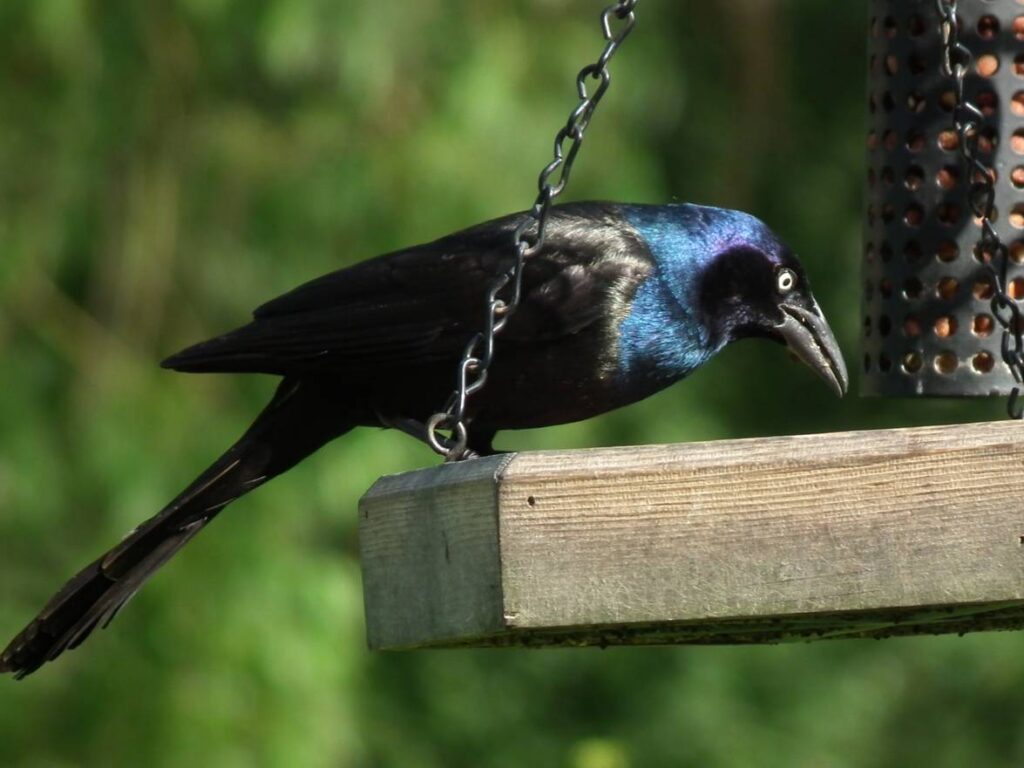
Some of the first migrants that come back to the area in the spring are the Blackbirds. Both Red-winged Blackbirds and Grackles arrive in large flocks. As they move in, these large flocks can be seen in trees where the birds will make screeching and rattling calls. Grackles can become a nuisance in yards and feeders, because they can be aggressive and ravenous. Starlings, although not technically a Blackbird, but in the Mynah family, often get grouped into this “Blackbird” category .
Blackbirds all come to bird feeders hungry after their migration and some will visit feeders all summer long. Although the large flocks tend to dissipate when the birds start to pair up to mate, Blackbirds will frequent feeders throughout the summer. Blackbirds will eat sunflower seed, peanuts, corn, and most blends of seed. If you want to avoid having Grackles at your feeders, switch your sunflower seed or seed mix to safflower. Safflower is a seed that is about the same size as sunflower seed, but it is white in color and has a bitter taste. Blackbirds do not like the taste of this seed and they will avoid it. What is even better, is squirrels don’t like it either! Safflower seed will attract Cardinals, House Finches, Chickadees, Downy Woodpeckers, Grosbeaks, and more, so you will still have a good diversity of birds coming. Nyjer seed is another type of seed that doesn’t normally attract Blackbirds. Nyjer seed is very fine and goes into a special Finch feeder which has small feeding portals. These holes are too small for a Blackbird to reach inside with their beak, but smaller birds like Goldfinches can feed from it easily.
Wide open trays and tube feeders with large perches are great for attracting a diversity of birds, but this includes Blackbirds. Feeders with small perches or cages around them, however, can keep Blackbirds away. Small perches of about an inch long or shorter are not usually big enough for the Blackbird to land on. Feeders with cages around them will keep out all large birds and squirrels, but will allow for small birds like Chickadees, Finches, and Downy Woodpeckers to fit inside and feed. If you want to keep Blackbirds off your suet, consider getting an “upside down” suet feeder. These suet feeders have a roof over the top of them, so birds have to hang upside down to get the food from the feeder. Woodpeckers, Nuthatches, and Chickadees can all do this easily, but Blackbirds cannot!
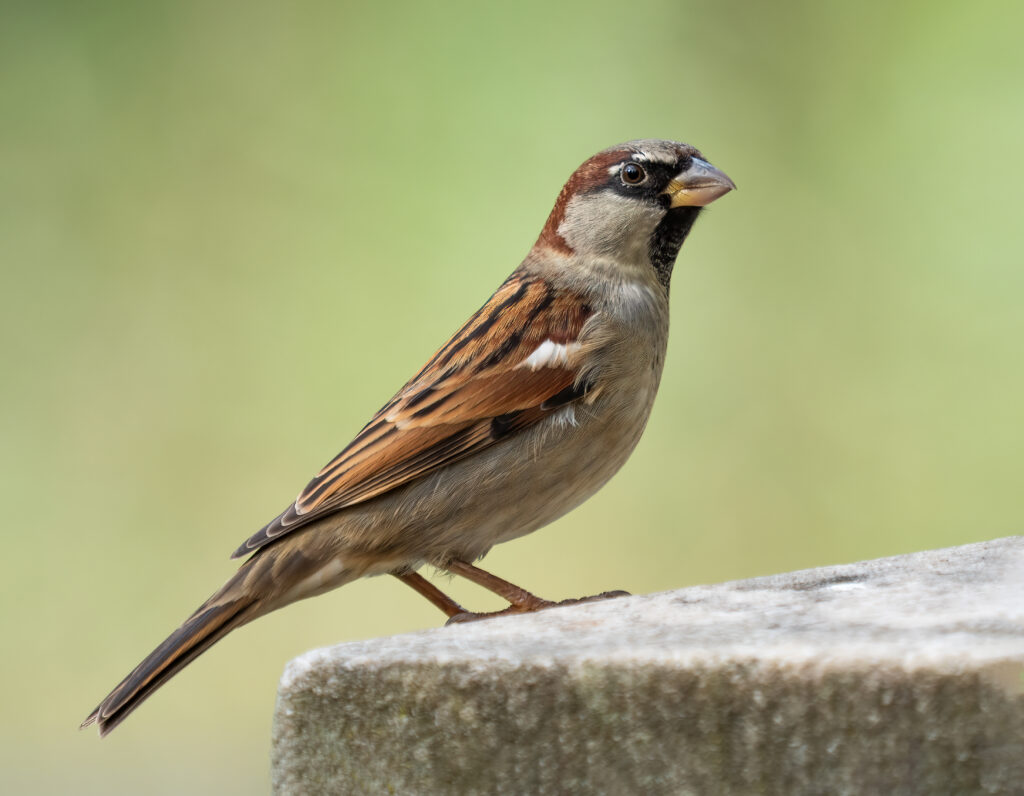
Another bird that can be considered a “bully” is the House Sparrow. House Sparrows are an introduced species that are often found in backyards at feeders and birdhouses. Putting out safflower seed will help keep the number of House Sparrows down just like it will Blackbirds. Some will still eat it, but it should reduce the overall number of Sparrows at your feeders.
The biggest nuisance House Sparrows pose is outcompeting native species for nesting cavities.
House Sparrows will nest in tree cavities as well as birdhouses. They have a bad reputation for disturbing Bluebirds who are nesting in houses by destroying their eggs or even attacking the birds themselves. Keeping Sparrows out of birdhouses can be tricky. Bluebirds need a nesting cavity that is 1.5” in diameter in order to fit inside. This size is large enough that Sparrows can easily fit inside of it too. Adding a “bird guardian” tunnel to the outside of the house can sometimes help. These tubular extensions are screwed to the outside of the house, making the entrance hole more of a long tunnel. These are designed to keep predators like raccoons from reaching inside the house to raid the eggs, but they can also help keep Sparrows out. There are also “Sparrow resistant” houses that have a small, confined nesting cavity and a rectangular entrance hole that the Bluebirds will use but the Sparrows don’t prefer. While not 100%, these houses aren’t preferable to Sparrows, so they may decide to go elsewhere. Another way to keep Sparrows out of houses, is to install a Sparrow spooker to the top of the house. Spookers must be installed after the bird you wish to attract, for example a Bluebird, have established themselves in the nesting cavity and laid an egg. Once they have laid an egg, the spooker, which is made of shiny reflective material, is attached to the top of the house. Birds don’t like shiny objects and it will keep others away while the established bird will keep coming to tend to its nest. Adding additional birdhouses to your landscape can also help alleviate some of the nest site competition, offering real estate for more birds at once.
If you aren’t picky about the birds you attract to your birdhouse, you can also add a metal plate called a portal to the opening of the house to keep Sparrows out. Portals are meant to keep the opening of a bird house a specific size, so squirrels or woodpeckers can’t work at the hole to make it larger. Portals with an opening of 1.13 inch or smaller are meant for Chickadees or Wrens and are too small for Sparrows to fit inside.
While there isn’t a single solution for keeping “bully” birds out of your yard, using these strategies can help create a more welcoming environment for other bird species and encourage the more aggressive birds to move along.
Liz Magnanti is co-owner of the Bird House in Brighton.
This article originally appeared in the July/August 2026 issue of Upstate Gardeners’ Journal.
Views: 53