





It’s midspring, and I am once again waking up to birdsong in the morning, welcoming the dancing daffodils along the hillside garden, and I eagerly await the night song chorus of peepers from the lower pond and farm field ditch. But if I were to pick the one thing that makes me giddy with anticipation this time of year, it is the blooming of spring ephemeral flowers.
The word ephemeral means “lasting a very short time,” and indeed, to catch the bloom time of these flowers, you must be able to pick up the signs, clear your schedule, and dash to their choice location of growth, or you will miss them entirely. For years I had my special spots, state forests for the most part; and though I diligently tracked the timing, alas, sometimes I could not get away to walk the woods in time. How fortunate I am, today, that the woods of our farm contain a delectable array of ephemerals, with one or two that I had never found before in all my visits to my special public lands.
If you want to dive deep into finding ephemerals, you should plan on visiting the same location several times over a period of a few weeks, as they don’t all come at once. I can remember my first spring on the farm. I was delighted to find mayapples and trillium, two of the more well-known ephemeral flowers. These two also tend to last a bit longer and can often be found in conspicuous drifts. But it wasn’t until I lived on the farm, and took daily walks, that I began to discover just how many of these springtime beauties were tucked among the fallen leaves of the woodland floor. I am not going to get into the nitty gritty of the science, but these all bloom at different times, for different lengths, with their own unique set of habitat characteristics.
Now, I invite you on a walk through my forty acre woodland, where we will discover the magic of the ephemeral flower. Let us imagine, for the sake of maximum bloom sharing, that our encounters are all combined into one literary walk together today. The sky is clear, and, as is the timing of ephemerals, the sun shines through the budding trees before leaf-out. The easiest access to the woods is a few feet from my favorite reading window, where I look out each day to observe the beauty of nature and the antics of my goats, of course. I hope you don’t mind, but we will most likely be accompanied by a cat or two, and my goat Gertie, who is very respectful of the ephemerals. To my delight, she prefers to munch on the invasive barberry that I really must get to eradicating. But today, we search for flowers.
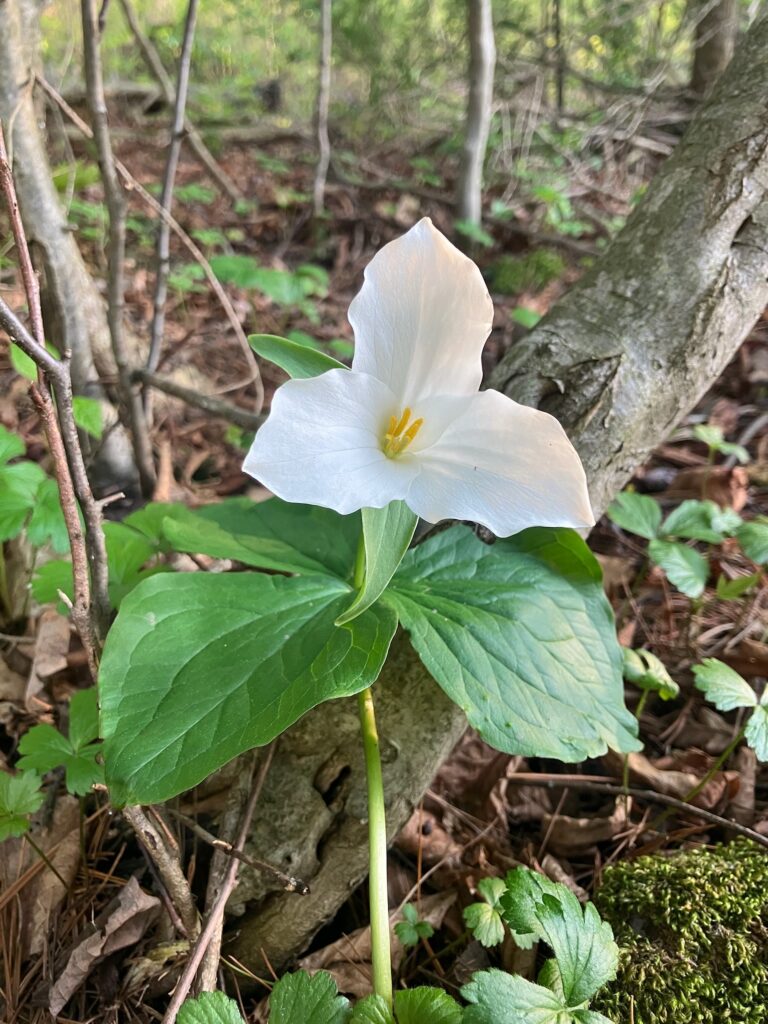
We begin our walk at the base of a north facing hill, just inside the tree line. It is quite steep, but well worth the exertion of climbing. As we enter what is primarily deciduous woods—think red oaks, hophornbeams, red and sugar maples, for the most part, with a smattering of white pines—I spot a fleshy dark green stalk near a downed tree, with three pointed leaves evenly spaced around it in a whorl. Rising above the whorl, a white, three-petaled flower nods, its three green sepals a sharp contrast between each petal. A few paces beyond is the same flower, a bit more open, this one facing upwards, revealing golden stamens and pistils in its throat. Trillium grandiflorum (great white trillium), which, I’m sure your botanical use of Latin can deduce is named for having plant parts in groups of three, is an eye-catching ephemeral, and can often be seen from quite a distance when in bloom. I’ll caution you though, as much as we love to bring blooms back to enjoy, that trillium is, in many areas, a protected species. Additionally, because each plant only sends one bloom up for a short time, picking it can set back the plant several years to gain the energy to bloom again, if ever. So we take in the beauty with our eyes only.
As we walk, take note of bits of green, these are often later blooming ephemerals, or the foliage of the late summer asters, which we will enjoy discovering in a few months’ time. Towards the top of the slope, I pause beneath a sizable Red Maple; here is a spot I haunt often for an ephemeral I had never encountered before. Little rosettes of shiny leaves grow between patches of moss, and at their center, deep pink blooms in the most peculiar shape- best described by their common name I think, Gaywings. Polygala paucifolia (Fringed polygala) is a delightful, and very brief blooming ephemeral flower, and this particular spot boasts at least two dozen blooms at once, with a tapering of one to two a day after their peak bloom.


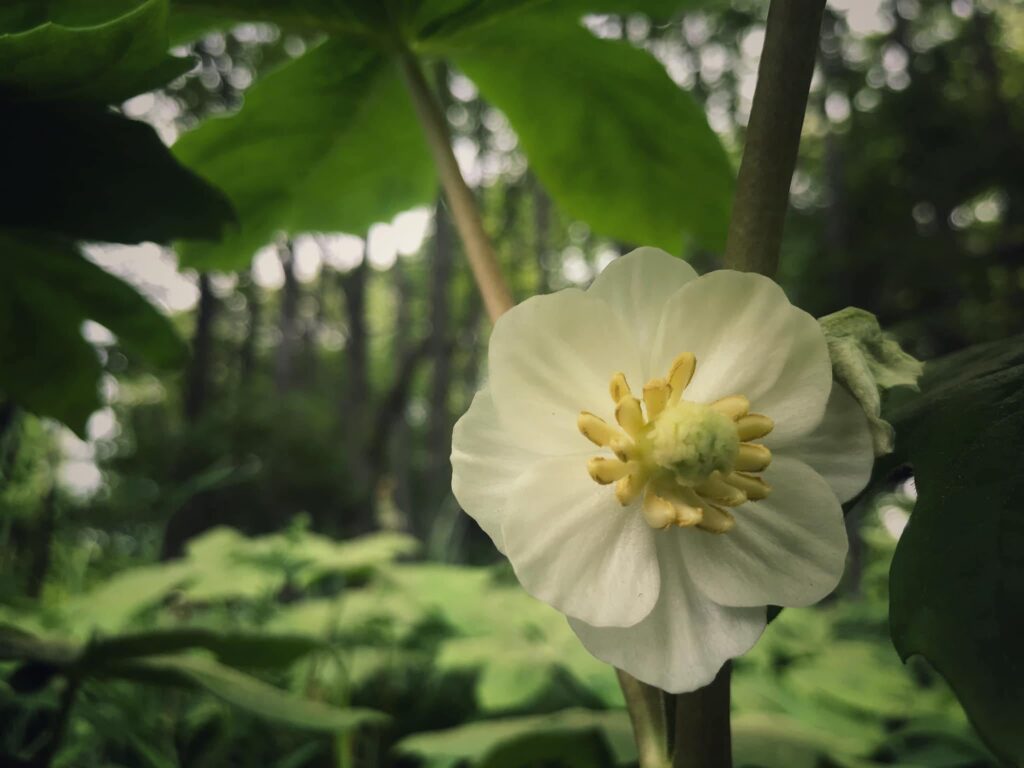
At the top of the hill the woods flatten out for the most part, and we turn east to walk along an old logging trail, venturing deeper into the woods. Here the woods change slightly to incorporate eastern hemlocks, and the ground is a bit more wet. It is in these woods I have encountered several large colonies of mayapples (Podophyllum peltatum), a mass of lime green mobbed together with their umbrella-like leaves. Most ephemerals are best enjoyed by getting down to their level, and mayapple is a prime example. To even see their flower, we must get down on our hands and knees, for the flower appears on the stem under the leaf, and resembles a delicate apple blossom.
A side perk to these ephemeral walks is seeing the woods wake up in other ways: fiddleheads of ferns, tree buds and blossoms, and then the parts of nature past, like fallen oak galls and seedheads that persist through winter. As a steward of the woods, I am also hypervigilant of any invasive species that exist or that have crept in since I last walked. Invasives often sprout or leaf out before most native plants, making early spring the best time to be aware of these plant invaders.
The flat area of the woods extends along a field that we primarily plant to corn, and I enjoy walking the edges between woods and field to see what grows in the in between. One spring when my husband was plowing, he pointed out a purple colored mass on the edge of the field. To my delight it was a clump of violets, of which the farm has several different species. This one I had never seen before, however. Viola rostrada or long-spurred violet is a lavender flower with a darker purple– lined throat that extends back into a long nectar spur.
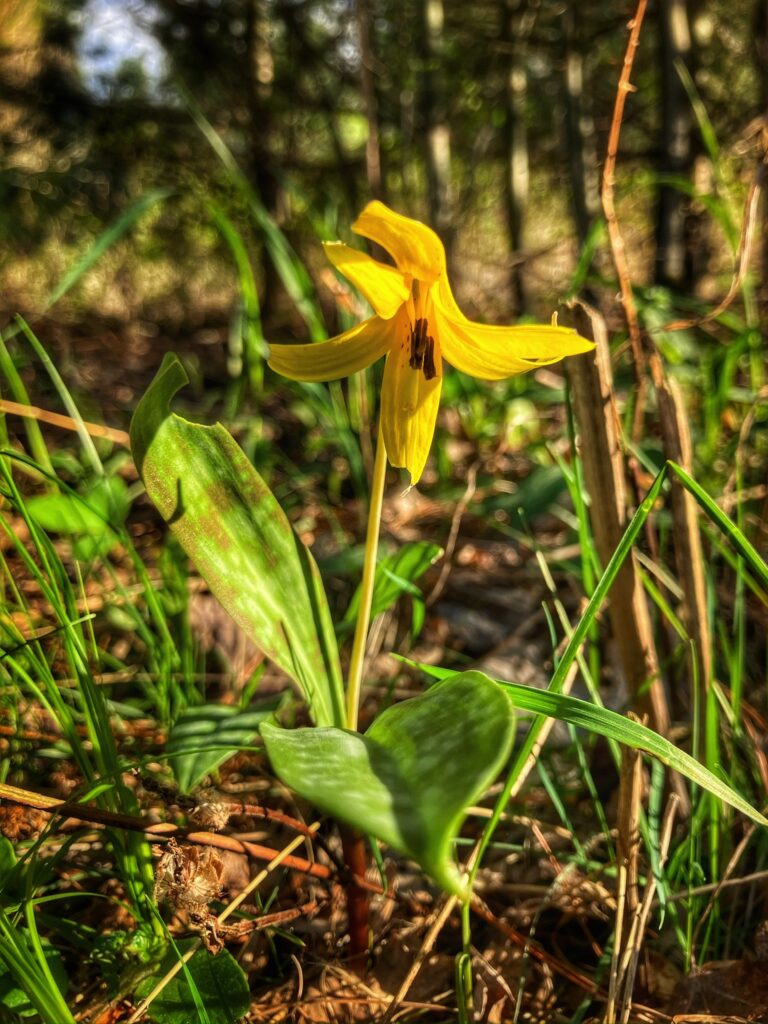
As we loop back through the woods to descend towards home, there is one last flower I wish to show you. Exiting the woods you see it first, a mass of yellow trout lilies in the grassy flat. When we first moved to the farm, this area was thick with brambles, and we cut them back that fall in anticipation of building our home there. The next spring, however, the cleared land showed a mass of blooming trout lily (Erythronium americanum). Of course, the location of the house was shifted for this botanical treasure. The leaves of the trout lily are a most conspicuous speckled pattern, and I see them all over the farm. But to produce a bloom, the plant must have two leaves, and this can take up to seven years, as well as specific site conditions.
Ah, what a joy a morning of bloom discovery can be, and today was no exception! Surely we missed a bloom or three, and I’ll challenge you to look closely next time at what might seem to be just leaves in a waking woods. For the fleeting beauty of ephemeral flowers are for the observant eye, and the plant lover who enjoys lingering among the trees.
Bonnie Warriner is a horticulturalist and budding flower farmer with a love for capturing beauty in pictures and words. You can find her among the wildflowers and goats on her family’s 150 acre farm in Jasper, New York.
This article originally appeared in the March/April 2026 issue of Upstate Gardeners’ Journal.
Views: 19