




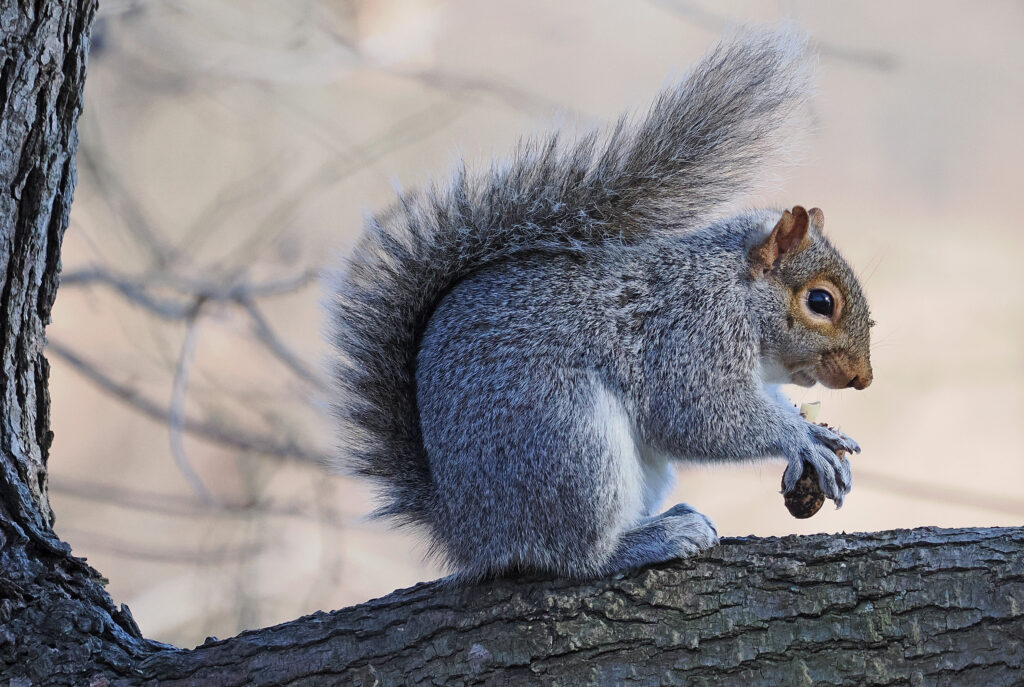
Often this article is about birds and how to attract them. However, if you’ve ever tried attracting birds by feeding them, you’ve probably had experiences with another creature that visits bird feeders—squirrels! Squirrels are one of the most common and entertaining animals found in the area. They are extremely acrobatic, can be found in a variety of habitats, and have continuously growing incisors (which grow about six inches per year) that require them to have to consistently nibble and chew on things. Between their relentless hunt for food and range of habitats you’ve probably had at least one experience with a squirrel.
There are several squirrel species that can be found in New York. Red Squirrels are often found in pine forests but are also becoming increasingly common in backyards. These squirrels are smaller than the very common gray squirrel and have reddish fur and a white ring around their eye. They eat a lot of conifer cones and also like nuts, seeds, and fungi. These small squirrels are very vocal, and it is not uncommon to hear a chorus of their chatter as you walk through coniferous forests.
The Eastern Chipmunk is a small, active ground squirrel who creates elaborate burrows underground. These burrows can be up to thirty feet long and contain multiple chambers and escape hatches. They will have chambers for sleeping, food storage, and waste. Chipmunks feed on seeds, nuts, insects, fruit, and even bird eggs. During the winter, chipmunks go into a state of torpor where their body temperature drops, their heart slows, and they only wake up periodically to eat from the food they have stored away. Because their food is cached underground, you will rarely see a chipmunk above ground during the winter.
You may also have a very large ground squirrel, the groundhog, or woodchuck, visiting your yard—yes, groundhogs are in the squirrel family. They feed on herbaceous plants like grass, clover, dandelion, and sometimes our garden plants. Although usually seen on the ground, woodchucks can climb trees and swim quite well! Woodchucks are considered “true hibernators.” They will go to sleep for about three months of the year. During this time, their heart rate drops to about four to five beats per minute and they only take about two breaths per minute. Like the chipmunk, they also build elaborate underground tunnels. Their tunnels can be twenty feet long or more and have chambers for waste, raising young, and sleeping.
Not all squirrel species are diurnal, or active during the day. Flying squirrels will visit backyards at night, foraging for lichens, fungi, seeds, nuts, insects, and more. New York has two species of flying squirrel—the Northern and the Southern Flying Squirrel. They don’t truly fly like a bat but use the large furry membrane of skin that stretches from their wrist to their ankle to glide from tree to tree. They also have very large, dark eyes which help them see in the dark. Listen for their chatter in your trees at night. Like gray squirrels, flying squirrels can cling to bird feeders and will readily eat from them. During the day, flying squirrels will live in tree cavities, large nest boxes, and other secluded spaces that provide cover and shelter.
Gray squirrels are the mammal most seen in the Eastern United States and can be found in habitats ranging from forests to backyards and city parks. They feed on acorns, nuts, seeds, flowers, fungi, bark, and more. Gray squirrels also have well-known and sometimes common color morphs, some being all black or all white. Gray squirrels are also very vocal and will chatter and flick their tails as a form of communication.
Gray squirrels are often found in backyards and their aerial acrobatics are second to none. They can jump five feet straight up, seven feet across from one thing to another, and nine feet down from something high to low. Their long bushy tails act as a parachute, allowing them to leap from a great height to something below while avoiding injury. Because of this, they can usually get to a backyard feeder if it’s not defended properly. But squirrels can be fun to feed, too. They will eat corn, peanuts, and sunflower seeds, among other things. Sometimes leaving food out for the squirrels will distract them from bird feeders. Squirrel feeders can be very basic ground platform trays but there are also really fun squirrel feeder designs. Some look like a little table with chairs or a picnic table that the squirrel sits on, and there is even one that is a bungee cord with corn attached to it which makes the squirrel bounce up and down when feeding! Of course, nothing beats providing squirrels with the natural food they can find on their own. Planting native plants and trees like oak, hickory, beech, and walnut will provide squirrels with plenty of food to cache. In the fall they can often be seen digging in the ground hiding, or “caching,” food for later in a behavior known as scatter hoarding. The squirrels will cache food in many different locations in their territory instead of one single place. Squirrels don’t recover everything cached, making them an integral part of forest regeneration.
Water is another simple way to make your yard more squirrel- friendly. Like all wildlife, squirrels need a reliable water source. As temperatures drop, a heated birdbath can provide squirrels and other animals with water throughout the winter.
One of the most low-maintenance things you can do if you want to give the squirrels in your neighborhood a place to live is add some shelter in the form of a squirrel box or even an owl box. In the winter, squirrels will spend their time in hollow trees or abandoned nest cavities, staying out of the elements. In the spring, they will build leafy nests called dreys high up in trees. Both gray and red squirrels will have two rounds of babies each year. The first babies can be born as early as February, and the second round of young are born sometime in the summer. It is always fun to watch these young squirrels learn how to navigate their surroundings.
Gray and red squirrels are active all year long, so expect to see them all winter, although during times of bad weather they will hunker down until conditions improve. With their Cirque du Soleil– style moves and big personalities, squirrels can be an entertaining and welcome presence in any backyard.
Liz Magnanti is co-owner of the Bird House in Brighton.
This article originally appeared in the November/December 2026 issue of Upstate Gardeners’ Journal.
Views: 2