

Volcanic soil is rich in minerals that can nurture plants. For one innovative and dedicated husband-and-wife team, that fertile soil can also be turned into handmade pigments, and those pigments can be turned into stunning works of art.
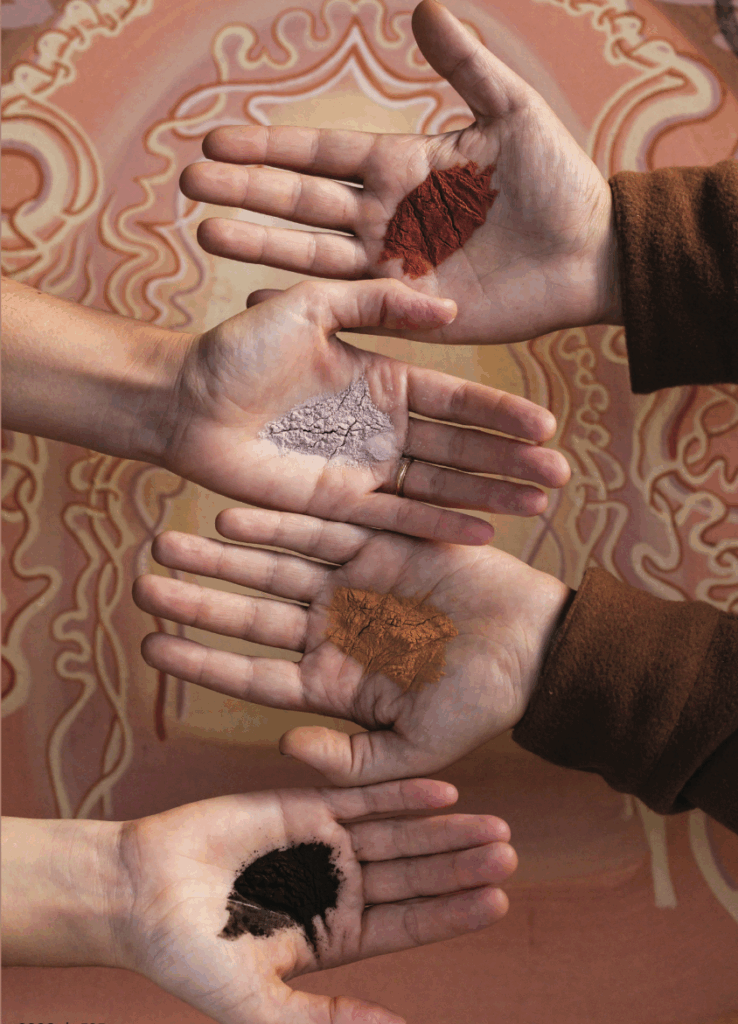
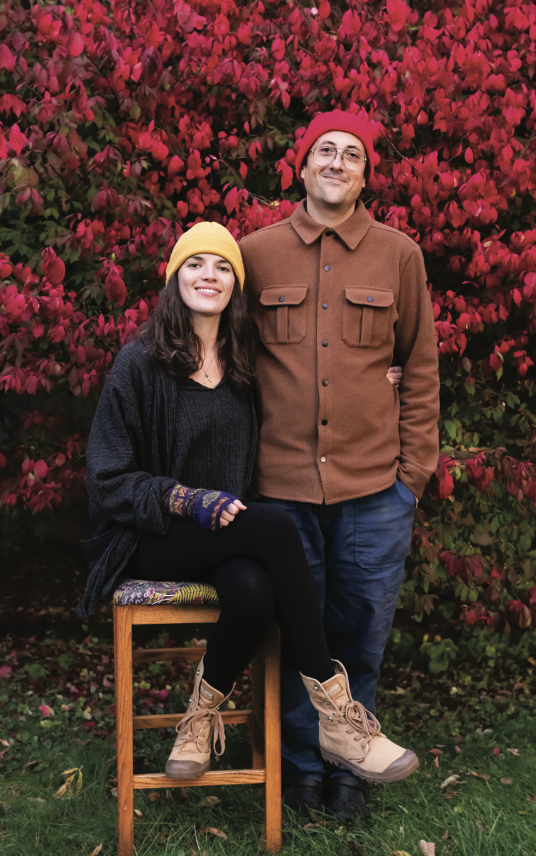
Hayley Dayis and Alexander Fals of Foraged Pigment Art occupy a unique place in the contemporary art scene. The couple splits their time between Rochester, where they often exhibit their work, and Cauca, Colombia, where they make their own pigments from soil. The volcanic earth in the Cauca region yields several distinct colors. “We know that there is sulfur, and iron, and calcium, and carbon,” Fals explains, “and they are all in different proportions in the bedrock and the topsoil.” The colors used to create the couple’s evocative paintings are sometimes described as a “monochromatic rainbow,” and for Dayis and Fals, they are much more than just colors.
Each pigment helps tell a story. “Beyond the visual aspect,” Dayis says, “each color is tied to a memory.” The pigments are imbued with the experience of sourcing and refining the materials in the field. The artists also feel a deep connection with the spirit and culture as well as the flora and fauna of the land from which they harvested. The foraged pigment allows the paintings to embody a synergy between art and place and between humans and the natural world.
Two of Fals’s uncles, both artists in Colombia, began making pigments around fifty years ago, reviving an ancient practice. Making paint from soil dates back to prehistoric times, but in the 1970s, it was also an affordable way to create art when art supplies were very expensive. Fals grew up in Naples, New York. He studied environmental conservation in college but became disillusioned with the idea that humans are separate from nature, or “a cancer on the Earth.” He spent a year with family in Colombia in 2016. By then, one of his artist uncles had passed away, but the other uncle taught Fals the technique that he and Dayis now use.
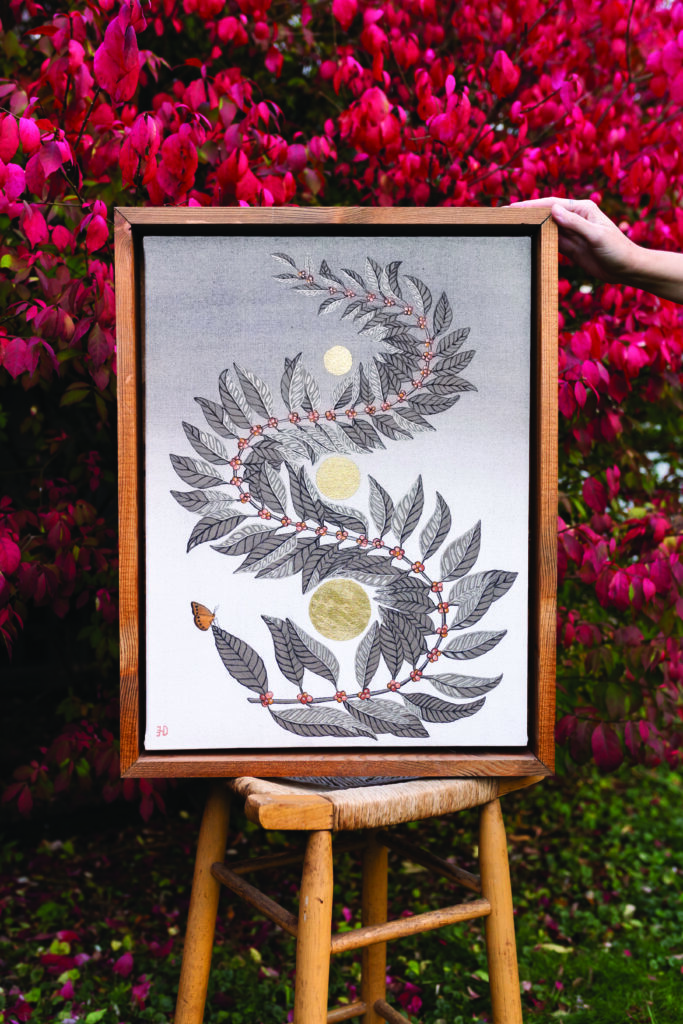
The process of making pigments and turning them into paint is simple and accessible. Soil is collected and dried in the sun and then ground, sifted, and mixed with an adhesive before being painted onto canvases. This creates an unusual medium in which to work, but is also economical and eco-friendly, as well as deeply meaningful for the artists. Ideally, Fals says, art is healing. Viewers tend to see the foraged-pigment paintings as warm and welcoming, speaking to a generosity inherent in the images. He notes that people often feel calm and grounded in the presence of the artwork. “People want to soak it up like it’s the sun.” At times, the couple has made foraged-pigment paint from soil in the Rochester area as well. Every place has its own unique palette, Fals explains. They haven’t ruled out someday taking trips to France’s ochre region to find its famous pigments or to Afghanistan to find lapis lazuli. “We don’t have specific plans, but everywhere we go, we’re looking,” Dayis says. There are only a handful of artists in the world who make foraged-mineral paints.
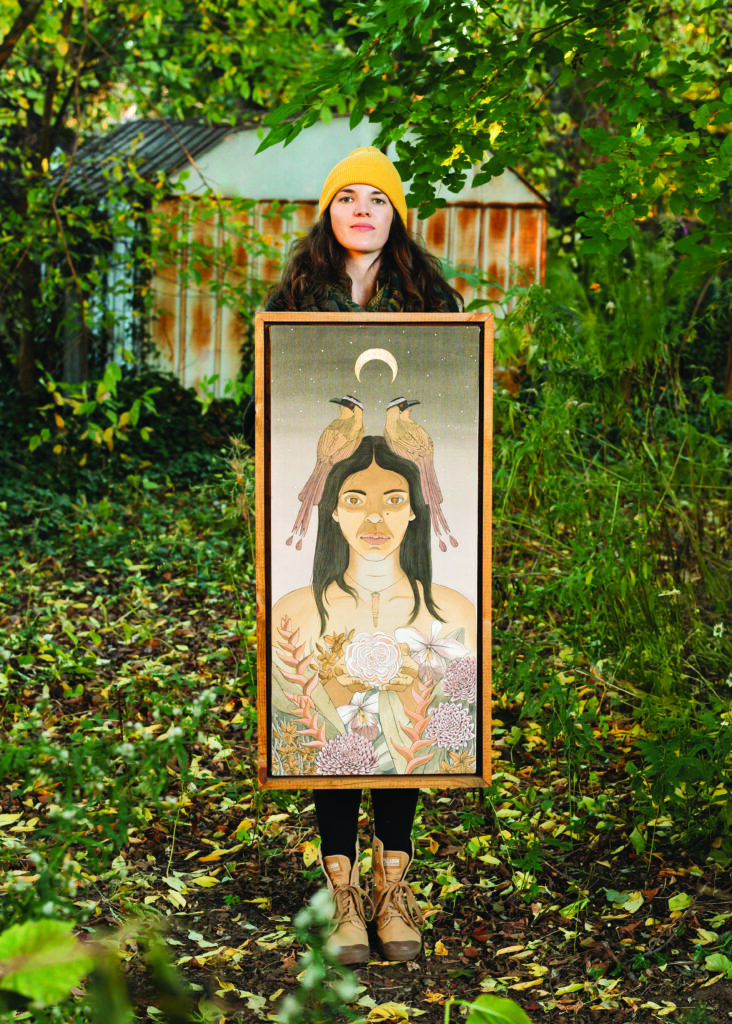
Hayley Dayis grew up in Rochester in a family of artists and attended the School of the Arts. In college, she majored in creative writing and later moved to Seattle to be a musician. Eventually, inspired by artists she met on the West Coast, she gravitated more toward drawing and painting. She became interested in painting with plant-based pigments while on a trip to Mexico. Then, around six years ago, a mutual friend suggested that Dayis should meet Fals and learn about the mineral pigments. She went to Fals’s art opening and immediately “fell in love with the palette,” she says, as well as the paintings. Soon, she fell in love with Fals himself. That was six years ago, and now the couple goes to Colombia together each winter.
They often teach foraged pigment classes in Rochester, and “there is a lot in the works right now,” Dayis explains. They are also available for private workshops and shows. Fals is especially passionate about teaching kids, feeling that the accessibility and eco-friendly technique is a great thing to pass down. Living a creative life, he says, does not have to mean spending large amounts of money at craft supply stores. Creativity can come from “the mud underneath your feet.” Dayis also loves teaching and encouraging others and thinks of people as “unfolding” into their own selves rather than being sculpted.
Dayis finds lately that her work is becoming “more internal,” and as she explores her inner world, “the pigments bring life to that in a different way than any other paint could.” They make her feel calm and grounded. “They’re raw elements of the earth, the same elements that our bodies are made of and that everything in our universe is made of.”
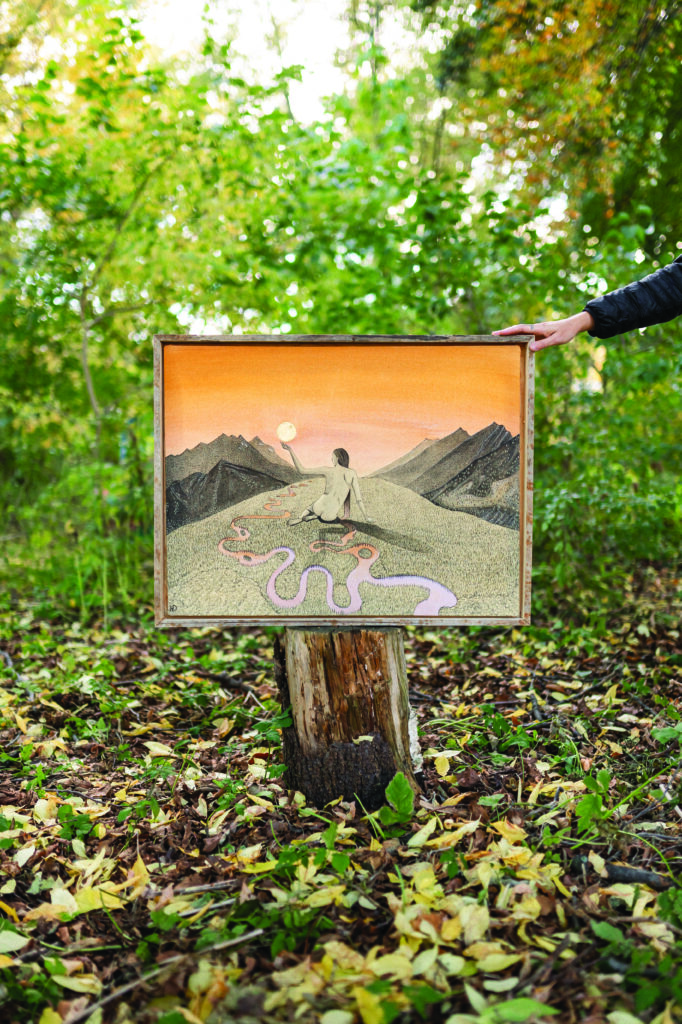
She is influenced by the work of Frida Kahlo, who was “very out of the box, mixing the body with art,” and painted herself in relationship with the world in innovative ways. Dayis has been contemplating Kahlo’s work as well as the work of Japanese block printers as she envisions the next steps in her artistic journey. Japanese block prints, she explains, are created in layers, not unlike the foraged-pigment paintings. Working with mineral pigments means not mixing colors ahead of time, but mixing them on the canvas, then waiting for a layer to dry before applying another one.
“I’ve been sort of cataloging my findings in Colombia,” Dayis says. She is inspired by the culture and history as well as the landscape, birds, and creatures. She is particularly proud of a painting that was recently exhibited at the Memorial Art Gallery, called The Guardian. It depicts a gray-breasted mountain toucan in a bush of berries, set in the Amazon, with smoke rising in the background. In Colombia, deforestation is a problem, often because the rainforest is cut down or burned to accommodate cattle ranches. But the situation is more nuanced than we might assume. Many people’s livelihoods depend upon the leather that comes from the cattle, including local craftspeople who make sandals. “There are all kinds of good and bad going on,” Dayis says. She created The Guardian with that duality in mind. “The bird is sort of looking you right in the eye.”
Fals would like his artwork to be a connection between humans and all living things. “I use art as a means to unite humanity and nature and save humanity and nature,” he says. Minerals, he points out, “are made from the same things as people.” He observes that for a long time, artists were the tools of people in power, but now they can create for themselves. His upcoming series of paintings will center on the union of science and spirituality.
Like Dayis, he is concerned with the balance between environmental conservation and the ability of humans to feed their families. The pain, trauma, and violence of the world “either gets stuffed down and continues to be violence and pain, or it gets transmuted through art.” He is interested in art that invites the viewer to “confront their shadow and transform it into a creative force.”
You can read about upcoming events and classes and see artwork for sale at foragedpigmentart.com.
This article originally appeared in the January/February 2026 issue of (585).
Views: 384