

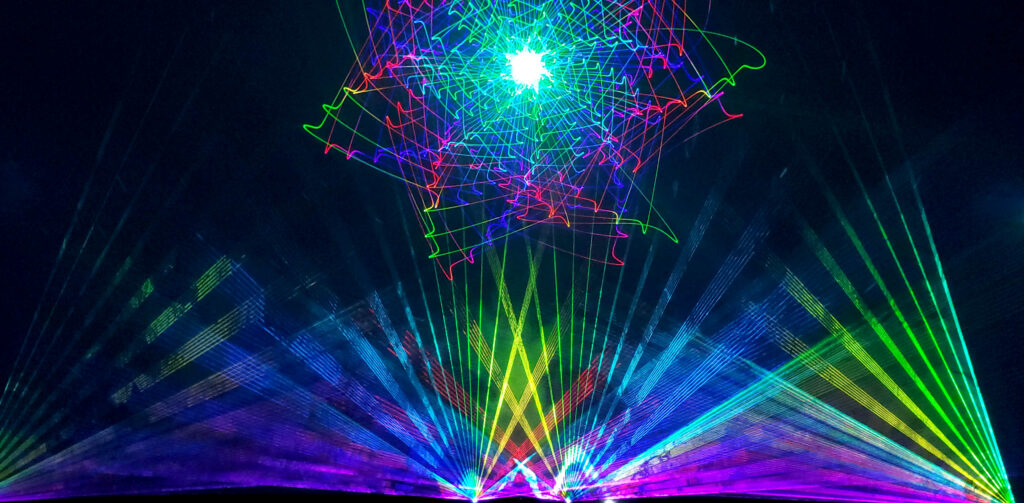
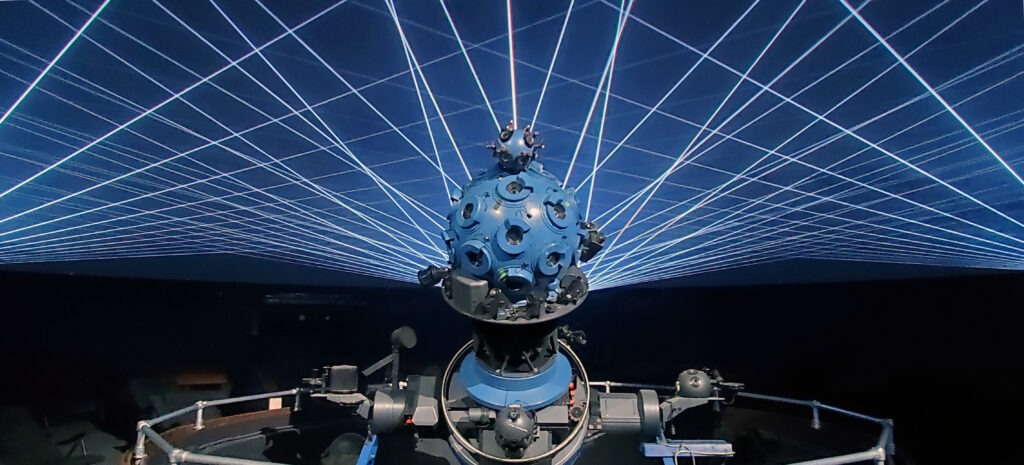
If someone mentions the RMSC Strasenburgh Planetarium, most people think about stars, planets, and space. The dome also serves as the perfect backdrop for laser shows. Set to music and primarily created in-house, these “dancing” lasers and images have attracted new audiences to the planetarium for more than fifty years.
In 1973, filmmaker Ivan Dryer (1939–2017), “the father of the laser light industry,” founded Laserium. After visiting a Caltech laser lab, Dryer became interested in merging films and lasers and so began his successful enterprise. Planetariums like RMSC’s hosted Laserium’s traveling shows during the 1970s.
In 1982, the Planetarium hired an outside programmer to create its own original shows. “I was fascinated by the laser technology and had the opportunity to play around with the control board when we weren’t running shows,” says Joe Ricci, senior manager of technology at RMSC.
Ricci’s personal history with the Planetarium spans nearly as long as the laser shows have been running. At age thirteen, he became a volunteer and helped with tech- related projects. When he turned sixteen, he was hired as a part-time employee, where his first job was to prepare slides and show materials to sell to other planetariums. He also worked as a building attendant and in collections documentation, all the while volunteering to run shows, until he graduated from high school and became a paid show operator.
“I eventually learned how to create various abstract laser designs and also built a computer-based system to display animated laser graphics,” says Ricci.
With his self-taught skills, Ricci programmed three laser songs using an analog laser image generator and computer-based animations. He recorded them on reel-to- reel tape, which was how they were shown to audiences at the time, and played them for the planetarium director. Clearly impressed, the director contracted Ricci to create a laser show for the planetarium: Laser Motion ’86. Soon after, Ricci was hired full-time by RMSC to produce laser shows and perform technical work at the planetarium—no more outside programmer needed!
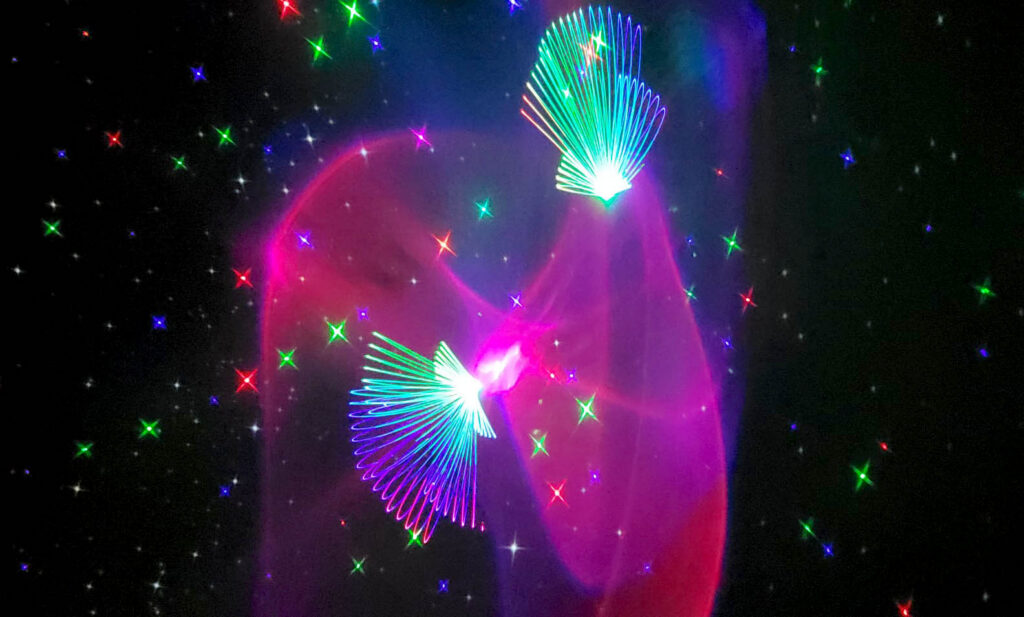
Since then, the technology has been continuously updated and improved. The reel-to-reel tape recordings were digitized, and by 2012, they switched to Pangolin Laser Systems programmable timeline software.
“Content elements are placed on a timeline for each song, where various effects such as color, movement, and rotation are added. We also augment the lasers with immersive effects using our Digistar Fulldome Visualization System,” says Ricci. “In 2020, we installed a state-of-the- art laser system consisting of nine projectors. Five of these projectors are designed to create overhead atmospheric beam effects.”
As for the music, the songs were originally chosen by radio stations that sponsored the shows. That format began to phase out, and the music compilations sold fewer tickets. Today, Ricci, the Planetarium Director, and the RMSC marketing team “try to choose artists who we expect to be popular and that would work well with laser effects in the dome environment,” says Ricci. “This has typically been classic rock and pop music.”
Now, the planetarium produces its own shows, paying music licensing organizations for fair use of the songs. It also brings in some from Laser Fantasy, “the worldwide leader in planetarium laser light shows,” according to its website.
Over the years, laser shows set to the music of Pink Floyd, Led Zeppelin, and the Beatles have been among the planetarium’s most popular offerings, while newer productions featuring artists and themes such as Daft Punk, Bad Bunny, and Stranger Things continue to draw large audiences. The most successful laser show in the planetarium’s history was Laser Taylor Swift, which debuted during the 2023–2024 Eras Tour and remains a crowd favorite today. Another longtime favorite is the annual holiday laser show, a family-friendly tradition that regularly sells out performances from Thanksgiving through the New Year.
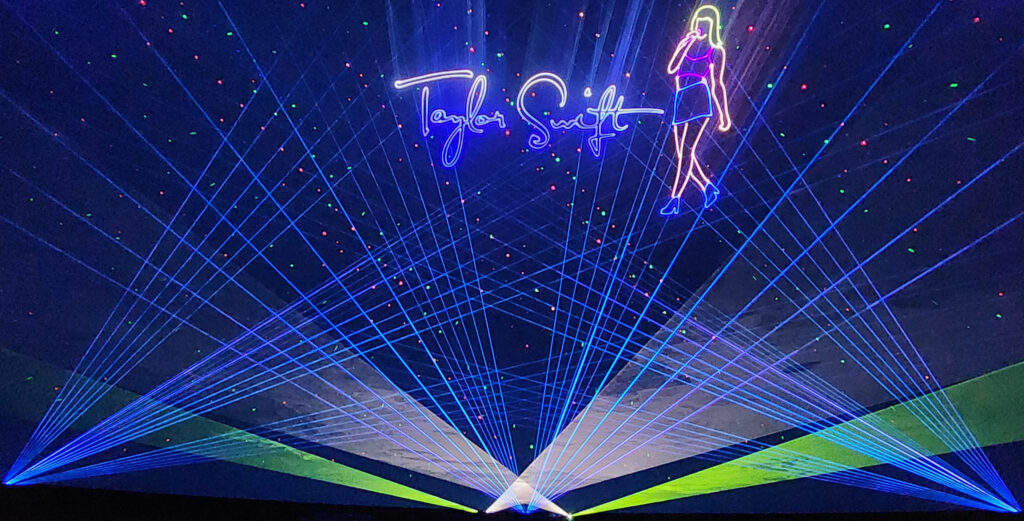
Laser Fantasy has also produced Laser ABBA, which opens at the planetarium on July 11. Ricci and his team are producing their own version of Laser Genesis with Phil Collins later in 2026.
If watching these laser shows piques kids’ interest in learning more about the technology, they are in luck—RMSC recently added a summer Curiosity Camp called “Laser Focus.” Campers ages twelve to fourteen will learn about lasers, light, and color, then work together to create a laser show. At the end of the week, they get to see their own work projected inside the dome! It is an amazing STEAM opportunity for budding artists and programmers.
Ricci also shared that a few years ago, he snuck something new into the shows: “A frog appears somewhere in every show. Some are obvious and some not so much, only visible for a fraction of a second.” It started when he added a frog background to Laser Taylor Swift during the song “Love Story.” Now he sneaks this “Easter egg” into all his shows. See if you can find the amphibian during your visit!
Music and light lovers are encouraged to peruse the planetarium’s calendar for the laser show that fits their vibe. RMSC recommends buying your tickets online in advance, as shows may sell out. Remaining tickets will be available at the planetarium box office before the show. Seating is first-come, first-served. Shows are recommended for ages 5 and up and are $14 for adults, $12 for college students, ages 5 to 18, and ages 62 and up. Discounted tickets are offered for members.
Sit back, relax, and let yourself be immersed in this multi-sensory experience. rmsc.org
This article originally appeared in the Summer 2026 issue of (585) Kids.
Views: 7