


“I was born in 1931, in a small community north of Chicago,” Pat Ward-Baker begins. “I grew up in the ’30s and ’40s. By the time I was ten or eleven, the Second World War was on, and everything around me felt rigid. Wives stayed home. They hosted tea parties, talked, shopped. Somehow my little self hated that. I wanted to escape.”
Even as a child, Ward-Baker’s curiosity extended to numbers. Her father introduced her to securities analysis early, opening a small investment account when she was five. “I thought I would be a musician and travel,” she says. She carried that ambition to the Eastman School of Music at the University Rochester where students were encouraged to be music teachers. “I realized I didn’t want to teach. So I transferred into the university [for finance].” By that time, her father had taught her another crucial lesson: understanding investments. “He opened the door for me, and I learned how to think about money, systems, and risk from a very young age.”
Her family reinforced independence in other ways. “My mother found ways to move out of that comfort zone by volunteering,” Ward-Baker recalls. “She would read to the blind at the university, work with students, travel. She had help, so she didn’t have to do all the chores. She really wanted to be a city planner. She found outlets to serve and to work.”
Other relatives offered quiet lessons in ambition and resilience. One grandmother led American women across Asia to study flower arrangements. Another was a competitive swimmer and pianist. Her grandfather, an French immigrant, walked into Thomas Edison’s office asking how to improve himself, worked harder than anyone, returned, and became a partner. Taken together, these lives formed Ward-Baker’s inheritance: proof that deviation was survivable, that independence was a path worth taking.
“My father gave me a little account to practice with,” she says. “The firm I had my little account with liked how I thought. They called me and said they wanted to hire me. This was 1970. I became the first female investor there, as an institutional broker. At the time, there were just twelve women in the business nationwide.”
She laughs softly at the memory of her interview. “One of the guys said, ‘Well, you have the background, the education, and the experience, but Pat—you are a woman.’ He even called the institutions I would serve to ask if they would have a woman as their broker. They said they didn’t mind, as long as “it” had ideas.” She still laughs at that today.
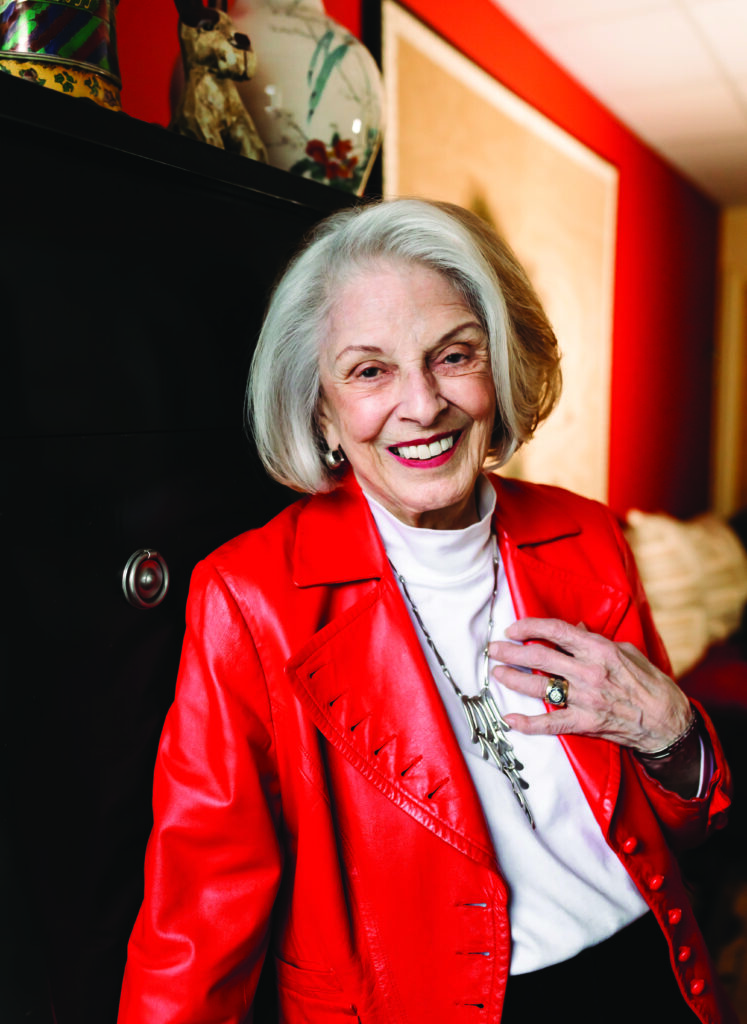
Pat Ward-Baker doesn’t have time to fuss over the little things; she is too busy keeping up with the stock market, supporting her clients’ investments, and embracing the wonderfully colorful life she has made for herself. At ninety-four, Baker is full of lessons, stories, and laughter. Her bold red office is her canvas—it’s full of fascinating pieces that she has collected over the years, and each piece continues to inspire her. When she answers the door, the first thing we notice is her stunning red leather jacket. It is a beautiful vintage piece with sharp lapels and an elegant, fitted silhouette, and is soft to the touch. Custom matching red buttons adorn the front and extend up the sleeves, creating a look reminiscent of a gigot sleeve (also referred to as “leg o’ lamb” sleeve) from the late 1800s. When asked about the jacket’s origin, she explains she’s had it for more than forty years. It was given to her by a stylist whom she still works with today. All the subtle elements of this jacket come together to create a piece that truly represents Baker’s energy: feminine but with a bite.—Caitlin Kenyon (C.K.)

“It didn’t even bother me,” Ward-Baker says. “That was the whole atmosphere at the time. My husband did not finish his degree. He was from England, and he went into the war. He could belong to the clubs, and I couldn’t … Feminism,” Ward-Baker reflects, “was a movement. Women gathered together to prove they were equal to men in their capacity to work. That was an active movement that happened. I did not get into that. I was just trying to do it. I was trying to succeed. The competitive atmosphere was so strong. Every night I went home to think, to work, to stay ahead. I was always in the top ten at Morgan Stanley, sometimes at the very top.”
Philosophically, feminism was about breaking free from limitation. “Someone was sitting on women’s shoulders, holding them down. Women could not escape the notion that they were household help. They took care of children and the home, but most did not have any career outside the house. My mom paid the bills, but she didn’t even know where the money was coming from. I think what began to happen for me was, look, I have some ideas of my own. How can I get out from under the way things are? Feminism, the non-marching feminist, is about developing your own interests.”
Ward-Baker structures her days deliberately. She wakes around 5:30 a.m. “Once I’m up, I’m up,” she says. Breakfast often doubles as a meeting space. “I have most of my meetings during breakfast. I go to the country club or Jines. That is when we talk.” From there, she walks across the street to her modest office. “I have a nice little office, right across from my house. It has an interviewing room, a bathroom, and a kitchen. It’s not very big, but it has a lot of room.”
She checks the stock market every morning. “I just want to see what it looks like. The market affects everything. I have been in this market since 1960. I do not remember anything quite like this. The ’70s were kind of weird, but this feels hesitant. There is no real trend that I can see. I would like to see more stability from the U. S.” She notices mood as much as numbers. “I have a feeling a lot of investors are hesitant right now. The market has been going up, but there is a funny feeling to it. Most years, you feel the year- end intensity—ebullient, a lot of volume, a lot of excitement,” she notes. “Right now, there is not a lot of volume.”
“So much of our culture treats aging as a slow narrowing—less energy, less relevance, fewer possibilities,” Ward-Baker says. She first became aware of this while at Morgan Stanley. “I noticed my clients were more worried about getting old than running out of money. It was almost universal. I was nearly seventy when I decided to go back to school. I studied the biology of aging, the spirituality of aging, an interdisciplinary degree. I finished my dissertation, and now I’m working with Dr. Matthew Schiralli, executive medical director of surgical services at Rochester Regional Health. We give talks around town at different places. There are things we need to do to maintain a healthy life.”
Ward-Baker’s doctoral research focused on people aged eighty-five and older—a group often treated as invisible. “The oldest old. The remarkable old,” she says. “Going in, I expected to find decline. I was trying to prove something I already believed—that the narratives about irrelevance were nonsense. I wanted to show they were wrong.”
Her dissertation took her into very different worlds. She studied a farmer at eighty-five, still bailing hay and lifting animals; an actress reinventing herself late in life; and a teacher at RIT pushing the boundaries of her craft. “These lives were physically demanding, emotionally demanding, and yet all of them were starting new projects, moving in new directions.”


While Ward-Baker may not be too concerned with having designer pieces, she admits she is a sucker for a bold piece of jewelry. Her motto for wearing an accessory is “go big or go home.” As we study her vintage bird brooch from her grandmother and the colorful necklaces she purchased in South Africa, our eyes couldn’t help but notice two eye-catching pieces she wears every day.
On her right hand she wears a gold band with three beautiful diamonds. While this piece has become a staple in her everyday wardrobe, Baker shared that she did not always find this particular ring to be of much importance. It was her grandfather’s, and she believed it was only costume jewelry; she jokingly called it her dust collecting ring that she kept tucked in her jewelry drawer. Finally, out of curiosity, she brought the ring to a jeweler who revealed that all three stones are genuine diamonds. Realizing that this piece was more special than she had imagined, Baker commissioned a custom band and now has a token from her grandfather with her every day.—C.K.
A striking sapphire and diamond ring (originally it belonged to Ward-Baker’s great-grandmother then grandmother) adorns her left hand. This ring is a meaningful family jewel but used to have a terrible habit of twisting and slipping uncomfortably between her knuckles. She enlisted a jeweler to add custom bands to the outer edges of the ring that make it more formidable, thus keeping it from twisting as often. These gold additions help to make a family heirloom her own and allow the sapphire stones to shine even bolder than before.—C.K.
“One woman in New England even created a whole village,” Ward-Baker recalls. “She reimagined the world she wanted to live in, a literal village square of her own making. It was astonishing. These people were not slowing down, they were still creating, still building, still shaping life.”
“We tell people to ‘prepare’ for retirement, but far less about preparing for old age itself,” Ward- Baker says. “If you are broke, living in an awful place, and don’t have enough to eat, you cannot support the life you want after you retire. Start saving! Add a little bit every month—the longer you do it, the more it adds up. I have a seventeen-year-old I’m helping. He’s learning to save for later life. You can start with a tin can. The earlier you start, the better your foundation.”
“To me, it’s a tragedy when people just give up, thinking they have to go downhill, that they have to get weaker. A lot of people don’t know what to do after they retire. They have nothing to contribute. My idea is that you have so much more to contribute because you have lived so long. I also think you become a little nicer, you soften more as you get older. Aging doesn’t have to be a slow exit from life—it can be a new chapter of engagement, insight, and contribution.”
Ward-Baker emphasizes that energy comes from movement. “If you walk, climb stairs, or just move to your car, you have to keep moving a bit. It’s not rocket science. You have to keep yourself energetic and full of life. You can be better than ever.”
Being at home with yourself is equally important. “This depends on the mindset a person grows
up with and evolves into. Yoga, meditation, even fifteen minutes a day isn’t a big burden. Reading along those lines helps too. Walk in your neighborhood or in the mall. Go swimming. Join older people’s groups. Stay active, stay engaged, keep yourself full of life.”
Ward-Baker expands the focus from physical movement to the mind. “Focus on what works. Focus on what is healthy, interesting, and what you are naturally attracted to. Notice what’s happening in the world. Read philosophy, anything that feeds your mind, nourishes it, inspires you. Look beyond yourself. See what science is doing with AI, ask yourself where that might lead. Talk to people who are knowledgeable. There’s a lot to think about.”
She emphasizes mindset as much as information. “Keep a basically positive outlook. Negative stuff—most of it—is not true. We’re all just people, just humans. Life was never promised as a rose garden. The key question for someone living well in older age is: What do I do about this? Whatever comes along, ask yourself, what can I do? There is always some answer.”
For seniors, or future seniors, who don’t want to disappear quietly into old age, Ward-Baker offers one guiding principle: “Unlearn the belief that aging inevitably causes decline. This is scientifically proven. Aging does not inevitably lead to loss of energy, curiosity, or purpose. You can keep growing, learning, contributing—if you decide to.”
Ward-Baker’s appeal is not that she defies aging, but that she refuses to simplify it. She reframes later life as bonus time; not guaranteed, not owed, but capable of depth, insight, and growth. Her work argues for dignity, showing human development does not stop simply because culture loses interest.
The work of becoming does not end. Even now, the question remains open: Who are we still becoming?
This article originally appeared in the March/April 2026 issue of (585).
Views: 3