


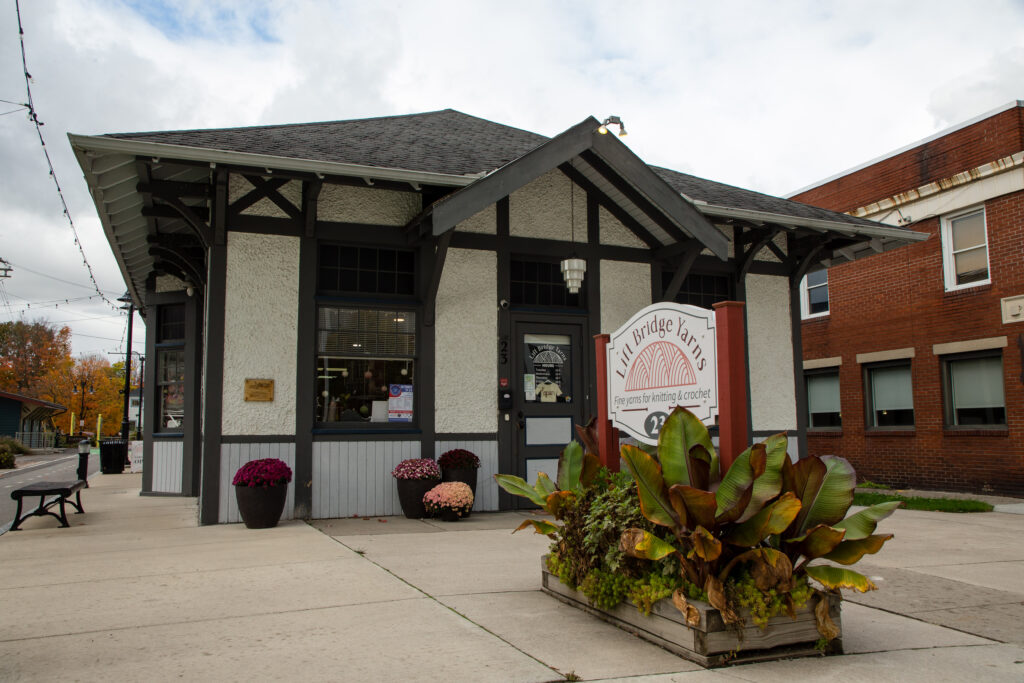
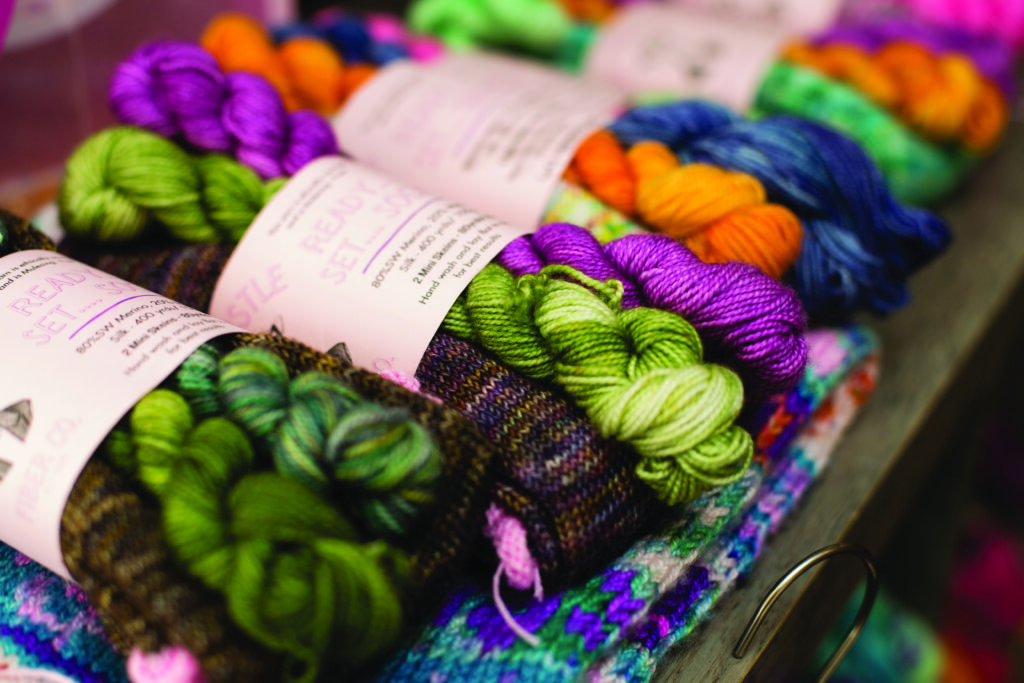
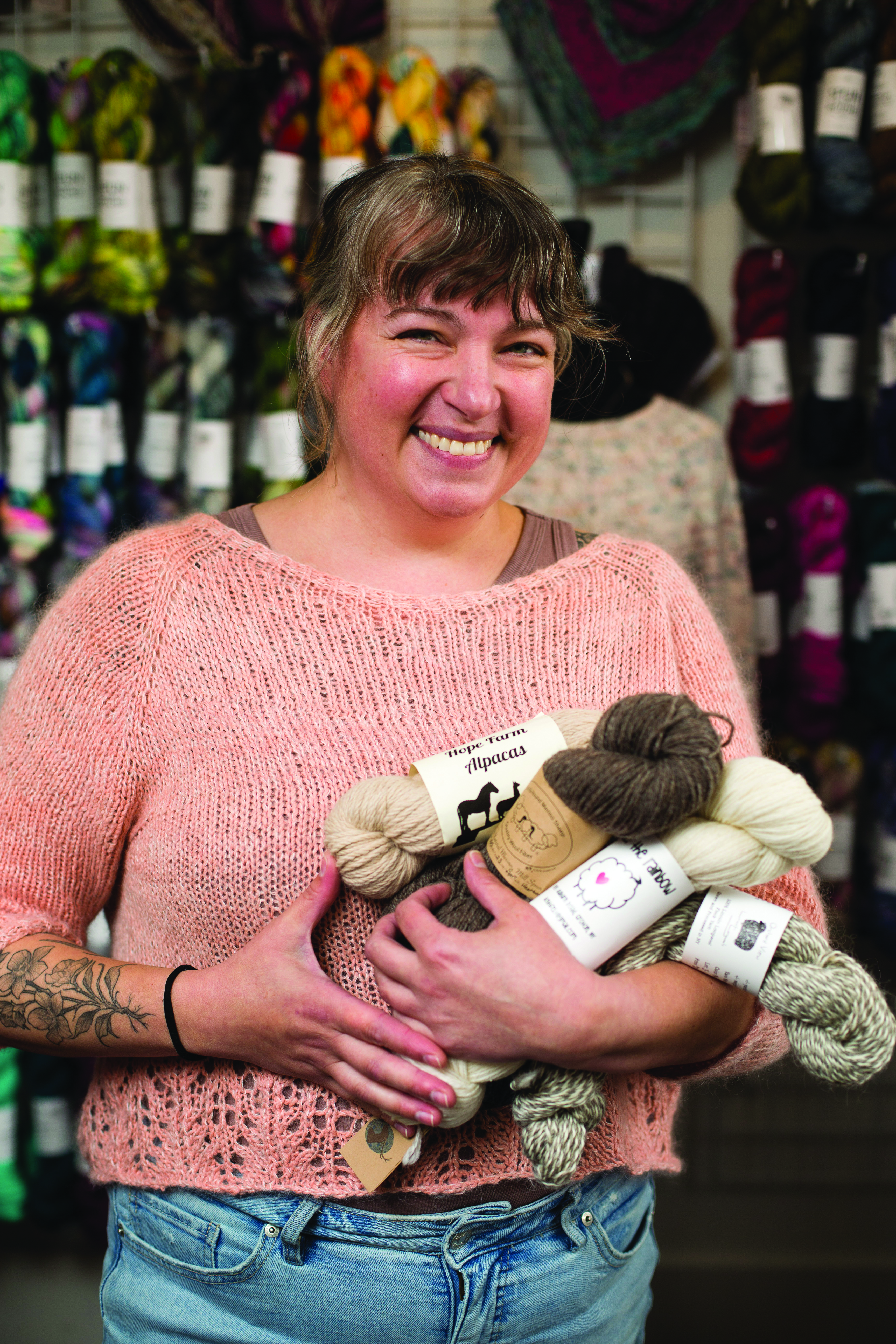
Lift Bridge Yarns is more than just a yarn store. It is a hub for the fiber arts community to gather, a rare third space where people come to connect, converse, and create. Lift Bridge began just four months before the pandemic hit, founded by two friends, Dawn Verdugo and Jessie McNaughton. The store sits along the Erie Canal in the village of Fairport, housed in a restored rail building within easy walking distance of many other points of interest. Inside, the store is filled with a colorful array of all things related to the fiber arts: shelves of yarn, craft kits, and displays of knitwear patterns that together create a cozy and welcoming atmosphere.
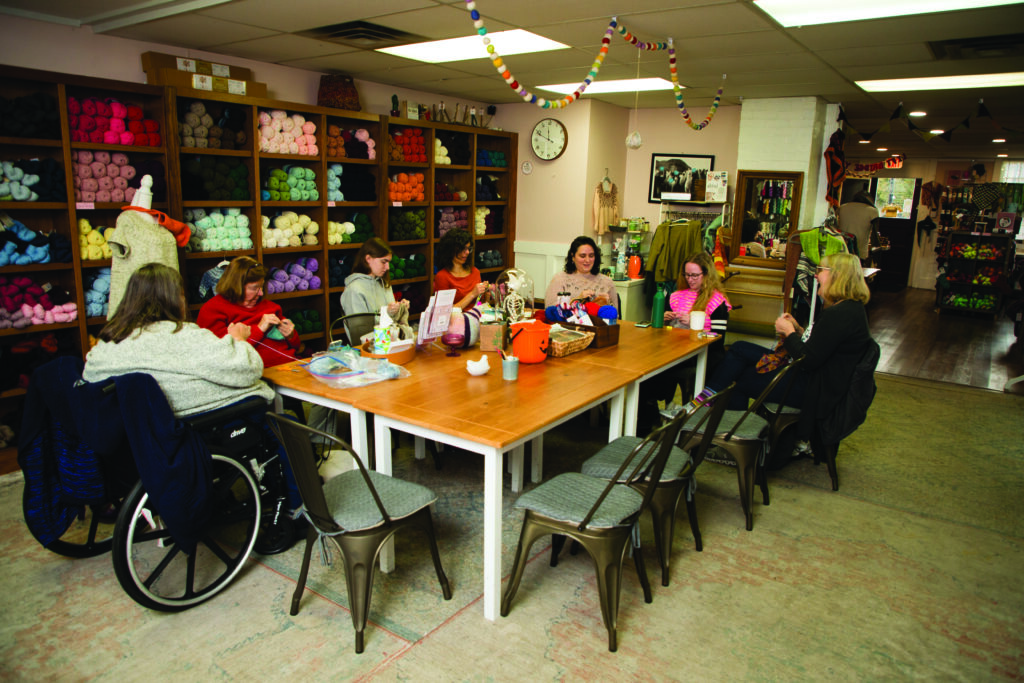
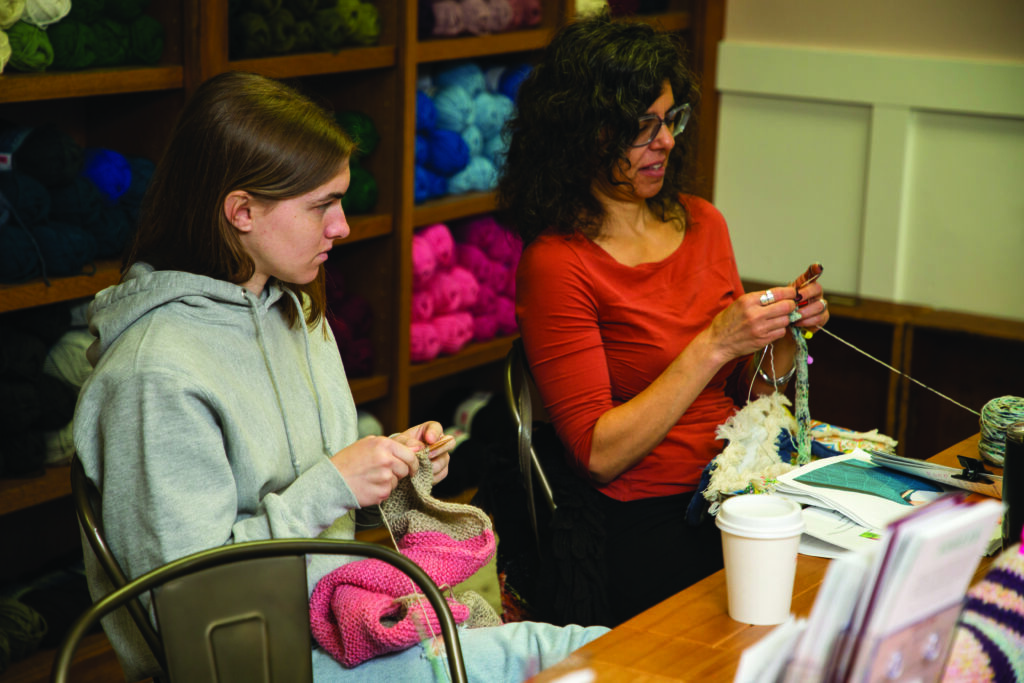
Toward the back of the store, visitors will often find people gathered around a table at one of the store’s weekly classes, workshops, or informal Sit and Stitches. Conversation flows with knitting projects in hand. The store provides one-on-one help, too, if you find yourself stuck in a project. “There is a whole community around yarn, and we wanted to preserve and grow that community,” says McNaughton.
The fiber arts—knitting, crocheting, felting, embroidery, and weaving—are often considered “granny crafts.” But in an age of increasing interest in tactile work, these arts are catching on with younger generations of women and with men, too. There is a quiet peacefulness to working with fiber and true pride in creating something out of a ball of yarn. An unwound ball of yarn is called a “skein,” one of the many medieval-sounding words associated with fiber, seemingly untouched by time.
Anna Powell, co-vice president of the Rochester Knitting Guild, says the fiber community is thriving. The guild hosts monthly evening meetings from September through May offering social time, guest speakers, and education. Current membership is around 150 people, and new members are welcome. Powell says, “Our goal is to lift everyone up and encourage growth in your preferred craft. You don’t even have to be a knitter! The benefit to a newcomer is the access to other experienced makers in the guild.”
The Weavers’ Guild of Rochester offers another established fiber arts community, with studio space that provides shared equipment for those wanting to learn the craft. The Weavers’ Guild, established more than seventy years ago, continues to boast an active and engaging repertoire of classes and workshops, welcoming both novices and experienced crafters.
The foundation of these arts is, of course, fiber. Most high-quality yarns are made from natural sources: wool from sheep, cashmere from goats, cotton, hemp, or silk. Less expensive yarn is typically synthetically produced from acrylic, nylon, or polyester. In today’s economy, nearly all textiles, including yarn, are imported from China or other countries that mass produce consumer goods. It is not a sustainable system. Check the tags on any textile, and chances are it was not made in America and likely not from natural material.
New York fiber farming
But it wasn’t always this way. Only in the last half-century has America relied on synthetic fibers and imported goods to drive its textile production. Prior to that, fiber was produced and processed locally with natural materials.
If you take a drive through the countryside surrounding Rochester, you will likely see some farms. While dairy and beef are the primary economic drivers, sheep and alpaca farms are still common. Sheep are sheared once or twice a year with each animal producing around five pounds of wool. Due to our cold, wet climate, breeds that thrive here are not merino sheep or cashmere goats with the familiar, high-value fiber. Most wool produced in New York is medium grade, best used in products that require durability, such as carpets, blankets, and socks.
In order for wool to be manufactured into a finished product, it must first be cleaned, processed, and spun into yarn. The raw wool, called a fleece, typically leaves the farm and goes to a fiber mill for processing. From there, it is sold as yarn to stores or to manufacturers who make a finished product. Over the last two decades, this critical supply chain has collapsed in New York. Fewer than ten fiber processing mills persist in the state, and the mechanisms connecting farmers to these mills have slowly disappeared. After years of earning only a few cents per pound, many farmers simply throw out their fleeces rather than attempt to market them.
More than half a million pounds of wool are produced every year in New York, and at least one third of it is discarded without ever making it into the textile supply chain. Somewhere along the way in the race for cheaper goods, faster production, and streamlined services we lost the connection to our local economy.
Still, many New York farmers take pride in raising animals with high- quality fiber. Emmaline Long owns Orchard View Lincolns, a sheep farm in Bergen. Her breed of choice is Lincoln Longwools, a rare heritage sheep with British origins listed as threatened by the Livestock Conservancy. Long saw her first Lincoln at a fair when she was ten years old and was instantly smitten with their long, curly locks. After trips to the UK to learn more about the history of the breed and connecting with breeders there, she has grown her flock for more than twenty years, specializing in natural color fleeces. “Sheep bring me joy,” she laughs. “I’ve never had another favorite animal.” Though Long sees fiber as an integral part of our agrarian economy and is committed to creating an entirely local product, she says it isn’t always easy to sell her yarn. Processing times at local mills can take up to two years and finding a buyer often falls on the farmer.
When Tom Stringham’s daughter asked for sheep, he had no idea what he was getting into. An artist by trade, he knew nothing about raising livestock. When he looked into processing the fleece for yarn, he was floored by the two-year wait time and began researching the larger textile economy, identifying gaps and barriers. The foray into fiber landed at a time when he was looking to build a sustainable business for his family. Within months, Stringham bought a fiber mill from retiring millers in Vermont and installed it in the family’s garage. Since then, they have worked to get the mill up and running, working through family illness and learning as they go. Establishing their operation as the Genesee Valley Wool Works, Stringham specializes in producing core-spun bulky yarn which he weaves into beautiful hand- made rugs. They currently sell online and at their farmstand in East Bethany. When he needed more wool than his flock could produce, Tom turned to Long and bought her natural-colored fleeces, keeping his entire production cycle local.
Fiber is good for the economy
Nothing can replace the value of understanding the story behind a product. Recognizing the advantage in connecting upstate farms with the downstate fashion industry, Governor Hochul approved a three-year, $9 million investment to rebuild the local textile supply chain. Part of the funding established a new network called the Northeast Fiber Exchange that connects fiber farmers to consumers. Another pool of funds supports innovative projects that bring wool into accessible consumer markets. Some recipients of these funds include Stringham, Long, and McNaughton, who are all working to restore, connect, and grow the local economy with New York fiber.
Two years ago, McNaughton established the New York Fiber Trail, a map with nearly 100 stops highlighting yarn stores selling locally made goods, fiber mills, dyers, artisans, and farms. So many customers came to her looking to connect with the local textile ecosystem that she felt inclined to pull it all together. The trail continues to be a popular draw for visitors and last August, Lift Bridge Yarns, in, partnership with the town, held the inaugural Fairport Fiber Festival. Many of the enterprises from the Fiber Trail were showcased. “I am just so grateful for this community and their support. These people have really restored my faith in humanity, and I hope we can make the Fiber Festival an annual event,” McNaughton says with a smile.
For someone looking for a new hobby, Rochester offers a thriving fiber arts scene that is welcoming new members. Stop by a local yarn store, explore classes at one of the guilds, or take a drive through the countryside and find a farmstand that sells handcrafted goods. You’ll be supporting local businesses, and you might have a bit of fun, too.
This article originally appeared in the January/February 2026 issue of (585).
Views: 170